STL Science Center

STL Science Center

15 August 2020

Things We Do Not Talk About

There is an entire Class of animals that we have not really discussed. They are always right there when we look up fossils. We should take a closer look at these alien, but very familiar, animals. Appearing between 540 and 520 million years ago, the Class we know as the Trilobites, are ovoid, sometimes clearly showing appendages, arthropods that existed until shortly before the end Permian extinction. No existing direct descendants of trilobites exist today. However, in the age of the greatest diversity of trilobites, from the Early Cambrian to the end-Permian, there are 11 known orders of trilobites that includes more than 30 genera and many more species. Talking about "the trilobite" fossils is actually quite misleading. Usually when someone mentions trilobites they conjure up images of trilobites such as Ogygopsis, or Meroperix. Perhaps you might think of a less ovoid member of the group, one that has large head elements, like Paradoxides, or with long tail structures, like Cheirurus. We will look at general anatomy of trilobites tomorrow, then, during the rest of the week, we will discuss some specific examples of genera or species of iconic trilobites.

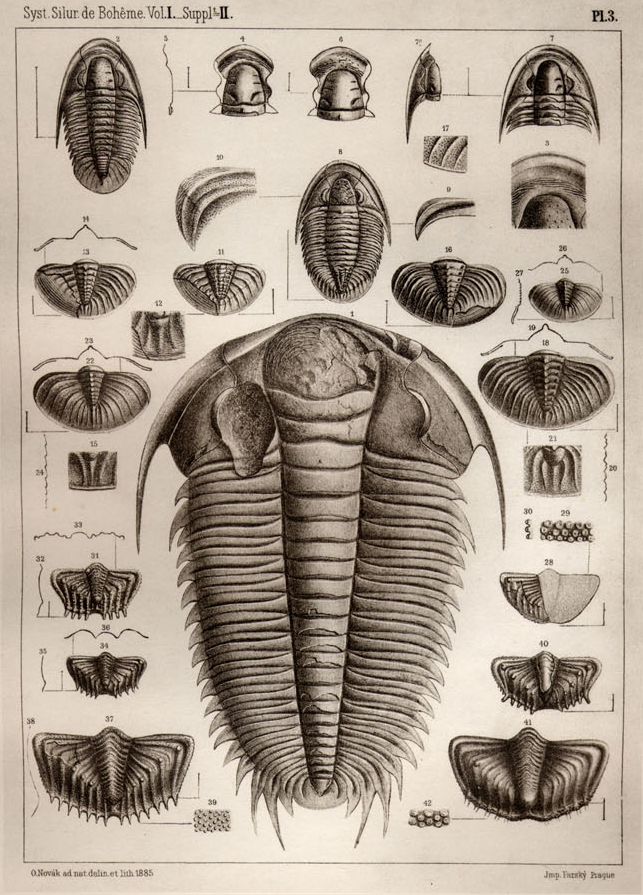
Plate from Barrande's work Système silurien du centre de la Bohême

13 August 2020

Freshwater Sharks

 Growing up we often kept Rainbow sharks in aquaria. These streamlined pets were fast when they wanted to be and were fairly aggressive. They often jumped from out of the tanks as well. We stopped keeping them after a while. However, these are not true sharks and freshwater sharks are globally rare in modern times.The most common are those of the genus Glyphis, commonly called "river sharks", and Carcharhinus leucas, commonly known as the bull shark. The bull shark is known worldwide (and by many names such as Zambezi shark, Lake Nicaragua shark, and freshwater whaler, to name a few), whereas the Glyphis sharks are less well known, by the general public, but they also enjoy a global distribution. Four extant Glyphis species inhabit mainly southeast Asian, Indian, and Australian rivers including the Ganges, Brahmaputra, and Adelaide Rivers (this is a small fraction of the rivers the extant species inhabit). Two extinct species, G. hastalis and G. pagoda are known from British and southern Asian fluvial fossil records respectively. The most important difference between Glyphis sharks and bull sharks is that the Glyphis sharks are true freshwater-only sharks, whereas the bull shark can adapt and survive in freshwater, but is more suited to marine environments. We could discuss the shallow, brackish water suitability and aggressive nature of bull sharks for days, but we are more interested in the history of freshwater sharks today. 

Glyphis sharks are more closely related to ocean-going tiger sharks and reef sharks than they are the original, well represented freshwater sharks. Many fossils from the Order Xenacanthida are known from the Carboniferous Period. The most well known are Xenacanthus and Orthacanthus. Xenacanthus may be the better known genus, on the internet at least, and consisted of many more species than Orthacanthus, even having some species survive the end Permian extinction event and last into the Triassic. Orthacanthus, however, appears to have been an older lineage and died out well before the end Permian extinction event. Both genera of freshwater shark were apex predators in freshwater environments and were likely in direct competition in freshwater environments throughout their existence. Orthacanthus, has a well documented predatory lifestyle. Coprolites (fossilized feces) from Orthacanthus have been discovered containing the remains (often teeth but also bones) of smaller Orthacanthus (cannibalism), other Xenacanthid, tetrapods, and various other fish. The coprolites are known to come from Orthacanthus because skin and other soft tissue impressions in fossils have allowed paleontologists to reconstruct rectal anatomy of Orthacanthus and match this anatomy to the shapes of coprolites.

Xenacanthus restoration, ©Nobu Tamura
Orthacanthus restoration, ©Nobu Tamura


12 August 2020

The Cretaceous Sharp Nose

 During the Cretaceous, when the crushing Ptychodus sharks were breaking open shells, sharks were often not the greatest predators in the neighborhood. They competed with plesiosaurs, tylosaurs, and even Xiphactinus, a very large fish with impressive dental hardware. Despite being outclassed in many of the world's oceans, sharks were still capable of becoming apex predators and competing directly with their fish and marine reptile neighbors. One of the sharks most capable of direct competition in the Cretaceous seas and oceans was the rather large (up to 8 m, 26 ft, and 3400 kg, 3.3 tons) mackerel shark, Cretoxyrhina. Mackerel sharks are sharks in the Order Lamniformes and are fast, powerful, ocean swimming sharks. The most notable living member of this group is the Great White Shark, which grows to approximately the same size as Cretoxyrhina is thought to have grown to. The genus Cretoxyrhina consists of four recognized species with C. mantelli being the first described; initially teeth of the shark were described in 1822 by Gideon Mantell as a modern shark's teeth and a second formally published description, honoring Mantell, was written in 1835 by Louis Agassiz. These teeth were all collected from England, but a number of exceptionally well-preserved vertebral columns (and some associated other elements including teeth) are known from the work of George F. Sternberg, and his father Charles H. Sternberg, that was conducted in the state of Kansas in the mid-western United States of America. 

 Charles Sternberg found a skeleton and 250 teeth in 1890 that were sold to a German museum (it was destroyed during WWII), but George Sternberg found many skeletons of Cretoxyrhina. The first (1891) contained portions of the jaw as well as a last meal of Xiphactinus and 150 teeth. In 1950 and 1965 he found even more of the shark, including specimens with preserved gills, portions of the skull, complete jaws, and pectoral fins. These are exceptional discoveries because, as many of us may know, sharks are cartilaginous fish, and much of their skeleton is difficult to preserve. Teeth are typical remains that we possess for sharks because of their durability, continuous replacement (allowing for many more teeth to be potentially preserved compared to whole individuals), and the number each animal possesses; remember that Charles Sternberg found 250 teeth in his 1890 fossil.

These large sharks, and their teeth, are associated with numerous other fossils, indicating what kinds of animals they fed on regularly. These include fish like, and including, Xiphactinus, plesiosaurs, mosasaurs, turtles, other sharks, and even pterosaurs and dinosaurs. Pterosaurs are thought to have sometimes fished over ocean waters, and it is thought, as shown in the Mark P. Witton illustration below, taht the sharks may have actively hunted low flying pterosaurs such as Pteranodon. Dinosaurs are often considered a scavanged meal in relation to Cretoxyrhina, showing that the shark was an opportunistic hunter as well. One hypothesis, involving a Claosaurus (shown below also), is that dinosaurs sometimes died on the shore, during a flooding event, or in some other way that enabled their bodies to float out into the ocean where they were eaten by sea creatures of all sorts. Evidence for Cretoxyrhina feeding on dinosaurs includes not only the hadrosaur Claosaurus, but also the nodosaurian Niobrarasaurus. The evidence for larger prey (fish have been found in the stomach areas of Cretoxyrhina) such as plesiosaurs, pterosaurs, and the dinosaur mentioned is mostly based on Cretoxyrhina teeth embedded in bones, where they were broken off during biting and feeding. Finding shark teeth in bone is very interesting. A plesiosaur vertebral column I worked with had shark teeth embedded. I did not diagnose the teeth, but the animal was from a time and area populated by Cretoxyrhina, so it is a likely culprit to include in the list of suspects.

Cretoxyrhina fossils from Newbrey et al. (2013) of G.F. Sternberg's 1950 discovery, FHSM VP-323, and another fossil, FHSM VP-2187
Cretoxyrhina breaches (jumps out of the water) to attack Pteranodon
Cretoxyrhina and two Squalicorax sharks circle a floating Claosaurus


11 August 2020

Crushing it in the Cretaceous

Yesterday we went over a bit of the development of sharks and discussed an early group of sharks that has persisted since the dawn of recognizable sharks and their jaw arrangements. Today we are going to look at a Cretaceous era group of sharks in the genus Ptychodus. These sharks possessed interesting teeth that would not be recognizable as shark teeth but were efficient and crushing and smashing food items, specifically large bivalves and crustaceans. Large numbers of the fossils of Ptychodus are known from the middle of North America in what was, during the Cretaceous, the Western Interior Seaway, but the distribution of Ptychodus species (22 species overall) is truly global. Part of the reason that large numbers of these fossils are known from the Western Interior Seaway is that this area, encompassing what is now the dry land stretching from the Gulf of Mexico to the Arctic Circle, is thought to be the last "stronghold" of Ptychodus sharks before their extinction around 85 million years ago.

The teeth of the Ptychodus sharks are peculiar, for a shark, as I noted above. Rather than individual conical, spiny, or serrated wedge shaped teeth, Ptychodus sharks possessed large crushing plates. These plates were known as early as 1822 from the Mantell illustrations by Mary Ann Mantell and likely could have been known earlier than this, but without published scientific scrutiny. The plates consist of multiple lobed projections and would have been used to crunch down on the shells of the sharks food items. In any kind of territorial battles it could have been used to bite down and crush other Ptychodus fins and bodies as well. My hypothesis is that being bitten by this shark would feel something like slamming one's hand in a car door. Or possibly more like being hit by a meat tenderizer. Regardless, it would likely hurt.

https://www.deviantart.com/teratophoneus
Ptychodus tooth plate illustration from Everhart, adapted from Shimada.


10 August 2020

The Gilded Age of Hexanchus

 The Devonian Era saw sharks developing and diversifying under the "rule" of larger armored fish like Dunkleosteus. Sharks diverged from their cousins, the Chimaeriformes, somewhere around the time of yesterday's animal, Cladoselache; this branching is not completely understood, even leading to some discussion, but nothing definitive, about placing Cladoselache in the Chimaeriformes group. As the Devonian Era came to a close (also the start of the Carboniferous Era, approximately 359 million years ago) approximately three quarters of all species on the planet became extinct, including many of the larger fish. This left an apex predator role open and sharks and chimaera expertly filled that role, continuing to diversify and increase their overall size. Many of the best known of the Carboniferous sharks are actually members of the Chimaera branch of the family tree. These include the anvil finned Stethacanthus and the wheel-mouthed Helicoprion. Despite being outshined by their Chimaera cousins during the Carboniferous, the sharks began to develop the characteristic jaws full of teeth that we now associate with sharks. The end Permian extinction (252 million years ago), which caused the extinction of approximately 96% of all marine, was significant for the shark species that survived. With their mouths full of teeth and few rivals (including their Chimaera cousins), sharks truly became masters of the ocean for some time; as marine reptiles evolved the balance of power would shift again. During the Jurassic Period (195 million years ago) the first modern sharks began to appear. These include the genus Hexanchus, which includes one of the oldest surviving lineages of shark: Hexanchus griseus, commonly called the Bluntnose sixgill shark.

Bluntnose sharks would fall into the common misnomer of "living fossil" as evidence of their existence is extensive in the form of fossilized teeth from the Mesozoic Era. The fact that more of its relatives are extinct than living and that this shark has a primitive body plan with a single dorsal fin, broad rounded pectoral fins, and a number of gills (six) that is between the more primitive sharks (possessing seven) and the more derived sharks (possessing five). The Bluntnose sixgill shark, one may complain, is not a fossil animal and therefore has "no place" on a fossil animal discussion platform. However, as a shark with more extinct relatives than living relatives, the living Bluntnose sixgill sharks is a living breathing representation of Hexanchus sharks that came before it. Not much has changed in this genus either; hence the "living fossil" misnomer. Hexanchus sharks (collectively known as "Cow Sharks" within the family Hexanchidae) belong to the order Hexanchiformes and are described as the most primitive group of sharks. To compare the living and the fossil is not always easy with these sharks, as many of the fossils are teeth and very little else (skin impressions do exist but are a bit more rare than teeth).

Bluntnose sixgill shark, image by NOAA Ocean Explorer from USA
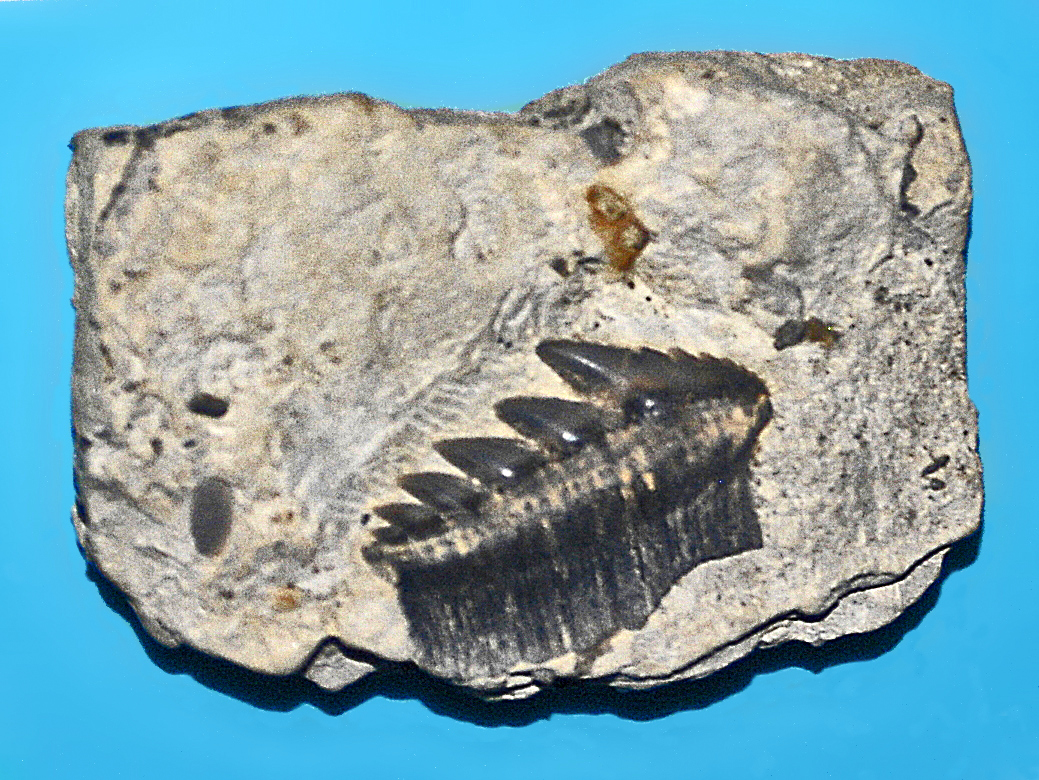
Teeth of Hexanchus andersoni from Jurassic,on display at the Museo Civico di Storia Naturale di Milano


09 August 2020

Dawn of Sharks

 Regarded as the first genus of shark, Cladoselache is a group of 8 recognized species, all from North America. These sharks are commonly called "scaleless sharks". They retain many ancestral characteristics including very fish-like heads and more than five gills (most modern sharks have five gills). The fins of these sharks possessed spines consisting of dentine and enamel, making them on of the strongest portions of the external surface of the body. The skin itself was almost entirely scaleless, possessing scales only near the eyes, mouth, fins, and portions of the tail. We know this because there are numerous exceptionally well-preserved members of the genus; so well preserved that we have internal organs such as the kidneys in the Cladoselache fossil record. Smaller muscles, a semi-scaled tail, and a semi-lunate shape that was nearly symmetrical all came together to form a lightweight, lower (than modern sharks) powered shark that was considered capable bursts of speed rather than maintained high speeds. 


Those short bursts of speed would have been immensely important to these small ~ 1.8 m (5.9 ft) long sharks. They are known from the oceans that covered modern North America approximately 380 million years ago during the Devonian time period. At this time, the apex predator of these oceans was the giant placoderm (armored) fish Dunkleosteus. These first scaleless sharks were were on the menu for most of the time that Dunkleosteus ruled the oceans. However, the scaleless sharks diversified during this time and their descendants outlived Dunkleosteus and eventually became the apex predators we know today from these fairly humble fishy origins.Cladoselache fyleri (Newberry, 1889) - fossil shark from the Devonian of Ohio, USA. (CMC VP7204, Cincinnati Museum of Natural History & Science, Cincinnati, Ohio, USA)


07 August 2020

Hammerhead Body

The body of Atopodentatus is fairly unremarkable in reconstructions. Other than the hammerhead face of the animal, its body is something we would consider rather typical for a swimming marine reptile. There are basic flippers on the forelimb and hindlimb; show here as early flippers with the digits extending just beyond the edges of the webbing. In appearance these flippers are not unlike the feet of ducks. They are less like the flippers we typically see in marine reptile reconstructions (plesiosaurs and ichtyhosaurs in particular) or in living marine reptiles (think of sea turtles). These flippers likely influence the evolution of the tail as well.

The tail of the animal is not paddle-like, and therefore probably not adapted for powered swimming. Considering the evolving flippers, that tail might not have been used in swimming at all. We could hypothesize that over time and evolution that the tail would become smaller (thinner, shorter, or any combination) like those of turtles or some of the plesiosaurs that we know. The tail would probably aid in turning a very small amount, if at all. However, it is unlikely that this algae grazing reptile needed to turn quickly in its daily life, so the tail not serving as a rudder or a propeller is not unexpected. I cannot speak to its overall speed, and I don't know if there is much study in that area either yet and saying that it likely didn't need to turn quickly is not an indictment of its overall traveling speed. I imagine, just as an off the cuff idea, that Atopodentatus was much closer to a manatee  or a sea turtle than other animals in terms of its swimming speeds. That would allow for short bursts, but overall indicate a nice slow meandering through much of its daily life.

The body itself, in the image below, is fairly average sized. There are reconstructions that show Atopodentatus with a more manatee-like pot belly as well. This imagery meshes well with the increased size we see in many herbivorous animals. One of the reasons for that, many of us know, is the need for increased digestive organ space. In some animals that can include elongated intestinal tracts, multiple stomachs, or organs like gizzards or crops that serve pre-digestive roles and often contain rocks to help grind down plant matter. Could Atopodentatus have had any of these kinds of extra long intestines or accessory organs? It is certainly possible! We would likely need a mummified fossil to be entirely certain, but some of the better preservations of this animal may also have clues. Could those accessory organs then lead to increase abdominal sizes in Atopodentatus? It is likely that they could, and, as noted before, some interpretations of reconstructions have included enlarged abdomens. That idea has permeated to the toy industry as well, so be prepared for young scientists whose first interactions with Atopodentatus are with an elongate, hammerheaded, and pudgy marine reptile.

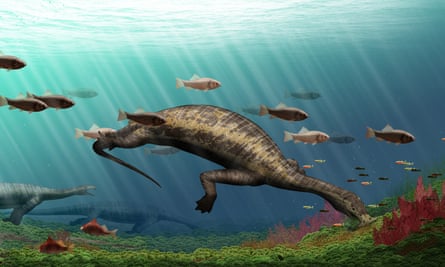
A reconstruction showing what Atopodentatus unicus would have looked like in life

06 August 2020

One More Head Post

In Luoping County in the Yunnan province of China in 2016 the newest fossil of Atopodentatus was discovered. That fossil, as we have seen, offered a very different perspective of the way that the jaws looked in this animal. That change, as we mentioned, required a new interpretation of how Atopodentatus was able to feed and what it fed on. Previously, the initial description described a filter-feeding marine reptile that pushed its head into the muddy bottom of its environment and push out the sediment, filtering that sediment and water in hopes that it would trap small arthropods hiding in the sediments. In the newer description, the change in the dental landscape called for a new interpretation. Instead, the new hypothesis proposed by Chun et al. 2016 (https://advances.sciencemag.org/content/2/5/e1501659) detailed a mechanism in which the the small chisel-shaped teeth were used to scrape algal growths from rocks, plants, and other details of the underwater scenery. The authors also hypothesized that the more posterior teeth were capable of of helping to break up plants so as to be able to retrieve the algae from these materials as well.

As we can see from the paper, two new skulls were described, providing extra information about the organization of the mouth and face of Atopodentatus. These two skulls, in addition to the original (type) specimen allow for a very well defined reconstruction of the skull. Putting those three views of this animal together we end up with a reconstruction that fairly accurately portrays the actual organization of this animal. That allows us to better understand how it fed, how it swam (heads do have an aerodynamic property in all fluids after all), and possibly even how these animals may have interacted with one another. Could they bite each other in territorial disputes? Did they groom themselves, or one another on the beaches? Could they even get to the beaches? Remember, there is evidence of flipper-like digits on their limbs and we have not really determined their ability to "haul out" onto the beach in the first place. The head tells us a lot about behavior, but there is still more to this animal. We will look beyond the head tomorrow, so look at the fossils and reconstructions and consider what we might be able to glean from the bones and the interpretations of those bodies.

04 August 2020

Two New Faces

Two Atopodentatus restorations, both by Nobu Tamura. The first was produced shortly after the initial description was published and is, admittedly, quite terrifying in many ways. It turns out that this initial find (published in 2014) was a little crushed, side to side, and the upper and lower jaws (maxillae and mandibulae respectively) were misplaced. The subsequent find (published in 2016) of a differently arranged, and apparently better preserved, skull changed the way that paleontologists, and artists, interpreted the mouth, in particular, of Atopodentatus. This arrangement of teeth (and mouth) is definitely still odd and unique, but helped to better understand the likely feeding habits of this interesting marine reptile.

This fossil, in a short amount of time, shows how new discoveries can change not only how we view an animal, but also how we can, and often need to, change our perspectives and hypotheses due to new discoveries. It also helped to clear up some mysteries about Atopodentatus (e.g. How did it eat with the originally reconstructed mouth? What could it have possibly be eating?)

Restorations ©Nobu Tamura

02 August 2020

A Short Video for your Sunday

1) Minor correction, I had a typo in the name of Atopodentatus yesterday, it has been fixed though!

2) Now, please enjoy some background info on the world of Atopodentatus and then some more on the animal itself in this video.


01 August 2020

Vegetarian Hammerheads

We typically write about dinosaurs here. We then branched into mammals at different points. We sometimes even talked about birds, small reptiles, varied reptiles (turtles, snakes, etc.), and amphibians from time to time. We have discussed traditional looking animals (i.e. animals that we expect to look a certain way as in T. rex always looks kind of like we expect T. rex to look). We have also looked at very odd looking animals (Megacerops and Ceratosaurus, I'm thinking immediately of you). I think we ought to restart with an animal that is different looking and from one of the interesting fringe groups that we have discussed. To top things off, this somewhat recently described animal looks like pretty much none of its closest living relatives, making it far from what we might expect to see.

Enough intrigue and vagueness, we will start off this month by discussing Atopodentatus unicus. An herbivorous pantestudine (a group that includes the living turtles, testudines, and their ancestors the extinct "stem-turtles") marine reptile that has been assigned as a possible primitive (basal) member of the sauropterygia (the "lizard flipper" group that includes long and short-necked plesiosaurs). This classification follows the Schoch and Sues 2015 phylogeny that places sauropterygia within pantestudines (one can find other arrangements of the family tree that make this description hard to accept). Regardless, this animal appears to be related to turtles, but also has a long neck and long limbs with elongate digits that appear to be situated into primitive flippers. It also has a long tail and many ribs and gastralia ("belly ribs"). Despite all of these "normal" sounding bodily descriptions of a large marine reptile that make it sound like a very typical swimming air-breather of the Triassic, its head is anything but normal.

The name Atopodentatus translates to "Unusual toothed" and, with a "zipper-like" smile of teeth, it is unicus ("unique"). The anterior part of the skull can best be described as "hammerheaded", with the teeth forming their "zipper-like" pattern at the front of the mouth. The entire head is not hammer head shaped, only the mouth. This formation is very interesting. It looks almost like a hadrosaur ("duck-billed" dinosaur) mouth, but filled with small peg-like teeth. Approximately 8 million years older than any other herbivorous marine reptile, Atopodentatus is thought to have fed on algae embedded in the sea floor.

Restoration of Atopodentosaurus ©Nobu Tamura

11 June 2020

An Exciting Opportunity


From the Facebook page of Julius Csotonyi:

A twist! On Sunday, join me in a drawing lesson on a rare modern-day survivor of the last ice age: the arctic ground squirrel or ᓯᒃᓯᒃ (pronounced "siksik") (Urocitellus parryii). Yukon paleontologist Dr. Grant Zazula will provide scientific commentary on this interesting (and large!) species of ground squirrel while I demonstrate its illustration, in an online event hosted by the Yukon Beringia Interpretive Centre at 1 pm Pacific Time on Sunday, June 14.

04 June 2020

Penguins Part II

Inkayacu, was approximately the same size as Palaeeudyptes


Fossil penguins were not always penguin "shaped", as we saw with Waimanu, but they became more distinctively penguin-like over time, as we saw with Kumimanu. Intermediate family members like Perudyptes and Anthropornis continue this "penguinification" trend of the overall body plan throughout the Eocene era and, by the times of Icadyptes, Palaeeudyptes, and Inkayacu, penguins look like the animals we think of when we hear the name penguin. There is one rather enormous exception to their recognizable penguin form: these are very tall penguins. Additionally, some of these penguins were likely still using their feet, in some capacity, in propulsion for swimming. Though we mentioned that it appeared as though Kumimanu may not be using its feet anymore to swim, it has been noted that the feet and ankles of some of these larger penguins indicate that they may have still played a role in swimming.The Eocene was an age of giant birds. Whereas the "Terror Birds" ruled portions of South America terrestrially, the giant penguins were taking to the ocean and at least terrorizing fish populations. Sharks were still apex predators in the ocean. Whales were in the process of fully transitioning from land to water. Enormous penguins could have been filling a niche that is now occupied by small whales and dolphins (and even smaller sharks like the reef sharks). Whatever their absolutely exact role, they were clearly highly successful birds that transitioned back from a terrestrial lifestyle to a nearly fully aquatic lifestyle. They did so as large animals that, over time, became increasingly efficient swimmers with streamlined bodies. Even if whales, dolphins, and smaller sharks (possibly seals and sea lions as well) pushed them into a finer definition of a niche, one which they currently occupy as pursuit predators. The nuances of penguin evolution, locomotion, diet, and the life histories of individual species are all complex topics that span the careers of scientists. Hopefully these two discussions are helpful in a very general sense to understanding penguins and their history.

01 June 2020

Penguins Part I

Waimanu manneringi ©Nobu Tamura
We know a lot about fossil penguins. Partly, this is because we have a fairly large number of fossils from penguins, which is a rarity for birds as a group in general. It's also a bit of a blessing. There are a number that are a little more well-known for various reasons (mostly to do with publication and news cycles) like Waimanu, Inkayacu, and Perudyptes; all penguins described since 2006. However, we have been recovering and describing penguin fossils since much earlier times: Pachydyptes (Oliver, 1930), Paraptenodytes (Ameghino, 1891), and Palaeosphenicus (Morino and Mercerat, 1891) are notable examples. Not all penguins are the same, so lumping them together is not really fair. However, their overall body plans are fairly conservative. Most members of the penguin family are recognizably penguin-like though ancestral members of the family are not exceptionally penguin-like. This includes Waimanu, an early member of the penguin family that has some penguin-like traits, but looks less like a penguin than we would imagine even an early penguin might appear. Waimanu has a longer tail and more wing-like upper limbs than we would expect a penguin to possess. However, its bill does look very much like the bill that we associate with fish catching birds and is reminiscent of that we see in penguins. The legs of Waimanu are more like those of a loon or a grebe and do not appear to be very useful for walking on land (just like those of loons and grebes). The position of the legs are better for swimming than for walking, to be honest, and from what we know about penguins, this makes a lot of sense.

Kumimanu biceae ©Nobu Tamura
Penguins do not swim with their legs though, they swim with their fins, their wings, providing propulsion underwater. So how does a penguin transition from leg power to wing power? The next oldest penguin we know (currently) from fossils, Kumimanu is decidedly more penguin-like. The feet look more like penguin feet. The tail is shorter than Waimanu's tail. The bill is still rather large and fish catching; not entirely penguin-like yet. We do have more flipper-like wings with Kumimanu, likely indicating that the legs are no longer propulsive and the flippers have taken over this function. The wings are not entirely like flippers that we see in modern day penguins though. Also, as we can see in Nobu Tamura's illustration, Kumimanu was a rather large early penguin. There are larger penguins that we know of, but rather than attempting to discuss all of the very important penguin fossils in one post, we will continue tomorrow with other notable penguins, some of which may be the largest penguins that ever lived.

25 May 2020

Long Distance Hugs

We could probably all use some kind of interaction from outside our family these days. While we cannot really pat one another on the back and continue social distancing, there are animals that could have done so. One such animal was the ornithomimosaur Deinocheirus mirificus. Originally, a pair of arms and their shoulders were described in 1970 by Osmólska & Roniewicz, and Deinocheirus was originally thought to be some kind of carnosaur. The description was amended after some time to assign Deinocheirus to the ornithomimosaurs, but new material to even more thoroughly describe the dinosaur was unknown for nearly 50 years. In 2014 (49 years after the initial dig that found Deinocheirus remains) new remains were found in Mongolia (later they were stolen but then returned to the country) from two individuals of the species. At an estimated 11 m and 6.4 t, this was a large and heavy ornithomimosaur of the Late Cretaceous.

The enormous hands and long arms are thought to have been well adapted for digging, which, given the duckbill-like head that seems adapted for water and grass foraging, appears to be at odds with the hypothesized diet. A large number of gastroliths associated with Deinocheirus support a vegetation heavy diet, as the dinosaur would have used these to help break down the fibrous plant matter. It has been reported that fish vertebrae were also discovered along with the gastroliths, meaning that it is likely that Deinocheirus was eating fish as well. Could oversized hands be useful for catching fish? There is a possibility for this as a use, but digging and manipulation of vegetation remains a good hypothesis.

Digging, with large hands, could help efficiently find supplemental dietary items like insects and burrowing lizards; there is no known evidence for this behavior currently. Also unknown is the nesting behavior of these animals. Could hands good at digging make very good nesting mounds? This is also a potential hypothesis. Holding vegetation to crop (or chop) small amounts of food could also be plausible. Defense could also be a plausible explanation for the namesake "horrible hands". Injuries to the holotype digit joints and bitemarks in the coracoids near the shoulder indicate manipulation of the digits (important for dexterous activities noted above) and unsuccessful predation. These predation events are attributed to one of the largest predators on Earth during the Cretaceous, Tarbosaurus bataar.
©Abelov2014
Adapted by Wiki users from the original at (https://www.deviantart.com/abelov2014)

15 March 2020

Talk to me on Twitter!


Hello all!
You're stuck at home. You're loved ones are stuck at home. I'm stuck at home. I'll be working on lectures and moving my class (and helping colleagues move online) all week. However, if you, your friends, or those lovely students you've suddenly been locked in with are looking for dinosaur or ornithology information over the coming weeks I'd like to offer what I can.

From 9am - 12pm EST during the weekdays I'll leave my Twitter feed (@ornithanatomist) open to questions. Maybe I'll get a lot of questions, maybe I won't! If you have questions, though, ask and I'll answer, find an answer (if I can), or point you to a good source to find the answer.

Stay tuned here and on Twitter. As I'm able I may be able to work out themed question days. I may (time permitting) be able to set up live Q & A sessions as well. Stay tuned everyone.

02 February 2020

Fossil Squirrels?

Good morning! What a wonderful morning it is! Punxsutawney Phil came out and told us all that spring is right around the corner, which is a very big deal. This is a North American "tradition" that was adapted from a similar German tradition (Dachstag: "Badger day") involving the European badger. American badgers would be far less amicable to this sort of treatment I think. In Pennsylvania, Phil is kind of a big deal him(her?)self. Groundhogs (Marmota monax) make a somewhat lucrative life for themselves in the state, even being endorsed by the state lottery as a spokes... hog named Gus. It is also quite hard to walk near any wooded area of Pennsylvania without running into at least a few of these large animals scurrying about the edge of the forest. But what are they really?

Fear is an acceptable response.
The animal has a lot of common names: groundhog, woodchuck, Canada marmot, and, my personal favorite, whistlepig, are just a few. Groundhogs, by any name, are not actually pigs or hogs (they are in the same genus as marmots, so that name has some basis, though they are certainly found south of Canada), but instead, they are actually some of the larger members of the squirrel family. Specifically, as some of their common names somewhat allude to, they are ground squirrels. Groundhogs can climb, despite their name, and a groundhog in a tree is something worth seeing.

When we think of oversized anything in the animal kingdom we tend to think that the only place to look is in the fossil record. That is, after all, where we find giant sloths, oversized wolves, dinosaurs, and enormous terror birds. We know that they are fantastic digging animals and spend a lot of time, including hibernation in a burrow. Was there, then, an even more giant ground squirrel that burrowed extensively in the history of life? Fossilized burrows are known from much earlier than the current era. The first burrows belong to very early animals, but if we are looking for the recent ancestors of giant squirrels, we do not need to go that far back.

Photo of Clarkia, Idaho squirrel fossil by
Bill Richards, North Idaho College
The first squirrels in North America appear in the Late Eocene, around 41 to 33 million years ago. Any "squirrel-like" fossils from before this are not squirrels.
The first ground squirrels appear shortly after the Eocene, in the early Oligocene, at approximately 30 million years ago in Europe. As far as the marmots themselves, there is no clear consensus on when this large group of ground squirrels first appear in the fossil record. They are evident by the Late Oligocene in North America. It is acknowledged that by the time we have a good fossil record, in the Mid-Miocene, the ground squirrels, particularly prairie dogs, are already well-represented within their modern range. The fact that we recognize their fossils as highly similar to their extant morphology does not really bode well for finding the origins of Punxsutawney Phil and Gus' family though. Truly, the fact of the matter is that squirrels, as long as we have known them in the extinct and extant capacity, have looked pretty much like squirrels. One could almost say that rodents are kind of like the cockroach of the mammal family in that they have existed long enough to have "survived anything and everything" that life can throw at them. We may see if this remains true in our own lifetimes, but let us hope that we do not.

For more reading:


  • Helgen, Kristofer M.; Cole, F. Russell; Helgen, Lauren E.; Wilson, Don E. (April 2009). "Generic Revision in the Holarctic Ground Squirrel Genus Spermophilus" (PDF). Journal of Mammalogy. 90 (2): 270–305. doi:10.1644/07-MAMM-A-309.1. Archived from the original (PDF) on 2011-10-22.


  • Kryštufek, B.; B. Vohralík (2013). "Taxonomic revision of the Palaearctic rodents (Rodentia). Part 2. Sciuridae: Urocitellus, Marmota and Sciurotamias". Lynx, n. s. (Praha). 44: 27–138.


  • Steppan, Scott J.; Storz, B.L. &; Hoffmann, R.S. (2004): "Nuclear DNA phylogeny of the squirrels (Mammalia: Rodentia) and the evolution of arboreality from c-myc and RAG1". Mol. Phyl. Evol. 30(3): 703–719. doi:10.1016/S1055-7903(03)00204-5 PDF fulltext
  • 29 July 2019

    Non-crocodilian Face

    Holotype as depicted in von Baczko and Desojo, 2016
    The holotype skull of Riojasuchus is very non-crocodilian to the casual observer. Having previously been associated with a number of people interested in crocodiles this skull shapes is not very alien to me and others that have experiences like mine. This is far from the strangest of crocodilian ancestors of course and we have discussed others here before (such as Simosuchus). The ancestral variations and resulting evolutionary history of crocodilians is actually quite fascinating. Riojasuchus is somewhere in the middle of this history. It is, obviously I think, not quite a crocodile and not one of the "primitive" herbivorous crocodilian ancestors. Further separating Riojasuchus from its descendant cousins (possibly a more appropriate description than saying it is directly ancestral to crocodilians) is the tree of Butler et al. (2011) which describes Riojasuchus (and ornithsuchidae) as a lineage that ends without more descendant lineages. Regardless of whether Riojasuchus has extant descendants or not, the skull shape is decidedly non-crocodilian, which is what we wanted to look at specifically today. The teeth are more crcodilian than some other crocodile ancestors. The dorsoventrally tall skull is quite distinct from living crocodilians. The transition from skulls of this shape to the more familiar flattened skull of crocodilians is the subject of much ongoing inquiry and research. It is a long, complex story, and we are still learning quite a lot from this group of animals about how and why head shape changes, or does not, over the evolution of a group.

    Butler, R. J., Brusatte, S. L., Reich, M., Nesbitt, S. J., Schoch, R. R., & Hornung, J. J. (2011). The sail-backed reptile Ctenosauriscus from the latest Early Triassic of Germany and the timing and biogeography of the early archosaur radiation. PloS one, 6(10), e25693. doi:10.1371/journal.pone.0025693

    Nesbitt, S. J., Desojo, J. B., & Irmis, R. B. (2013). Anatomy, phylogeny and palaeobiology of early archosaurs and their kin. Geological Society, London, Special Publications, 379(1), 1-7.

    27 July 2019

    More from 1969

    More paleontological discoveries were made in 1969 than just Deinonychus, though that is certainly one of the most famous of dinosaurs. A supposed basal was also described during 1969 that turned out to be a little more unique than a basal dinosaur (of course these are unique themselves). Described by J. F. Bonaparte along with another "new reptile" (Andescynodon being the second description, but not the focus of today's discussion) of the Argentinian Triassic, Riojasuchus tenuisceps (Bonaparte 1969) is an ornithosuchid ("bird crocodile") archosaur whose line of descendants include extant alligators and crocodiles. The holotype includes a nearly complete cranium and partial postcranial elements; more than 50% of the postcranial skeleton is preserved. Four total skeletons are known. The skulls average 25 cm (9.8 in) in length. Riojasuchus actually has a similar head to total length ratio compared to its descendants despite the general appearance of having a much shorter skull than alligators and crocodiles. Ornithosuchids, including Riojasuchus' relatives are known to reach approximately 2 m (6.6 ft) in length. Two other genera (with single species) show that there was likely a fairly wide distribution, if not a global distribution, of the ornithosuchids: Venaticosuchus Bonaparte 1971 (known from Argentina also) and Ornithosuchus Newton 1894 (known from Scotland).
    ©Nobu Tamura

    19 July 2019

    Modern Dinosaurs

    Since the description of Deinonychus by John Ostrom in 1969 the "dinosaur renaissance" that was kicked off by this paper and the hypotheses it generated, in part, has radically changed how we imagine and study dinosaurs. Deinonychus, for example, was originally illustrated as a leather skinned dinosaur. Deinonychus illustrations ranged in color and from strong looking to the often emaciated appearance that many dinosaurs, especially in the 1980's, were illustrated like. These versions have the skin pulled taut over bones in a way that makes the animals appear to lack muscle and other soft tissue. However, we do not generally see these kinds of illustrations anymore. Now, Deinonychus illustrations are almost always covered in feathers and typically have some elaborate feathers on the forelimbs, tail, and/or head. Admittedly, some of my favorite illustrations are those of Emily Willoughby, who has made this ferocious nightmarish dinosaur into an almost innocent looking (though likely still murderous) ball of fluffy feathers (on Wikipedia and DeviantArt). The bird-like appearance of Deinonychus has been taken to extremes at times as well; consider Luis V. Rey's rather turkey-like version of the dromaeosaur here. Unfortunately, the feathering and bird-like appearance have not been adopted by the most mainstream representation of Deinonychus: the "Velociraptor" of Jurassic Park. Crichton's dromaeosaurs were based off of Deinonychus antirrhopus. Jurassic Park (1990) was published shortly after Gregory S. Paul's Predatory Dinosaurs of the World (1988) which assigned Deinonychus to Velociraptor. This may explain why Crichton's Jurassic Park refers to these animals as Velociraptor antirrhopus; it's a nice story either way. However, the movies have increased the size of the animals and retained their old style of integument, possibly too inspire fear. The very minor exception is Jurassic Park 3, which did show some proto-feathering on the dromaeosaurs.
    Some effort shown here, right?