STL Science Center

STL Science Center

27 November 2013

Grasping Hands For Grabbing You Up

©Shelley Kornatz (Eykoart)
There are a lot of things that have not yet been discussed in terms of Compsognathus, though the papers yesterday and the discussions about feathers have given us quite a lot to talk about already. Regardless, one thing that has not been mentioned and cannot be ignored is the hand anatomy of a dinosaur like Compsognathus. Early German specimens appeared to possess only two digits, while later French specimens have three digits clearly seen. The third digit, Digit I, was short and incompletely preserved in the German specimens, but the implications of the digit arrangement is that the hand appears to possess the ability to grasp prey. Grasping hands certainly appear in the Maniraptoriformes and in the earliest relatives of birds. The grasping ability of the forebears of the Maniraptoriformes are sometimes used to differentiate theropods as well. Regardless of how the character is used, it is fairly evident in Compsognathus and a lot about the diet can therefore be conjectured at including the ability of the dinosaur to grasp and eat its prey rather than having to relay on jaw muscles and teeth alone.

26 November 2013

All the Papers

©Karola (Caimryo)
Almost "turkey day" here in the US (strange how the colloquialism has become solely about a food that was possibly not even present at the historical Thanksgiving feast), and what better way to celebrate than reading papers about the great (x 15 million, give or take a few generations) grandparents of modern turkeys? I like to think of the following list of reading material as following the bouncing Compsognathus literature, hence the use of the image above. Let us not argue about the exact evolution of turkeys and Compsognathus given the previous statement but instead enjoy the original naming and description of Compsognathus, if one can read German; English translations of this are, as far as I can tell, not available. One could also read about the synonymization of C. corallestris with C. longipes in Peyer's 2006 paper. Gishlick and Gauthier in 2007 examined the hand morphology of Compsognathus and restructured our vision of the digit count ad use of the digits in Compsognathus. For those interested in taphonomy, I found a paper by Reisdorf and Wuttke that uses decay in modern domestic chickens (referred to as "Gallus gallus L.", which is a hybridized Sri Lanka Junglefowl) to describe taphonomy in Compsognathus as well as Juravenator. There is plenty to read here today.

25 November 2013

Compy Puppets!

I am going to let the videos do the talking today. There is a puppet video as well as the I'm A Dinosaur version for Compsognathus.


24 November 2013

Coloring and Learning

©Emily Sheldon
There are a variety of sites that offer some knowledge on Compsognathus in literature that is written for a younger audience; which we always love to see. The sites that get used the most are represented quite well today including KidsDinos and Enchanted Learning. I am far more excited about the coloring today. Share the information with those around you, but share the coloring more today, because there is a lot of it!


23 November 2013

Staring Pretty

©NRG (a good fellow from Argentina)
Compsognathus, as a near relative of some of the earliest known feathered dinosaurs, may or may not have had feathering. These could have been fibrous filaments or it could have been downy tufts or even full fledged feathers, depending upon how long ago feathers actually did begin to develop as more highly evolved and adapted keratinous scales. Regardless, older illustrated versions of Compsognathus or those illustrations at least done in older styles, show scaled individuals. Some show them as highly active predators while others show them as simply stereotypical small dinosaurs walking about in ferns and other prehistoric backgrounds. Rarely do they appear illustrated, feathered or scaled, with any sort of anthropomorphic intelligence. In this scene it almost appears that our little Compsognathus friend is surveying the world and taking a relaxing moment. Most of the physical features of the dinosaur are obscured enough that the neck and tail anatomy are about all we can comment on in terms of the physical build of Compsognathus.

©Nobu Tamura
As far as newer versions of illustrations are concerned, the feather fibers of Compsognathus are a little debatable overall. This version highlights an early version of feather evolution with the appearance of downy fibers all along the body. The snout, feet, and hands are lacking in feathers as they would not require nearly as much insulation as the body of Compsognathus would. Physiologically, blood traveling from the body to the feet, hands, and snout would heat the blood returning to the body from veins in/from the feet. This would keep the body warm in the same way that birds keep their bodies warm while allowing their feet and beaks to remain cold. Insulation in this manner would be the practical physiological purpose of filamentous feathers like these, but additionally these feathers would be pigmented and be able to be used for display purposes.

22 November 2013

So Small I Missed It All This Time

I've seen this before, but I cannot make out the illustrator's name.
"The compys didn't look dangerous at first sight. They were the size of a hen and walked nervously like a hen. But he (John Hammond) knew that they were venomous. Their bites delivered a slow-acting poison that they used to kill wounded animals." —Jurassic Park (novel)

Granted the above quote is in reference to the novel's Procompsognathus denizens and we are covering their descendant, Compsognathus, it is still a wonderful little quote from the novel about a somewhat understated lineage of dinosaurs. Both Procompsognathus and Compsognathus were small theropod dinosaurs with "elegant jaws" (the meaning of Compsognathus). Compsognathus consists of a single species, C. longipes, though a now synonymous species was once purported to exist as well (C. corallestris). The originally described size was slightly smaller than the full grown adult size of just over a meter or about 3.3ft. The reason for this is that a juvenile specimen was initially described as an adult. Regardless, at approximately a meter long and between 1.8 and 7.7lb (0.83 and 3.5kg) Compsognathus was the smallest non-avian dinosaur known for many years. An obligate biped, Compsognathus was quite gracile and agile, able, more than likely, to chase down many smaller prey items like large insects and small mammals and lizards. Though often depicted (in Jurassic Park related media primarily) as pack hunters, no evidence of this behavior exists that has been documented. Feather coverings, though not depicted often, may have been present on living members of the species, as they are closely related to known feathered dinosaurs such as Sinosauropteryx and Sinocalliopteryx.

21 November 2013

Exciting Times!

There is little to discuss in terms of the popular culture impact of our small basal Ornithopoda friend Atlascopcosaurus this week. As such, we will discuss the world in which this dinosaur lived. Atlascopcosaurus was discovered in Dinosaur Cove's Eastern area in 1984. 104 million years ago the Dinosaur Cove area was closely associated, geographically, with the landmass of Antarctica and well below the Antarctic Circle. Current research indicates that the areas within the southernmost area of the globe near the Antarctic Circle potentially occurred dark and light seasons. More famous denizens of this light and dark season land include Muttaburrasaurus (the taxon in which Atlascopcosaurus is sometimes considered a member due to its fragmentary nature), Leaellynasaura‎, and even a carnivore simply referred to most often as Dwarf Allosaurus. It is unfortunate that more of this little dinosaur has not been recovered (and also that it actually be a nomen dubium that belongs to another species). Regardless, the adaptations to light and dark seasons that could potentially be seen in this taxon would be wonderful. Should more ever be discovered it will tell us a lot about the dinosaur and it will definitively answer the question regarding the position of the dinosaur itself.

20 November 2013

Once A Hypsilophodont

©Robinson Kunz
Originally diagnosed as a middle of the group Hypsilophodontid, Atlascopcosaurus, has since been reassigned to the honored position of one of the basal-most Ornithopoda. Hypsilophodontidae would still be recognized as the family to which Atlascopcosaurus is assigned had it not been deemed paraphyletic and effectively banished from dinosaurian systematics. Regardless, as a basal member of the Ornithopoda Atlascopcosaurus possesses many characters that define the clade later on. Bipedal herbivores, Ornithipoda like Atlascopcosaurus, possess predentary beaks and occluding grinding teeth in a distinctive cheek region along the maxilla and dentary. They also should, remember that Atlascopcosaurus remains are exceedingly fragmentary postcranially, possess ossified tendons along the caudal vertebrae that stiffen the tail, making structurally very much like a cantilever bridge; it provides stability and support to balance out the center of gravity oriented in the upper thoracic area. The nearly horizontal body position is well exhibited in this illustration, and the feathering or filamentous fibers, are a fairly certain reality as well at this point. Small basal members of Ornithopoda are no longer so bland as they used to be thankfully.

19 November 2013

A Book Star

Atlascopcosaurus has not made a significant impact, overall, in the peer reviewed scientific publication world. It has, however, appeared in a number of books as passing information and even as a key character. Some of these books may have been mentioned in prior entries given that they have information contained with that discusses other Australian dinosaurs. These include books like Minmi and Other Dinosaurs of Australia as well as World's Smallest Dinosaurs. Rich and Vickers-Rich published the initial naming and describing paper, as previously stated, but they also co-wrote a 1999 paper which was much more about the Hypsilophidontids of Australia as a whole; the abstract can be found through this link. Chapter 18 of Dinosaur Systematics describes the basal Ornithopoda and here too Atlascopcosaurus is touched upon. The Witmer Lab at Ohio University hosts a PDF version of this chapter, making it available online; Dr. Witmer is a co-author of the chapter.

18 November 2013

Australia in Motion

Atlascopcosaurus is not a vividly in motion Australian dinosaur. There are few resources that show Atlascopcosaurus in motion adequately but there is a tribute video, and that is a step in at least a somewhat progressive direction. Beyond that there really is not much in the way of videos. Below is the tribute video that shows Atlascopcosaurus, however briefly it is; it is a video highlighting all Australian dinosaurs afterall.

17 November 2013

Atlascopcosaurus and Little Fact Pages

Atlascopcosaurus shows its face rarely if at all in terms of reliable internet sites. This is not much different from the types of things that exist to present on normal Sundays; in a perfect world there would be far more sources for every animal for younger readers. However, today the only quality links, and thankfully they are quality links that happen to exist, come to us from About and the NHM in London. I also took the liberty of clearing out a rather blank image to begin with for coloring purposes.

16 November 2013

Blank Faced Ornithopods

©Karkemish (via Deviantart)
Today I have decided that we will only have on illustration. There is a reason to such madness. The fragmentary nature of the discovered cranium makes it difficult to illustrate or even describe what the post cranial skeleton looks like. Therefore, any recreation is little more than an approximation based on a generalized Ornithopod body plan. Some studies have gone as far as to determine that Atlascopcosaurus is a nomen dubium (none cited in the Paleobiology Database though this is where the original claim of nomen dubium originates) while others have claimed that the likelihood of a relationship between Atlascopcosaurus and Muttaburrasaurus requires a redefinition of the Iguanodontia including the designation of the family Muttaburrasauridae. Atlascopcosaurus is a much smaller animal than Muttaburrasaurus but the likelihood of a parallel evolution of body shape within the closely related Australian Ornithopods is more than likely what most illustrators and descriptors are basing their images on.

15 November 2013

The Riches

The world owes a fairly big chunk of its knowledge of Australian dinosaurs to Tom and Patricia Rich (more correctly known as Patricia Vickers-Rich). Using the equipment of a company known as the Atlas Copco Company in 1984 (naming and describing taking place during 1988 and 1989) the duo dug out and named a dinosaur after their tool company! Additionally, the specific epithet honors the state manager of Atlas Copco, and an assistant in the dig, William Loads. Therefore, the name Atlascopcosaurus loadsi, was coined in the description of this dinosaur. A small basal Ornithopod dinosaur, Atlascopcosaurus is known from fragmentary cranial skeletal material and not well known at that. Since the postcranial material is missing, not much is known about the overall shape of these dinosaurs other than that they were basal bipedal Ornithopods, and this is hypothesized from the skull. Difficult weeks are a lot of fun around here!

14 November 2013

Star Tyrannosaur

The story behind the long narrow snout of Alioramus remains quite unsolved and a little bit conjectural. The purpose of such a snout clearly has an embedded purpose and we have certainly entertained many interesting and educated guesses/hypotheses during this week. Alioramus is something of a star also, having had many mentions in many different areas of popular culture. Brian Switek has written about the horned features, that we never covered, in the skull of Alioramus altai. More importantly, in terms of pop culture, the nearly always represented Dinosaur King and Spore video games once again give us pop culture links for our dinosaur of the week. The Spore model is pretty well done actually, even going so far as to include the ridged nasal bones seen in many of the illustrations:
This one dances, so it may be more inaccurate, but... it dances, so really it is also pretty awesome:

13 November 2013

Alioramus is Unique Enough

Whenever an image says only "artist's rendition" I cringe a little for the artist and hope that someone knows someone that did the artwork. That stated, this Alioramus is even more unique than expected of the long snouted and interesting dinosaur that we have come to love (or at least enjoy thinking about how this clearly tyrannosaur-like dinosaur looks so very much like an allosaur). What sort of necessity is there to this interesting camouflage scheme though? Is it artist's fancy or is it well thought out considering the ecosystem of the Nemegt Formation? Floodplains with large river channels and the related soil deposits make up the majority of the Nemegt Formation sediments. Hardened calcium carbonate deposits mark periodic droughts in the Nemegt sediments as well. A variety of prey items lived alongside Alioramus, and Tarbosaurus as well, in this periodically dry floodplain in present day central Mongolia. Camouflage for the smaller tyrannosaur would most likely be a must not only for ambushing prey but for hiding from the larger Tarbosaurus as well. Camouflage, of course, is not the only reason for markings on any animal; species recognition and looking attractive are also quality reasons to have some wonderful and interesting markings. A strangely white background in the environment, such as chalk cliffs, would make sense with this illustration's color scheme.

12 November 2013

Looking at Brains and Heads

There are quite a few studies of Alioramus out there to be read. There is a little for everyone in fact. There are studies on osteology of Alioramus specimens out there. The study referenced in this paper even questions the validity of A. altai based on the fact that it appears to represent a younger individual that may in fact only have ontogenetic differences separating it and A. remotus. Additionally, this paper makes note of, and reinforces, the point made here earlier that the jaw, unique amongst Tyrannosaurids, was probably not used in a typical tyrannosaur method of excising large chunks of food for swallowing. An alternative is not mentioned specifically, but instead it is proposed that that mode of feeding may in fact be present in adults of the genus; unfortunately only individuals deemed to be immature have been discovered.

A second paper of interest examines the braincase, via CT scanning, and describes the structure in a highly detailed manner. 21 characters from this structure were used in redefining the tyrannosaur phylogeny recently and all of these characters are addressed and discussed in this paper. It is certainly well worth the read if one has the time. Interest in a somewhat separate area of tyrannosaur phylogeny is represented in this PLOS ONE paper that expounds upon the hypothesis that the rise and fall of  tyrannosaur lines can be used to parallel the rise and fall of the Cretaceous oceans. Much of this paper discusses Larimidia (the western half of North America) and the Western Interior Seaway, but there is also mention of the Asian tyrannosaur families as well. Of these North American tyrannosaurs, those from Utah are most highly discussed and the parallels of the ocean habitats of the Cretaceous are drawn from these animals. Despite not being of particular central interest to this paper, Alioramus is a tyrannosaur and, supposedly at least, the same conclusions ought to be able to be drawn by studying Alioramus in a similar fashion.

11 November 2013

Disney Has Fun

A minute into the Dinosaur! ride at Disney's Animal Kingdom an Alioramus rears back and ingests what is supposed to be a Champsosaurus according to the accounts I have read. The only real problem with that is that Champsosaurus is a North American genus that, to my knowledge, has no representative species seen in Asia where Alioramus resided. Regardless, the long snouted Alioramus digging into the ground to pull out the long bodied Champsosaurus kind of meshes well with the statement made Saturday that the long snout allows for extension into cavities, though body cavities not caves and caverns, in search of food. Regardless, digging for food was probably not the primary means of extracting prey items for a dinosaur with a long snout based on its shortened forelimbs. As hypothesized earlier, the snout was probably used as the primary weapon, inflicting quick and sudden bites on prey items during hunting expeditions. The idea that the elongate snout could be used for digging or extracting animals from crevices, while not entirely farcical, would most likely have been a last ditch attempt at procuring food items.

10 November 2013

Kids Play with Alioramus

Alioramus shows up in a few kid related areas, which is always nice. Notable sites that I love to reference include, of course, Dinosaurs for Kids and Academic Kids. For the higher level students there is an entry on the Tree of Life site that discuss Tyrannosaurid systematics a bit more in depth. There is also a nice coloring sheet that really accentuates that Allosaurid snout that has been mentioned.

09 November 2013

Two Species and Not A Single Skeleton

Constructed by Steveoc86
Alioramus remotus is the more fragmentary skeleton of the two named species. However, it is still distinctive enough to be both Alioramus and a distinct second species of the genus. The skull, obviously lacking in many aspects, does contain the majority of the dentary and maxilla as well as a good portion of the postorbital surface of the skull. The postcranial skeleton is represented entirely be two toes and a portion of the ankle. Fortunately, it appears, that the general size and shape of this dinosaur can be approximated using the few bones we have knowledge of, comparative proportions of other Alioramus specimens, and most likely proportional comparisons to its close relative Tarbosaurus as well.

Constructed by Conty
Alioramus altai, however, consists of quite a bit more skeletal remains, overall at least. Regardless, the dimensions of the dinosaur are quite well known from the collective fossil assemblage of all of the Alioramus specimens. The most distinctive feature of the skull as a whole is the long narrow snout of Alioramus. This type of snout, overall, appears to be appropriate for reaching deep into prey items as well as lunging attacks with quick snaps of the powerful and solid built jaw. Given the apparently agreed upon configuration of the forelimbs as highly tyrannosaurid, a long quick jaw related attack would more than make up for these rather small forelimbs.

08 November 2013

A Different Branch of Dinosaur

Tyrannosaurids are always a fun branch of dinosaurs to discuss. After last week's nearly non-existent information on Aeolosaurus I think we ought to cover a nearly equally difficult to fossil carnivore. The love people show to tyrannosaurs ought to somewhat offset the little available fossil material of Alioramus remotus Kurzanov 1976 or Alioramus altai Brusatte 2009. Alioramus is a bit of problem child as fragmentary evidence of the two species has been recovered only from Asia and only as fragments. There is no real problem with being an Asian dinosaur, it is just that the fragments have only been discovered in Asia and that the dinosaur has been noted only as being related to Tarbosaurus bataar which, itself, has debated origins and positioning in the phylogenetic tree. There are some rather interesting similarities between Tarbosaurus and Alioramus that will need to be highlighted to understand where Alioramus belongs on the tyrannosaurid tree, and hopefully we can go over what makes this dinosaur an Asian tyrannosaur during the course of the week!
©Nobu Tamura

07 November 2013

What We Know

We know that Aeolosaurus is not a popular dinosaur, unfortunately. That has been borne out over the week. No one has offered any answers to any of the questions that remain without closure, sadly. However, I do have one more image I can share that is attributed to Aeolosaurus. The image has no attribution as far as I can find in terms of illustrator though.

06 November 2013

Aeolosaurus and Its Tail

The tail of Aeolosaurus had some rather interesting neural spines on their vertebrae. We mentioned previously that Aeolosaurus has anteriorly deflected neural spines on the caudal vertebrae. What is the precise reason for having a neural spine that is positioned forward rather than the typical convention which faces posteriorly, or backwards? Neural spines are used for muscle attachment, as well as other attachments such as stiffening tail rod ligaments in some species of dinosaur. There are other instances, other than closely related titanosaurs, which have anteriorly directed neural processes. Searching for for some valid reason, other than a different configuration of muscle attachment that serves the same purpose as posteriorly deflected processes, that neural spines would be deflected forward rather than to the rear has been fairly difficult and, honestly, nearly impossible to find in morphological studies. Muscle configurations that serve the same purpose but are aligned differently would not necessarily be farcical; it could simply be that Aeolosaurus was built differently. It could also be that something was put together incorrectly, it has happened before. I hope that someone somewhere is studying the configuration or that someone knows the answer already and I just have not found it or do not see the answer clearly at this moment, but will sometime soon!

05 November 2013

Writing Like A Maniac

Aeolosaurus has been written about a lot more than it has starred in documentaries. The mentions of it in scholarly articles are pretty fantastic as well as the number of papers dedicated solely to Aeolosaurus. One of these papers that is of great importance is a 2007 article by Casal, et al. which details the discovery of a new species of Aeolosaurus from Argentina. This species is the second named species, which is why it is an important paper. Additionally, Martinelli, Riff and Lopes wrote a paper discussing when and where fossils of Aeolosaurus have been discovered in South America that makes for a rather fun and interesting read. I encourage everyone to read the first paper if you have to choose between them for any reason!

04 November 2013

Motionless Winds

Sadly, for a dinosaur so rooted in winds, by virtue of its name, Aeolosaurus is rather motionless. There are a variety of reasons that this could be, but the sad fact is that there is simply not any documentaries or even wireframe models out there constructed by dinosaur enthusiasts. There are not even modded models in games like Zoo Tycoon. The most important thing about Aeolosaurus that should not be forgotten, despite this lack of wonderful motion and images of a rather unique and interesting sauropod, is that there are many individuals, fragmentary as they are, that are known and therefore the ability to create models in the future becomes greater with every discovery. Since that does not exist, however, please enjoy this wonderful image of Aeolosaurus today:

03 November 2013

Kids and Dinosaurs

Aeolosaurus is not well known, we can accept that many of the titanosaurs are not well known I think. Cutting out a lot of the speculative and scientific debate of many other articles online, Academic Kids does a good job of just posting the bare minimum of information to introduce kids to the dinosaur. Unfortunately, the bare minimum for a poorly understood dinosaur is a very little amount of information to begin with. For a little more in depth information, after gathering the bare minimum, the outline version of information presented on Bob Strauss' About pages again offer a good place to direct the children eager to read more and talk about this dinosaur more. Sadly today we have no coloring pages to offer up while children read or are read to, but perhaps the kids out there could draw one of these dinosaurs for themselves.

02 November 2013

Pointing Forward

From Garcia and Salgado 2013
One of the most unique features that allies Aeolosaurus with other titanosaurs, specifically Gondwanatitan, is that the neural spines on the caudal vertebrae are angled forward in the direction of the head (anteriorly). That sort of trait is not common in the titanosaurs meaning that Gondwanatitan and Aeolosaurus are closely related. As some of the only material discovered with the type species, these caudal vertebrae were an important piece of the puzzle as to what this animal was exactly. They united Aeolosaurus with other titanosaurs as well because they were elongated medially from front to back and they possessed shallow fossae on the lateral sides of the centra; both are titanosaurid characters of caudal vertebrae. The initial puzzle pieces consisted of these few vertebrae, elements of the forelimbs, and the right hindlimb. These elements also aided in identification of the animal, of course.

Picture ©Marco Aurelio Esparz
The femur of Aeolosaurus was a rather large bone, as we expect from titanosaurs. The size, dimensions of proportion, and general shape of the femur all attributed to the diagnosis of belonging to a titanosaurid dinosaur. The relationships alluded to by the femur are hazy and basically educated guesses at this point as titanosaurid material is both rare and incompletely understood. However, the femur of Aeolosaurus is rather large and quite a nicely preserved bone all in all.

01 November 2013

Keeper of the Winds

©Karkemish
Aeolus, keeper of the winds in Greek mythology, would probably be a little more light on his feet than the dinosaur that can claim him as a namesake. Aeolosaurus is a genus consisting of three recognized species; A. rionegrinus Powell, 1987 (type), A. colhuehuapensis Casal et al., 2007, and A. maximus Santucci & De Arruba-Campos, 2011. This South American titanosaur of the Late Cretaceous measured in at approximately 45 ft (14 m), however, weight estimates are not accurate when available due to the loss of much of the skeleton. There are a number of distinguishing characters in the skeletal material that has been recovered and these, of course, will be topics of much consideration and discussion over the course of this week. We will start bright and early tomorrow in this discussion.

31 October 2013

In Storage

Originally posted by Mickey Mortimer
The skull of Adasaurus, not seen for many, many years, was unveiled in a paper last year that reviewed Dromaeosaurine systematics and phylogeny. It was alluded to in Tuesday's post of papers that were not free to the public and were not explicitly about Adasaurus. Mickey Mortimer posted the image above on his own site on the same day the paper was published. Part of the reason that Adasaurus has never been truly popularized can be seen in this skull. The skull is missing many elements and the majority of the skull. It is not, in its current state, on display to my knowledge either. These things combined with little recognition outside of the professional and amateur communities have created a very small sphere of recognition by the public at large and thus made this dinosaur minutely if at all known to others.

30 October 2013

Adasaurus is A Stocky Animal

©Mike Hanson
This Adasaurus does not appear as stocky as my title in today's blog would have anyone imagine. However, remember that at about 6 ft (2 m) long, this is not an exceptionally large animal overall and therefore that body mass that we can see here is in a small area, all said and done. Estimated weights for Adasaurus have not been published; perhaps not even calculated actually. Dromaeosaurus, of nearly equal length, has an estimated weight of approximately 33 lbs (15 kg) and this is probably a reasonable estimate for Adasaurus considering the similar body plan and size. The animal is assigned to the same subfamily (Dromaeosaurinae) as Dromaeosaurus and one of the characteristics of animals in the subfamily is a stocky appearance giving the impression that the animals were more wrestlers than runners. Perhaps more studies and remains will be recovered in time and a more in depth understanding of these somewhat small but powerful and deadly dinosaurs will fill in some of the gaps and purported knowledge with hard fact. For the moment, however, Adasaurus will be the Mongolian version of Dromaeosaurus in at least my imagination.

29 October 2013

Inkless

Adasaurus has a short history of being written about. Unfortunately, it is a history that is mostly lacking. In part due to the recentness of the writing and in part due to the fact that the writing was not recent enough that it made its way onto the internet. There have been other articles which mention Adasaurus or allude to it such as this 2000 article about a French Dromaeosaurid. Sadly, that means, there are no scholarly articles to share without finding a paper copy of the original and scanning it. Hopefully someday someone will do that or we will find a copy that the publisher finally decided to put online.

28 October 2013

Gaming Material

Good morning from GSA in Denver, first of all. Secondly, Adasaurus has not made its way into any documentaries that I have found online. That is a little sad in and of itself. However, as we can see here, some intrepid gamer has taken it upon themselves to re-purpose and play with the models of Zoo Tycoon enough to add a modified Adasaurus into the game. I could write a fair amount about the model and how it looks rather plain compared to the feathered appearance of most modern Dromaeosaurid interpretations, but it looks pretty nice all said and done to be honest. I am going to go listen to a talk on archaeology, enjoy your day, and the conference if you are in Denver.

27 October 2013

One For Kiddos

There are few fact pages dedicated to children for Adasaurus. We have seen fewer than are available today though. There is a pretty easy to read page over at Academic Kids, its only real short coming is how short it is. The About page on Adasaurus is a little more detailed, so we should definitely share that as well. The biggest loser of the day, though, is in the coloring pages area. There really are not any. This gelatinous dinosaur exists and there are a few that might qualify on deviantArt (the first page is kid friendly and only has one non-dinosaur but fully clothed model photo, beyond that I have not checked, so be wary). Those illustrations are not meant as coloring pages though, so so not assume that they can be used as such!

26 October 2013

Being Average

Unknown but clearly based on the Timothy Bradley illustration
The thing to know about illustrations of Adasaurus is that they all appear to be very uniform in terms of looking like Dromaeosaurids. They always appear rather gracile regardless of how stocky they seem to appear, and they are always portrayed with the toe claw characteristic of the majority of Dromaeosaurs in an extended position. It is a sad occurrence that there is not imagination typically portrayed in these dinosaurs, but that is how it is.

25 October 2013

Adding Up!

©Karkamesh (accuracy disputed)
Adasaurus mongoliensis, meaning Ada's lizard, is a small theropod dinosaur described and named in 1983 by Rinchen Barsbold. Ada is a Mongolian mythological character considered to be an evil spirit, and this Dromaeosaurid dinosaur certainly could be considered an evil looking animal. Unfortunately the relationships of Adasaurus and other Dromaeosaurids are not well understood because Adasaurus is represented by fragmentary fossils of the skull as well as post-cranial skeleton. These fragments, however, have lead to the idea that Adasaurus should be considered a member of the subfamily that includes Dromaeosaurus and Utahraptor, the Dromaeosaurinae. These are heavily built members of the family. Conversely the animal is shown to be a part of the Velociraptorinae subfamily which consists of smaller and more gracile members of the family.

24 October 2013

Dubious Favorite

Acanthopholis, meaning "spiny scales", is somewhat famous, despite being dubious in its distinctions, from time to time.  Unfortunately, the debatable nature of things due to fragmentary remains as well as the 1999 study that determined it to be a nomen dubium. Regardless, it has shown up on websites for information purposes and not in many other places. In fact, toys, books, and even modifications to video games seem to be lacking for Acanthopholis. It is just too bad that there is not much in the popular culture world for this dinosaur.

23 October 2013

Something New to Consider

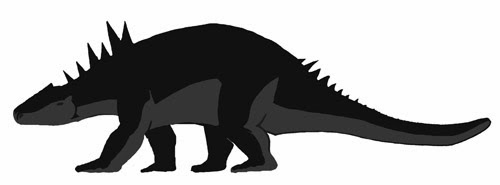
In 1999 Superbiola and Barrett reviewed the materials attributed to Acanthopholis and determined that the material was not distinct enough to merit being anything more than fragmentary bits of the average Nodosaur. As such, they determined the name to be a nomen dubium and to disregard its existence. However, the name is still in use and considered valid, apparently, by the majority of research that I have seen. Nestled in the family Nodosauridae, Acanthopholis is a small member of the family with small oval dermal ossifications with spikes in the shoulder and neck area and along the spine. Nomen dubium or small Nodosaur? You decide.
©Mariana Ruiz

22 October 2013

Short of A Prize

Thomas Huxley described and named Acanthopholis in the 19th century. Some of the writings he created in which the dinosaur is mentioned have survived long enough to make it online. However, these writings are far from free and, honestly, are quite a bit more expensive than a one or two page historical document would appear to warrant; though I am not a historiographer nor am I an appraiser so I cannot say with certainty that this is true. Regardless, at around $45 a piece, some of the articles from the Geological Magazine printed by the Cambridge University Press can be obtained. Ken Carpenter tackles armored dinosaur phylogeny in a book he edited called The Armored Dinosaurs and mentions the positioning of Acanthopholis within the family and this reading is far more easily available at any large library or here in piecemeal if one wanted to simply skim over an article.

21 October 2013

Drawing in Tribute

Acanthopholis has tribute videos, like many another dinosaur that has been featured in these hallowed spaces throughout the few short years this page has been open. It appears as though all dinosaurs will be revered at some point after we know about them and spread the wealth of our knowledge about them. The tribute video is shown here, view if you would like, or not. Remember, sometimes images are not exactly what they are credited as and that there is usually music. This one is in Spanish also, which is interesting. Personally, I am a big fan of this speed drawing video in terms of videos related to Acanthopholis; it really is not that speedy honestly, but it is faster than I would draw it.


20 October 2013

Acanthopholis, Late for Kids

Acanthopholis, though a bit late today, is for children and quite friendly in that regard. Since it is so late on a Sunday (in the states) I can only imagine this will not be seen by children until Monday. Therefore, may they enjoy an early Monday, or late Sunday fact page and a somewhat simplified coloring sheet:

19 October 2013

When You've Seen Them All

Nodosaurs, and Ankylosaurs, in general, appear to have always been drawn in a very odd way. Older illustrations are always pretty entertaining, and therefore, we shall start with that older illustration this time around. Acanthopholis in an old school fashion appears as do many of those old school Nodosaurs; namely with a semi-sprawling gait, dragging tail, and odd posture of the trunk brought about by the combination of sprawling and shortened forelimbs depicted here. The head of this Acanthopholis is also a little odd in that there is no dermal armor depicted on it; as if it was completely devoid of any type of protection. Even without "armor" the head of this dinosaur was most likely not entirely smooth as appears to be the case in this illustration.

The DK illustration, illustrator otherwise unknown, is a little more acceptable in terms of modern interpretation of the skeleton of Acanthopholis. The dermal armor on the trunk and tail are a little more heavy duty than they appeared on the older illustration. The tail is also held straight out from the body rigidly rather than drooping and dragging in the dirt. The trunk is now show as being mostly leveled with the forelimb less sprawled and therefore nearly as tall as the hindlimb. The head has also been massively updated with a keratinous beak and at least a less smoothed over skull roof if not a dermal plated skull roof.

18 October 2013

Feminine Dinosaurs

©Karkemish
A small Nodosaur, Acanthopholis horrida, was named and described by Thomas Huxley in 1867. This dinosaur was unearthed and recovered in England at Folkestone, Kent, in 1865 by John Griffiths and sold to Dr. John Percy. Dr. Percy brought them to Huxley who then paid Griffiths even more money to dig up all of the dinosaur remains he found at the site. The original name was Acanthopholis horridus as prescribed by Huxley, however, Arthur Smith Woodward changed the name to horrida because Acanthopholis, and horrida, is feminine.

17 October 2013

Seeing Elaphrosaurus Again

Elaphrosaurus does not appear in the toy world nor does it appear in the literary world (outside of Paul's Predatory Dinosaurs) and it does not appear in many other places like documentaries and movies. How does such a long known and even a well known dinosaur over time become so unknown to the general public? Perhaps this dinosaur was not as famous as it seems to have been when it was discovered. Perhaps it just fell out of favor as more and more of the synonyms disappeared over time because they were investigated further and determined to be synonyms. Regardless, Elaphrosaurus was a very interesting dinosaur and has been illustrated hundreds of times even though it has not appeared in many typical popular sources. Take one last look at Elaphrosaurus:

16 October 2013

Elaphrosaurus is Snakey

Regardless of the image I use for Elaphrosaurus, it always seems as though it is just a little bit off. This includes the use of the two different skeletal mounts that have been simultaneously attributed to Elaphrosaurus. Both of those skeletons, however, do share traits that are very similar. The difference is in the skull. The mounted skeleton, which is the newer mounting of the skeleton, that is free-standing has a robust and much more oval-like skull whereas this encased skeleton, the original mounting, has an elongated snout that is low in profile. The skeleton, post-cranial, is very gracile though, appearing rather slender and "snakey" in that it appears to have allowed for a great deal of flexion in many different planes. The newer mount reflects a much more active animal and appears a little stiffer, but still retains that rather gracile look at the same time. The older mount, we can see here, has the "classic" dinosaur profile with the tail nearly dragging. This mount is certainly based on the old way of mounting skeletons and given that the animal was unearthed from the Tendaguru Formation in 1910, that makes a lot of sense; it is also very informative as to how dinosaurs used to be viewed for younger readers that may not remember the depiction of dinosaurs as slow tail dragging beasts.

15 October 2013

Lack of Papers

©Michael BH
Elaphrosaurus, for all the study done concerning it and all of the information out there about it, does not appear in many papers that are available online. A partial paper, available for around $40, is shown as a sample, that was written in 1982 by Peter Galton. The paper discusses the North American and African, as well as the European, records of known Elaphrosaurus remains that have been unearthed, but does not provide much new information as we typically try to highlight here on Tuesdays. Another paper by Novas et al. compares the articular head of Elaphrosaurus and Abelisauroidea humeri to a newly discovered (as of 2006) humerus from South America. The paper determines that the humerus is from an Abelisaurid, but does not assign a determinant genus. Other papers exist, but again, they are not available online.

14 October 2013

Old Posts

Today feels like one of those days back when I started doing particular ideas or themes for different days of the week. Back in the beginning I found a lot of so-so tribute videos with music that was tolerable at best in the background. I also found a lot of Dinosaur George videos in which he answered emails on camera like this one.


These videos were always fun to watch; they have become quite a bit less frequent though and I assume it is because he has been a very busy guy as of late. Regardless, he has some good information and opinions, as always.

13 October 2013

The Tortoise and The Elaphrosaurus

I really like the days when I can let a video or something for all the talking. Not too informative, not like a Dinosaur Directory entry or another fact sheet, but it is interesting to cartoon enthusiasts, specifically kids today on family day. We also have a coloring sheet today, and there does not have to be much discussion with either the video or the coloring sheet and fact page, so enjoy!

12 October 2013

A Rather Blah Theropod

©Nobu Tamura
Elaphrosaurus was a fairly basal theropod dinosaur. The Late Jurassic, however, was a time of radiative adaptation by theropods in the eat-or-die arms race of evolution. How a rather basal theropod was successful long enough to appear in the fossil record could be a point of contention, but it is possible that even smaller populations of species can appear in the fossil record as well. That said, this illustration of Elaphrosaurus does not create a very likely picture of a highly successful carnivore. Instead this illustration of Elaphrosaurus makes the theropod look more appropriate as an omnivore or at most a carnivore whose diet would consist of small mammals and lizards. Perhaps, given the small size of Elaphrosaurus compared to apex predators such as Allosaurus, this diet and this look would be ideal for a carnivore like Elaphrosaurus.

©M. Shiraishi
Appearing more like Dilophosaurus in this image, this Elaphrosaurus interpretation appears much more vicious in terms of carnivorous appearances. Regardless of how much more of a larger game hunter this Elaphrosaurus would have been, it would still have been the same size as an adult as would have been the previous illustration. The skeleton on display in Berlin, however, does not have any crest on its skull. The crests pictured here are speculative and are not present on known specimens of Elaphrosaurus. It is possible that Elaphrosaurus had some sort of dermal crests, but these sorts of soft tissue protrusions have not been preserved in any known specimens to this point that has been described.

11 October 2013

A Lightweight Lizard

Elaphrosaurus skeleton, Museum für Naturkunde in Berlin
Tanzania, Africa. 1920. Werner Janensch and his expedition unearth, name, and describe a small theropod. Also unearthed in Egypt and North America, Elaphrosaurus bambergi is now considered a ceratosaur (it was previously described as a late coelophysoid) genus consisting of a single species. A Late Jurassic carnivore, Elaphrosaurus existed with sauropods, stegosaurs, iguandonts and other theropods such as Allosaurus and Ceratosaurus. The size of Elaphrosaurus was somewhat smaller than other theropods, only measuring in at about 20 ft (6.2 m) in total length. The diet of Elaphrosaurus most likely consisted of small ornithopods.

10 October 2013

New Popularity

When dinosaurs are discovered and named they are media darlings for, usually, a few months, before their name starts to fall out of headlines and disappear back into the quiet rocks from whence they came (to get a little poetic). As noted, the official paper was released this year that described Nasutoceratops, but the story goes back 7 years to the 2006 unearthing of a nearly complete skull and a rather well preserved post cranial skeleton; "rather well" is a bit of a misnomer when we consider Ceratopsian post cranials as they are not often associated with skulls if they are present at all. The paper and name were known in 2010; editing and peer review, as usual, slowed publication for years. Nasutoceratops, therefore, should have been popular for the past 7 years instead of the last 7 months. Thankfully, though, Dr. Scott Sampson has presented our newest friend here at least once, as seen below, and that gets the name spread around. I predict this will be a much loved dinosaur in the next few years given its interesting anatomy.

09 October 2013

Horns and Noses

From Sampson et al.
Nasutoceratops had, as we have seen many times now, very unique horns and an immense nasal passage. As mentioned in many sources this week, the purpose of that enlarged cavity is not, as had been hypothesized here, exhibiting a powerful sense of smell. What is that cavity for then if this hypothesis is rejected? The cavity is filled with pneumatic excavations. These make the skull lighter, but what else do pneumatic excavations do for any animal, dinosaur or not? Could they be involved in some sort of vocalization or perhaps they were simply for heating air in the skull and respiratory system. Pure speculation could even create a hypothesis, using the idea that the excavations were used for heating air inhaled by Nasutoceratops, that these excavations were used by an animal that had the ability to survive in colder climates. Is there sufficient evidence for a cold weather climate anywhere in the world during the existence of this Centrosaurine?  I sincerely hope that there was some seasonal climates somewhere that this dinosaur may have encountered and needed a warming passage for. Barring that, the idea of some sort of undiagnosed noise production apparatus in the Nasutoceratops nasal region would also be very interesting.

08 October 2013

In the News

Nasutoceratops, as we have discussed, is in the news a lot this year because of its discovery and naming in May. The paper that announced and discussed the anatomy of Nasutoceratops is available for free through the Royal Society. I can let the paper talk for itself today I think!

07 October 2013

More Newscasts

It is rough being the new guy on the block. As a dinosaur, unless it is the prime dinosaur documentary making time, which seems to happen every few years, there are pretty long furloughs where newly described dinosaurs have to wait for extended periods of time to be recognized. In our "gotta have news" world, however, I can dig up newscast after newscast that announces new dinosaurs; media outlets seemingly revel over being able to discuss new dinosaurs no matter what the public may think of that particular outlet's stance on dinosaurs and evolution I have seen announcements for newly named and described dinosaurs treated nearly equally by creationist websites and ABC news while NPR takes calls and comedians announce how ridiculous these new animals look. Everyone, somewhere in their mind, seems to love dinosaurs; I am not complaining. However, Nasutoceratops is far too recent a discovery to warrant its inclusion in anything other than newscasts though I have no doubt its unique physique will make it into a documentary sometime in the near future. Yesterday I shared an NPR broadcast that was a bit longer than a traditional news story, and today I would like to share the other extreme by sharing this one minute news story. Speed reading at, arguably, a very fine moment in news.

06 October 2013

Nasutoceratops is for Kids

Technically, it is not for kids. Really, there is not even really much of a fact page concerning Nasutoceratops that is completely related to children or for children. In part this is due to the newly described nature of the remains and it is also partly due to the fact that it just has not been done quite yet. In response to the lack of a fact page I have dug up an NPR Science Friday broadcast concerning the discovery and naming of Nasutoceratops. Have a listen and enjoy.

05 October 2013

Exaggerating the Exaggerated

©Lukas Panzarin
The horns of Nasutoceratops are a very interesting and important subject to cover when discussing this dinosaur. There are a variety of reasons why the horns of any given ceratopsian are important. This dinosaur's horns, however, are important because their design is rather unique and, coupled with the bulbous sinus cavity of this particular Centrosaurine ceratopsian represent apomorphies of the dinosaur and can be used to diagnose the position of the dinosaur within the subfamily. The horns appear slightly exaggerated, and they are to a point, but these coupled with the unadorned parietal frill and the enlarged sinus all point to a position within the family that is in the medially basal part of the phylogenetic tree. The Centrosaurine phylogenetic tree basally exhibits characters that include vaguely ornamented parietal-squamosal frills combined with medium to large brow horns and a low nasal ridge or small nasal horn. The more advanced members of the family lose brow horns entirely and have ornamented frills with thick nasal bosses and ridges along the parietal.

The parietal frill's ornamentations are, simply put, very weak compared to the ornamentations of later members of the family like Styracosaurus. The brow horns' cores are slightly smaller than those of even more basal forms, such as Diabloceratops. The nasal ridge is quite prominent in Nasutoceratops and the sinus cavity is enlarged, as stated previously. The antorbital fenestra is not exactly larger than any other Ceratopsian or Centrosaurine specifically, but evidence for the extension of the sinus cavity extending along the nasal and top of the maxilla  has been described briefly at least. An enlarged olfactory and sinus may provide us with what was essentially the first truffle scenting animal. Picture that for a moment as you look at this skull with its extremely forward pointing and almost horizontal brow horns; a truffle digging ceratopsian. That idea is one part speculation and two parts hopeful interpretation of what we are looking at on my part, however, and is not, to my knowledge endorsed by anyone else.

04 October 2013

Centrosaurs Bring in October

©Andrey Atuchin
The "Large-nosed Horned Face" is plodding in, a few days after the 1st of October, to welcome us to one of my favorite months of the year. Possessing horns much like those found on rather large bovine, Nasutoceratops is a newly described member of the Centrosaurine subfamily. As with many ceratopsians, Nasutoceratops is known from the discovery of a nearly complete skull. Osteodermic ridges were preserved along the edge of the frill in addition to the bulbous nasal bone and bovine-like horns. The sinus area of Nasutoceratops is rather large, but we can discuss the implications of an extended sinus later, for now, simply take in this interestingly beautiful creature.

03 October 2013

Popularity and the Hound

Highlights by David Thomson
Hesperocyon, which we never said means "Western Dog", never ventured very far from the middle of North America as far as we can tell. Perhaps, in part, that is why it is not a widely known animal. The small fossil record of Hesperocyon may also play a part in this. As with any species that is known globally though, as dogs are now, it is quite amazing to see how that ancestral animal was so limited in its range. I would like to have a lot of popular links to share today about Hesperocyon or at least a toy or stuffed animal, but instead, take a look at a pretty good approximation of the known/suspected total range. Take this into consideration when you hold your (French bred) Basset Hound later today.

02 October 2013

Before Things Got Dire

Hesperocyon, as the progenitor of the canid lineage, was an interesting small dog. Being only about 3 feet long and 4 pounds the "dog" was a rather small animal. It was also the only dog in the canine family with retractable claws (as far as I am aware). The body of the average Hesperocyon actually appeared much more like an extant civet than it did either a dog or a cat. The fact that it was not an arboreal living hunter make it much less like a civet or even its ancestors the Miacidae. Hesperocyon would eventually lead to a rapid radiation of canids including at least 28 members of the subfamily of Canidae, Hesperocyoninae that are most closely related to Hesperocyon. Canidae today includes a lot of species placed into two modern tribes: Canini (wolf related) and Vulpini (fox related); though this was generations away from Hesperocyon. We have seen many of those traits over this week that would continue into the descendants as well as those that would be lost, such as retractable claws.

01 October 2013

Hesperocyon's Brain

More than one study has been conducted on canine brain evolution. This, in part, is most likely due to the fact that people love dogs; canines are man's best friend after all. There have also been recent (this article is from 1994, so not too recent) phylogenetic studies conducted on Hesperocyon as well, but I admit I am more interested in the brain question today. Both of the papers I have found on brain evolution in canids discuss the evolution of the entire lineage of canines from Hesperocyon to the modern members of the family. One study uses endocranial casts of skulls throughout the lineage to discuss the evolution of the canids whereas the second paper discusses the endocranial casts of only Hesperocyon gregarius and Hesperocyon sp. to draw conclusions about the evolution of the canine brain. The former is available with purchase, subscription, or library loan and, while it appears to be solid in its science, that is only a preliminary conclusion drawn from the abstract. The latter paper is available for free, is a a fairly good read, and does provide a lot of good information in addition to a few very high detail images of skull casts, which are great to look at.