STL Science Center

STL Science Center

30 December 2011

Little Cousin


Living at the same time and more than likely in some of the same areas as Daspletosaurus, Gorgosaurus was a slightly smaller tyrannosaurid of North America. The two animals both lived in western America and Canada with Daspletosaurus living mostly to the south of Gorgosaurus, however, they have been found together. It is believed, because of the more robust body of Daspletosaurus, that the animals could have easily coexisted and this theory explains some fossil finds in which both animals are found near one another without marks of predation or combat between skeletons. The sleeker Gorgosaurus it believed to have dined on large animals with fewer strong defensive attributes such as horns and tough armors. These, it is believed, Gorgosaurus left for Daspletosaurus who was tougher and more robust and more likely to take the punishment of an Ankylosaur or Chasmosaurus where it would more easily kill a Gorgosaurus.

Gorgosaurus is a genus that consists of one recognized species, Gorgosaurus libratus. Many other species have been named but have been eventually determined to either be a G. libratus or some other animal entirely, as happens (see last week's dinosaur). Though a tyrannosaur, Gorgosaurus was smaller than Tyrannosaurus Rex and even Tarbosaurus, weighing in around the same size as Daspletosaurus but closer to Albertosaurus, an animal that the remains of Gorgosaurus have been mistakenly assigned to in the past. At about 30 feet long and 2.7 tons, this dinosaur was still a very large predator despite being one of the smaller members of the family. Gorgosaurus, however, had many key differences in its body and these are well documented in the dozens of skeletons found. One such difference from its family was its brain shape, another being the shape of its eyes which rested in a circular cavity rather than an oval or key shaped area. Its skull was also longer and thinner than many tyrannosaurs and was fairly reminiscent of Albertosaurus' skull. Additionally, skin impressions found in the type fossils have led researchers to the conclusion that Gorgosaurus had smooth skin, rather than the scale covered skin found in most skin impressions of fossils.

29 December 2011

The Popular Mythological Beast

Monoclonius, we have now seen, does not truly exist for a multitude of reasons. Actually, it exists, it's just its own separate genus or species because, unfortunately for this genus, all of the skeletons have been adopted as young or sexually dimorphic representations of other genera and species. The largest popular cultural influences that Monoclonius shared with the world, and continues to share because children and toy companies certainly still recognize the animal, were its roles in documentary pieces like the shots for Prehistoric Beast and Dinosaur! as well being a toy and character in the show DinoRiders. However, there are other places Monoclonius has popped up even in recent years as a toy
Why it looks evil I do not know
and Monoclonius has even survived to make it into the Japanese anime/card game/video game Dinosaur King

28 December 2011

Discovery Day

Monoclonius was discovered and described and named by Edward Drinker Cope in 1876. Since then we know that all of the species in the genus have been shuffled about and claimed by other genera. This confusion began with the discovery of the animal itself. When initially discovered, the skeleton consisted of few bones and a partial skull. Cope initially believed that the skeleton and skull belonged to a hadrosaur and named the animal based on its teeth as it did not have a horn by which to name it. Therefore, any source which mentions the name meaning "one horn" is actually very incorrect. The name actually refers to the roots of the teeth of the animal and means "one sprout" in reference to the manner in which the teeth grew in a single set to be replaced when mature teeth were worn out rather than having two sets of mature and immature teeth growing in at the same time in the animal's mouth. Cope, however, did fix his own mistake after reading Marsh's description of Triceratops, realizing that Monoclonius was a ceratopsian dinosaur and not a hadrosaur. In 1904 Lambe began comparing his newly discovered Centrosaurus with Monoclonius, and thus began the long slide of Monoclonius out of the good graces of being a true genus!

27 December 2011

Organizing Information

In the 1992 edition of Dinosaur Systematics edited by Carpenter and Currie there are quite a few mentions of Monoclonius and discussions over similarities between it and other species as well as analyses of the skeletons placed in that genus. The articles in the book, especially that of Dodson, which mention Monoclonius take a scientific approach to the subject and are very well written in general. The best articles, though, are the older articles which assume that Monoclonius is its own genus, in terms of understanding the animal itself. In fact, one of the best papers for understanding Monoclonius is Barnum Brown's 1914 article.

A Complete Skull Of Monoclonius, From The Belly River Cretaceous Of Alberta was Brown's title and the paper was highly detailed in relation to the find. Brown explains the finds of other scientists, compares Monoclonius to other Ceratopsians, and at the end of his paper announces that three species are to be recognized based on their straight horn (M. crassus), backward curved horn (M. dawsoni), and forward curved horn (M. flexus) with their supraorbital horns also figuring in to the equation of what kind of animal they are.

CM Sternberg, in 1938, compared Monoclonius and Centrosaurus skeletons a second time after Brown. Unfortunately the article is in JSTOR, and, as I've lamented many times before, I do not have a way to get into JSTOR articles. I assume this would be a very interesting reading beyond the first page though, so if anyone can get into JSTOR and pass along the knowledge, that would be great!

26 December 2011

Monoclonius' Big Moment

Monoclonius made its mark on the 1980's cartoon DinoRiders, but it's real big time on the screen was in Robert Guenette's"Dinosaur!" hosted by Christopher Reeves in 1985. The footage in this special featuring what was then called Monoclonius came from a stop motion film of about 8 minutes made the year before by a man named Phil Tippett in his garage. Tippett used this short film, called Prehistoric Beast, to catapult his teeny studio into a firm which handled movies like Jurassic Park amongst other documentaries and movies (Robocop, Starship Troopers, etc) and continues to be successful in the modern era working on films like Breaking Dawn (just to name something famous). However, I will always remember Tippett for this short film and I will always remember the dinosaur as Monoclonius, no matter what science wants to call it in the end. It's one of my earliest memories of television and I remember cheering when the Monoclonius wounds the Albertosaurus and being sad when the image fades to black after those snarling teeth. Juvenile or not, this is what Monoclonius will always be to me.

25 December 2011

24 December 2011

Looking at What May Not Exist

Monoclonius may not exist, we said as much yesterday. However, it is clear that the artist's conceptions, overall, would place this dinosaur almost solely into the Centrosaurus family and we know that there are those that feel that Monoclonius may be a female or juvenile Styracosaurus as much as it may have been its own animal.The name Monoclonius came from its tooth growth, having nothing to do with a single horn because the original type specimen did no even have a horn it was so incomplete. There is evidence for all of the cases that have been made for this animal being Styracosaurus and/or Centrosaurus specimens of different genders or ages. The evidence for Monoclonius being a sample of Chasmosaurus and/or Brachyceratops, to me, is not as straight forward, though that of course does not make it wrong, it just means I have more research to do for myself.

©Hal Robins
An alternative without the "tear" in the frill is equally viable
for the same reasons
 The case for a Centrosaurus line up of Monoclonius' remains makes sense based on the frills often found with Monoclonius which, coincidentally, are typically included in the artist renditions as they are here in this Hal Robins illustration. The markings on the frill are wonderful, but it is the top center portion of the frill which calls out as a Centrosaurus trait. The frill of Centrosaurus is just as large as any other Certaopsian dinosaur's frill, but at the top of the center of the frill on a Centrosaurus we see the remarkably torn appearance of the frill with horns facing into the torn area as well as down from the bottom of it pointing toward the face of the animal. This is what gives us the evidence that a Monoclonius, along with other evidence I assure you as I am being exceedingly simplistic in this analysis, is a younger Centrosaurus. There are other skeletal clues as well, though these clues are very important as the frill could certainly age from the above depiction to that of a Centrosaurus very easily.

 One person I am very anxious to get a hold of, and have been for quite a while now, has been Keiji Terakoshi. One of the reasons is to get official permission from him to use his artwork, the other being to congratulate him on his publications like this book sample below. While it is all in Japanese it puts all three of our questioned species, for today at least, together in one simple and easy place. Monoclonius is pictured at the top of the picture while Styracosaurus and Centrosaurus appear in the center and right on the bottom, respectively. Styracosaurus juvenile, we can see, is a little more of a stretch as it would require a considerable growth spurt in the frill. While not something that is not to be excluded from thought, it is not as probable as the growth of the Centrosaur frill. However, Peter Dodson has in the past put forth the idea that Monoclonius may have been a Styracosaurus gender role, being the female of the gender. This lack of ornamentation in females is seen all over the extant animal world in birds especially, but also in mammals and reptiles and fish as well. This is an interesting debate, and I hope to see some good evidence from the "professionals" as I continue to research so I can share it with you.
©Keiji Terakoshi

23 December 2011

Enter the Realm of Debate


I thought a long time what to do with this week's dinosaur. The reason is, as a kid, you grow up caring little for the quibbles and fights of grown men even in your favorite things. As such, I grew up ignoring the debate over the placement of Monoclonius in the dinosaur family. Peter Dodson calls it the female Styracosaurus, others call it a Centrosaurus, and in some cases it has even been enveloped into Chasmosaurus and Brachyceratops. The type skeleton, Monoclonius crassus, is about the only one that has escaped total inclusion into another genus or species and this is mainly not debated only because it lacks so many features that it's hard to place it in one area or another. Fifteen species, in total have come and gone as they were found to be juveniles, sub-adults, female specimens perhaps even.

Given all that information, is there even really a point to continuing a week dedicated to a nearly dubious dinosaur? For nostalgia, yes, completely. For science, yes, entirely. Without the failures, mistakes (and this is far more mistake than failure given that we have none of these animals to study and that we do not always get the luxury of pulling a family of five straight from the earth to see male, female, baby to adult), and even totally laughable errors, we cannot move on in science. This blog has discussed Styracosaurus. So this week, my aim is going to be to show how Monoclonius (which takes its name from its teeth, not its single horn), has been lumped into Styracosaurus and Centrosaurus so easily. Plus there are some wonderful pop culture and movie sources from the 80's that I would be completely remiss to ignore just because science has forsaken the Monoclonius. Besides, I can also discuss Centrosaurus a fair amount as well this week and give both their fair due; I'm on vacation after all!

22 December 2011

Unedited

Because we know that Eustreptospondylus has only made an impact really through Walking with Dinosaurs I am doing almost zero talking today and instead providing videos for the Cruel Sea episode. Also, there are some toys, one of which you can read a review for at the Dinosaur Toy Blog.

But here are your videos:

21 December 2011

Getting There

Finally I feel almost human. My back from about my 7th ribs up to the back of my head is killing me though. Sore muscles from coughing are no fun at all.

Anywho, Eustreptospondylus is one of the old time dinosaurs. Originally described by Richard Owen in the 19th century as a new species of Megalosaurus, Eustreptospondylus had to wait until in 1964, a little over 120 years later, to be given his/her own name by Walker. Walker at the same time named another creature Magnosaurus but this turned out to be a synonym for Eustreptospondylus. Gregory Paul has gone one step further in his recent publication stating that Eustreptospondylus actually is placed within the designation of Streptospondylus altdorfensis, another species of animal completely. Since there is no presented justification of this placement I cannot comment on what made Paul place the animal within another genus and species, though I can say I find it quite weird. Rauhut has also proposed a reclassification of the animal based on its hip bones as Magnosaurus, stating that the differences in the two animals are, in that region, so minute they must be the same genus at least. So this leaves us in a unique position with a dinosaur; the question must be asked eventually of who is or was right: Owen, Walker, Rauhut, Paul? Is it a Magnosaurus, Megalosaurus, Streptospondylus, or Eustreptospondylus? These are the sorts of things that fights start over, let's hope it doesn't come to that ever!

20 December 2011

Papers

So, there are quite a few good papers about on Eustreptospondylus. Unfortunately, it's one of those dinosaurs where I can't post PDF links for you. I forgot to ask my friend from the Theropod Archives, but if anyone expresses any interest, I'll ask if he can forward it to me, because he has it somewhere. The only other sources are bits and pieces of abstracts found in this list of search items.

19 December 2011

A Montage

Rather than try to post the entire episode Cruel Sea today, I found this montage of clips from the episode which should suffice. Other than this video and other videos related to Walking with Dinosaurs including the Cruel Sea episode, there really isn't much available in the form of videos for Eustreptospondylus. So, enjoy this montage and look up the episode if you haven't seen it.

18 December 2011

Still under the weather

I'm still not feeling well friends. However, to do my duty, here is, today, the two solid links I found for our dinosaur on DinosForKids and Enchanted Learning. Please have fun and enjoy and tomorrow I'll try to be better to do my job better!

17 December 2011

Eustreptospondylus Poses

Eustreptospondylus is a typical Megalosaurid theropod. Two arms, two legs, big teeth, long fairly stable tail, tridactyl toes and fingers. The major differences we see in illustrations of this dinosaur come in the neck, hands, and face. The Walking with Dinosaurs model from the episode Cruel Sea is a fairly typical and accurate animal. The muzzle of the dinosaur is meaty, we cannot see the outlines of the bones or the fenestra that line the skull too heavily, only near the front fairly far forward on the muzzle. The hands and feet are tridactyl with the hands facing inward toward one another. The tail hangs out and up, flexible, but not too flexible, securely counterbalancing the animal as it walks. Eustreptospondylus' teeth are medium sized, not enormous and by no means tiny either. They recurve toward the rear of the mouth as do most predators' teeth and they have some serration to them to aide in slicing meat off of the bodies they take down. While not an enormous predator, in its environment it was the biggest scariest island predator of its day. The dwarfed island denizens would agree wholeheartedly with this I am sure.

This illustration is not too bad. I don't know who did it and I can't find a name, so if anyone does please let me know. The only problem I have with it is the starved look it has. The neck looks twice as long as any other neck I've seen drawn myself and that is mostly because it has almost no meat on it. The same can be said about the muzzle. The fenestra are deeply pronounced on this illustration in part because of the very lean, not too well fed appearance of the dinosaur as a whole. It could be that the artist just pictured it as a lean and fast animal, but as a large apex predator in its domain I expect more muscle and meat on it from head to toe, myself. Additionally, the tail looks stunted and on that one, I cannot really tell why I think it looks stunted. It just seems awfully short.

This last illustration is a lot like a healthy compromise between the two previous illustrations. The deep fenestra punctuation still exists in the face. It is so deep, in fact, that the eye could not possibly see in any other direction than straight out from the skull at a 90 degree angle. I find that quite unbelievable honestly. That would leave the dinosaur at a terrible disadvantage when hunting as it would likely run directly into trees and whatever else lay directly ahead of its path. The arms and legs as well as the tail look great and the neck is meaty and muscled, the way I like my apex predator necks. Really, the only issue I see is that unfortunate eye structuring. It is my opinion that if the eye were that sunken in the pit of a fenestration that the eye would be almost useless to the animal in anything other than a scavenging role. Personally, I find it difficult to imagine processing a non-binocular field of vision anyway myself.

16 December 2011

I feel like this is what I have right now...


Eustreptospondylus, which sounds a lot like streptococcus (which I always think I have when I get a sore throat), was a medium sized Jurassic dinosaur living in Europe in the area of what is known to have been an island chain, and some main lands, ringing the Northern Tethys Sea (This could also be considered the start of the North Atlantic, depending on what source you go with). Sir Richard Owen described the original specimens, which makes the fact that Eustreptospondylus oxoniensis is considered a Megalosaurid not really big news; Owen pretty much labeled anything on two legs a Megalosaurid because he was a pioneer in a fledgling field and no one was going to question him at the time. In 1964 Owen's sample remains were compared to remains known to be called Eustreptospondylus and re-categorized. The poor animal has been lumped in with Streptospondylus as well in the past and a 2000 study determined that only minor differences in the hips made Eustreptospondylus identifiable as something not in the genus Magnosaurus.

Poor Eustreptospondylus, right? Wrong! The medium sized animal was the apex land predator of the island chain in the Northern Tethys. The only animal that could regularly bother this animal was in the water and that sort of danger only exists when swimming or standing on a beach. It is believed that Eustreptospondylus could swim short distances through shallow water and shallow water would have been much safer than deep water considering the size of animals like Liopleurodon that would have threatened the land carnivore. All in all, Eustreptospondylus was a fairly good predator and we'll see why over the next few days in greater detail.

15 December 2011

Super Pop Culture

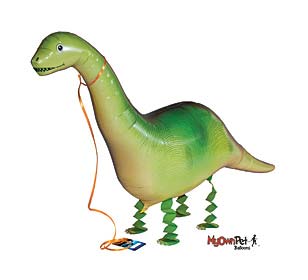
As noted, Supersaurus has appeared in many documentaries and in many other places. There was that website DinosaurDays.com, there was Mammals vs. Dinos, we saw a couple coloring pages and kids fact pages. We didn't see this yet though


or this
Yes, it's a balloon
or even this toy
Made by Bandai... crazy Japanese video game companies!
There's also a band called Supersaurus. I'll let you make your own conclusions about their music when you find it, check YouTube. Also, here's a video about Jimbo, the dinosaur in the Wyoming Dinosaur Center:

14 December 2011

Supersaurus 400th Entry

Oh!, that Vivian and Eddie Jones!
Supersaurus was found by Vivian Jones, no not this Vivian Jones or even that Vivian Jones. No, Vivian and Eddie Jones were Uranium prospecting after Word War II, looking in Wyoming for Uranium deposits they could sell to the US military in 1972, when they came across a large fossilized bone (there are other versions that state they were merely rock hounding as amateur geologists, but I think Jensen's version of the story is much more awesome). That bone turned out to be a scapularcaracoid, a shoulder girdle, from one of the largest animals to ever grace the face of the Earth. It wasn't until 1985 that James Jensen named the animal Supersaurus and not until the mid 1990's when the other two animals he named in that were found in the area, Ultrasaurus (Ultrasauros) and Dystylosaurus, were decided to be parts of Supersaurus specimens. in 1996, to be specific, a Supersaurus named Jimbo was unearthed in Wyoming that helped put the argument over the three species to rest and made them all one. Jimbo now lives at the Wyoming Dinosaur Center in Thermopolis, Wyoming.

13 December 2011

Is There Any News?

Supersaurus is as big in the recent (past 30 years) history of paleontology as it was in its era of plant eating domination. A gut as large as the one on Supersaurus certainly led to many eating competition prizes and now, all that fuel which created such an enormous dinosaur has led to a great deal of excitement in us far smaller creatures about what this giant was like and what we know about them. The bones are enormous, of course, and any paper that has made use of the bones has been forced to show them on whole pages and, where details of small segments of these enormous bones are required, without going anywhere near showing the entire bone on that whole page dedicated to the bone.

I think, despite the many papers and articles I found today that go into very good, fair, sometimes crappy, and even extraordinary detail about Supersaurus, I am going to stick with those papers that are always of the utmost importance to dinosaurs, effectively what we could consider their birth certificate into human culture: discovery, description, and naming articles and articles that step back years and years later and discuss the morphology of the species. To that end, the first paper that I will present is James Jensen's October 1985 article which ties Supersaurus vivianae and Ultrasaurus mcintoshi into a conspecific hierarchy, effectively eliminating U. mcintoshi from the vernacular, and making it a junior synonym, in favor of Supersaurus. Though this would actually happen later, after the name was changed to Ultrasauros, the groundwork for the name change was set by Jensen himself unintentionally. I am sure Jensen doesn't mind considering the third dinosaur he described in this 1985 article, Dystylosaurus edwini is now also considered to be a specimen of Supersaurus misnamed. Another interesting item from the article that has been revisited over the years is that Jensen repeatedly refers to Supersaurus as a Brachiosaur and Supersaurus is now known to exist within the diplodocid family. A minor detail that has been changed, but a very important detail as it is very important to the family tree of sauropods.

The second article, by David Lovelace, Scott Hartman (who does fantastic skeletal recreation that I have used to teach myself quite a bit), and William Wahl, discusses the morphology of Supersaurus and evaluates diplodocid phylogeny twenty two years after Jensen's article. Lovelace, Hartman and Wahl's 2007 article describes a new specimen of Supersaurus recently found and goes on, after describing it, to discuss osteology and shows an alternative placement for Supersaurus as an apatosaurid specifically, a subfamily of diplodocids generally not attributed to the Supersaurus genus. In fact, most places I have looked, and there may be a debate I do not know about concerning this placement, has Supersaurus in the diplodocid family in the subgroup diplodocinae where this paper makes the genus a part of the diplodocid family and the apatosaurine subgroup. I think I may have to shoot an email to Mr. Hartman seeking his opinion of their placement in that subgroup to more fully explain it to all of us. The article goes in to great detail on Supersaurus and sadly I do not have the time it would take to discuss it all, but there are some wonderful photos of bones and well done skeletals, as would be expected, used in the article. Take a good chunk of the day to at least skim the article, 18 pages is a lot of science reading after all, and I know you will learn a lot about the dinosaur and its family at the same time.

12 December 2011

Videos of A Giant

Supersaurus lived longer than 100 years at times, couldn't chew its food, and had a 35 foot long neck. I won't spoil all the facts these documentaries want to share with you today, in fact, I am not going to say anything more today. Watch and learn!


11 December 2011

Jim the Supersaurus

In 1996 the first complete, nearly completely complete, Supersaurus was found and, like Sue before him, was named. His name is Jim. Jim the Supersaurus. Jim the Supersaurus has links for the kids to look at.Kids can learn about Jim at Dinosaur Facts or they can learn about Supersaurus in general at Enchanted Learning and KidsDinos. Additionally, they can watch a video on it at Dinosaur Days. There are no coloring sheets today, sadly. I was trying to do something awesome for the kids today, but I'll have to research it during the week and try again next Sunday.