
STL Science Center

20 September 2012
On the Ground or In The Trees
Bambiraptor, whether a ground dwelling or tree living animal, has made its mark in popular culture. This is partly because it was initially found by a teenager and partly because the majority of science agrees that it was a feathered dinosaur. Even as a ground living bird Bambiraptor would be just as interesting to the world as it is as a link between birds and dinosaurs. The fascination with Bambiraptor has created a desire for a number of books geared toward children, teens, and adults as well. There are books of dot-to-dots along side in depth debates about the origins of flight in birds on the list of books which are about or discuss Bambiraptor in detail. Bambiraptor has also made it into the crafting world, and anyone can do these honestly; I built a reindeer a while back from the same website for my classroom at the time. One of its largest impacts, though, has been in the gaming world. It has been created in Spore, like many other dinosaurs, and has also appeared in Zoo Tycoon 2 and Tiny Village. Spore is up to the creator to decide how accurate their animal will be. Zoo Tycoon aims for as much realism as it can fit in. Tiny Village, on the other hand, is a cellphone based game adapted to iphones and Android phones about making a caveman village with prehistoric pets, and the prehistoric animals are fairly whacky looking for the most part. Check each one out:
Spore
Zoo Tycoon
 Tiny Village images of Bambiraptor


19 September 2012
Doing A Little Reading
Bambiraptor has a furcula, or a wishbone, and shares many other avian features with modern birds, almost more features than it shared with other dinosaurs. Much of the pelvic girdle and legs is highly reminiscent of other Dromaeosaurs like Velociraptor and Deinonychus. The fact that Bambiraptor has such a mixture of characteristics of both birds and dinosaurs is par of what has led to debates within the paleontology community, as well as outside, as to the exact nature and placement of birds in evolutionary history and their relationships to dinosaurs. There are those that claim all of the animals in the Dromaeosauridae as dinosaurs, and there are those that claim they are birds; some Creationists, by the way, claim that there is no argument and that no dinosaur ever had feathers, many citing Alan Feduccia's work and the argument in the paleontology community as 100% proof that paleontologists are making everything up. That is not really fair I suppose, it was mainly just this one article that claimed all that, but there are plenty that agree with the article. Feduccia's skepticism about the origin of birds lying in dinosaurs is supported by some prominent paleontologists in one fashion or another and Bambiraptor is one of those battlegrounds on which the two opposing sides fight, sadly. In part it is the make up of the bones of the Dromaeosaur family that help fuel arguments that they were only large flightless birds mimicking dinosaurs, which is an interesting argument, and part of the argument is much, much older and has to do with when and where dinosaurs and birds split originally in their independent evolutions.
The naming paper has a large section of the discussion devoted to discussing those bird-like elements possessed by Bambiraptor but, most likely due to the highly diversified authoring team, there is no directed dinosaur or bird conclusion as such. David Burnham would go on a few years later to present a thesis which presented the arguments for and against a dinosaur bird link, he also called Bambiraptor "a terrestrial runner" whereas the majority of other sources consider Bambiraptor an arboreal carnivore. His thesis, in the end, concluded the argument the way that Feduccia and Larry Martin have been siding on the argument; that dinosaurs and birds developed alongside one another and that birds did not come from dinosaurs. The evidence of the argument, we are, as the general public, assured exists, but we are not really granted access to the evidence either for or against this argument. The majority of what the public believes, therefore, must come either from the media, which is certainly dinosaur-bird heavy, or from reading or listening to the two sides of the argument and making our own opinions. I would like to keep the old theory as my own, but we will see what I see as I continue down this career path, and as such, I am trying to keep an open mind; though for now I still think of Bambiraptor as a dinosaur that may be a transitional form lingering on during the rise of true birds.
The naming paper has a large section of the discussion devoted to discussing those bird-like elements possessed by Bambiraptor but, most likely due to the highly diversified authoring team, there is no directed dinosaur or bird conclusion as such. David Burnham would go on a few years later to present a thesis which presented the arguments for and against a dinosaur bird link, he also called Bambiraptor "a terrestrial runner" whereas the majority of other sources consider Bambiraptor an arboreal carnivore. His thesis, in the end, concluded the argument the way that Feduccia and Larry Martin have been siding on the argument; that dinosaurs and birds developed alongside one another and that birds did not come from dinosaurs. The evidence of the argument, we are, as the general public, assured exists, but we are not really granted access to the evidence either for or against this argument. The majority of what the public believes, therefore, must come either from the media, which is certainly dinosaur-bird heavy, or from reading or listening to the two sides of the argument and making our own opinions. I would like to keep the old theory as my own, but we will see what I see as I continue down this career path, and as such, I am trying to keep an open mind; though for now I still think of Bambiraptor as a dinosaur that may be a transitional form lingering on during the rise of true birds.
18 September 2012
Late Start to A Paper Filled Tuesday
Thanks to our friend over at The Theropod Archive we have two places the original naming paper can be found for Bambiraptor. Scroll up just a teensy bit from this link, looking under Burnham et al., and you can find it rather quickly. I do have to say, though, that typically, as of late at least, links to Currie's PDF's on his homepage at the University of Alberta have been outdated or completely erased, so my advice is to go with the top PDF rather than the bottom one. Since I am running later than usual today I have not had time to read over it, but I am hoping to be able to this evening so I can discuss it in some detail tomorrow (I also have a test to study for and papers to grade, so it should be a fun filled day). Another paper I want to find time to read, also by Burnham, is hosted by the University of Kansas and is about, as Burnham's title states, Maniraptoran "Dinosaurs." Burnham's quotations are what make it of interest to me because they indicate, obviously I feel, that he is going to say something about the clade being, more than likely, much more avian than reptilian and I'm wondering if he may pose a separate evolutionary track. I just hope I have time to read it sometime soon. Taylor and Francis, hosting the Journal of Vertebrate Paleontology, which you have to subscribe to or buy per article, have a hosted paper on comparison of forelimbs of Deinonychus and Bambiraptor by Phil Senter published in 2010. The abstract looks a little technical so I imagine the article itself is a bit specialized, but I'll give a look-see sometime soon, though I will not be writing anything about it within the next 24 hours for sure.
17 September 2012
Behind the Scenes with Bambiraptor
Bambiraptor is behind the scenes in most documentaries. Once in a great while it will pop out without any warning or explanation as a nondescript feathered dinosaur in the background or in a trailer, but it is never discussed in depth in the course of a documentary. In part this is sad, mostly because it is an interesting dinosaur regardless of the debates about feathers and its placement in the family of Dromaeosaurs. Part of why it is not featured is more than likely on account of how little we do know about the animal. The skeletons we have have given us a lot of information, but there is a lot more to collect and there is the issue of feather evidence. Once there is a little more evidence for feathering there may very well be more documentaries in the future, but not for a while it seems.
16 September 2012
Bambiraptor: A Fawn For Kids
I actually found a website today that denounces Bambiraptor as a feathered dinosaur and goes further to argue that no feathered dinosaurs other than those which have legitimate fossil feather impressions existed with feathering. It goes on to argue that evidence of quill knobs are not enough evidence to make a statement about a dinosaur having feathers as well. In the end the whole website boils down to statements that twist words such as paleontologists saying things such as "Shuvuuia likely possessed a coat of feathers" and turning it into a statement, which the author says "in English means" that "Therefore, this dinosaur must have had bird feathers" even though the language above clearly states that the animal's covering is an educated, hypothesized, guess. The author states that the book consulted for the post never offers children a look at the fossils themselves and asks children to trust scientists and their "faith" that they're right. Enough about this sort of thing today.
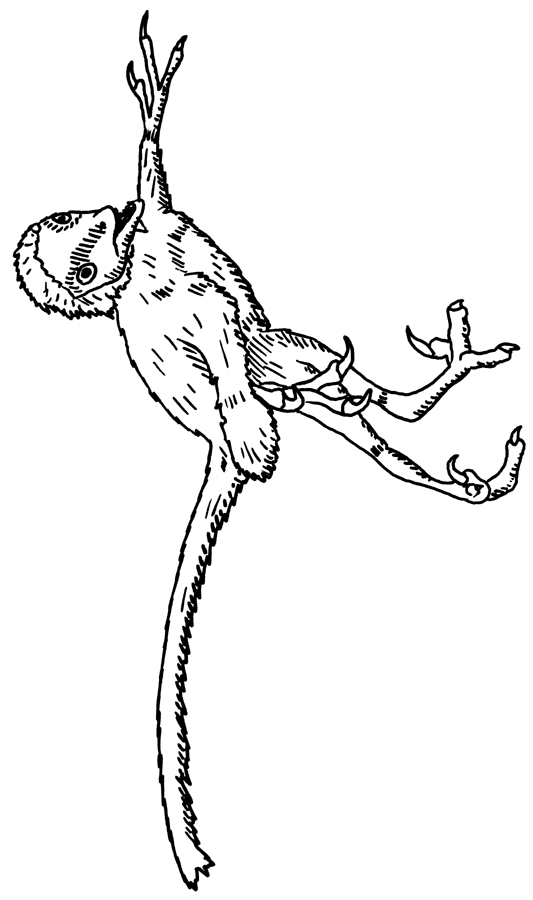
I think given the nature of children they can decide if they believe this dinosaur had feathers all on their own. They can look at the Dinosphere at The Children's Museum of Indianapolis' information site. They can also consult theDinosaurs.org's information about Bambiraptor. This site actually shows the fossils that have been found for children to look at, including the holotype skeleton which shows no feathering at all in it. There is not really anything to color today except this one picture, but it is better than nothing at all. Let the children look at Bambiraptor today and make their own conclusions from the fossils and everything they read, I am sure that they will make some very clever observations and surprise everyone no matter what they believe Bambiraptor looked like while it was a living, breathing animal.
I think given the nature of children they can decide if they believe this dinosaur had feathers all on their own. They can look at the Dinosphere at The Children's Museum of Indianapolis' information site. They can also consult theDinosaurs.org's information about Bambiraptor. This site actually shows the fossils that have been found for children to look at, including the holotype skeleton which shows no feathering at all in it. There is not really anything to color today except this one picture, but it is better than nothing at all. Let the children look at Bambiraptor today and make their own conclusions from the fossils and everything they read, I am sure that they will make some very clever observations and surprise everyone no matter what they believe Bambiraptor looked like while it was a living, breathing animal.
 |
| Taken from http://www.dinosaurier-interesse-2.de/ |
15 September 2012
Bambiraptor the Feathered
 |
| Artist Unknown at this time |
 |
| ©Scott Hartman |
 |
| ©Puntotu |
14 September 2012
Bambi Goes Cretaceous
 |
| Not the correct Bambi |
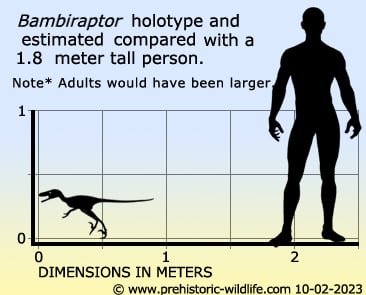 believed to be a juvenile of Saurornitholestes, but was, after the original description and the discovery of more partial skeletons, retained in a new genus and species. The holotype skeleton, in fact, is 95% complete, which is extremely rare, while the subsequent discoveries are far less complete; they comprise a few partial adult skulls and skeletons that are noticeably, but not much, larger than the juvenile. That juvenile rocks the scales at a whopping 4.4lbs (2kg), estimated, and approximately 90cm long, with some tail vertebrae missing which would probably make up about 10cm more, making the whole juvenile approximately 1 meter long (about 3.3ft). Thought to be arboreal, the Bambiraptor juvenile had a brain about the size of a small bird like a Blue Jay or Sparrow, making it fairly smart in the terms we generally think of for dinosaurs. It's brain, though, is thought to have been geared toward agility and higher thinking skills, as high as most birds get of course remember, as these parts of the brain cavity, particularly the cerebellum's area in the brain cavity, were larger than the rest of the brain.
 |
| Finally, the correct Bambi |
13 September 2012
Life at the Popular Watering Hole
Being bizarre works for Amargasaurus. It works so much that there are toys, PBS shows (as well as toys based on Dinosaur Train), and even Dinosaur King materials which feature Amargasaurus. In my opinion the kids' shows are more important than most other forms of dinosaur popularity, as I have stated many many times now. The reason for this remains that the children are the future of paleontology. Somewhere some child is taking in all the Amargasaurus materials that the world has to offer- Dinosaur Train, Dinosaur King, toys, coloring, Dinosaur King cards, Dinosaur King video games- and that child is going to grow up wanting to study that mysterious dinosaur. Amargasaurus is not showing up in the kitchen like some other dinosaurs, but it is still making quite an impact on the culture of the world in museums and animatronic shows, for instance. Some day, perhaps, we will learn enough about this dinosaur to make a sure guess about its soft tissue, and maybe some day we will even be lucky enough to find the rarest of the rare in dinosaur skeletons: a mummified Amargasaurus. Until that time, however, our imaginations and scientific information will have to continue to shape the many theories shown in the many adaptations of Amargasaurus in the popular world.


12 September 2012
Amargasaurus and Those Spikes
Gregory Paul has come out, in 2000 actually the first time, and said that there is pretty much no way that Amargasaurus' spikes supported a sail structure; I have paraphrased grotesquely. I tend to agree with that idea, and with another part of his theory behind those spikes, but he raises one interesting idea which I find quite interesting and seems quite plausible that I, and most others probably, have not given much thought to when considering the neural spines possessed by Amargasaurus.One of the points of Paul's theory, mentioned briefly in his latest literary work The Princeton Field Guide to Dinosaurs, is that the neural spines, while used as a deterrent against large predators, could also be used to communicate. He notes that they "may have been used to create [a] clattering noise display" (page 188). Though his intent is to make the reader aware of this as an intimidation tactic, if this was a regular behavior for this species it more than likely would have also been used as an alarm to danger as well as way to recognize the presence of a herd or to call a herd; for example, in the case of an animal being separated during a predatory attack or having simply lost the herd while feeding. This would come in handy if studies (I'm looking for these purported studies actively) suggesting sauropod vocalizations were geared more toward hissing than lowing in the way of modern cattle are correct; sauropods have always had a rather decidedly bovine-like voice in Hollywood, so it is very hard to imagine them making hissing sounds actually. Paul does mention (page 37) that the long necked sauropods' long tracheas should have been able to create and emit low frequencies and therefore, using Paul's viewpoint, the rattling of the spines would have been an auxiliary mode of communication over distances rather than a primary form of communication.
Those spines, however, would probably have produced more of a thud sound due to their shape behind the cervicals. This is probably the reason that Paul has, in his illustrations, combined the idea of the camel-like hump behind the shoulders with the free keratin sheathed spikes on the cervical vertebrae. As noted yesterday in the linked SVPOW article, those dorsal neural spines are somewhat deep paddle shaped bones as opposed to the longer horn like cervical neural spines. It is pretty interesting actually that Amargasaurus, as interesting as it is already, would have such a diverse network of spines on its vertebrae.
References:
Paul, G. S. The Scientific American Book of Dinosaurs, New York, NY.: St. Martin's Press., 2000
Paul, G.S., The Princeton Field Guide to Dinosaurs, Princeton, NJ.: Princeton University Press, 2010
Those spines, however, would probably have produced more of a thud sound due to their shape behind the cervicals. This is probably the reason that Paul has, in his illustrations, combined the idea of the camel-like hump behind the shoulders with the free keratin sheathed spikes on the cervical vertebrae. As noted yesterday in the linked SVPOW article, those dorsal neural spines are somewhat deep paddle shaped bones as opposed to the longer horn like cervical neural spines. It is pretty interesting actually that Amargasaurus, as interesting as it is already, would have such a diverse network of spines on its vertebrae.
References:
Paul, G. S. The Scientific American Book of Dinosaurs, New York, NY.: St. Martin's Press., 2000
Paul, G.S., The Princeton Field Guide to Dinosaurs, Princeton, NJ.: Princeton University Press, 2010
11 September 2012
Amargasaurus in Print
Amargasaurus' initial print debut, a paper by Leonardo Salgado and Jose Bonaparte, is fantastically detailed with thorough descriptions of the bones found and compared to known Dicraeosaurid bones from Africa. Speculation into the use of some of the more fantastical elements of Amargasaurus' bones such as the tall neural spines are fairly ignored and the facts as they are take center stage. Some interpretation is made, but it retains the straightforward detail of scientific observation, which is very professionally done. Additionally, Salgado went on to write another paper some years later, this time with Jorge Calvo, examining the cranial structure of Amargasaurus. This paper I have not yet had time to sit and read, though I am quite interested to discover what new things Salgado and Calvo have to say about Amargasaurus since Salgado and Bonaparte's initial discovery. Hopefully I will have time today sometime and I can update this accordingly. Either way, don't ruin it for me by telling me in advance! As for newer papers, I have not found any readily available, though I have found snippets of comparison and discussion around Amargasaurus in other papers. One resource that is current are these blog entries on SVPOW about the shape of the neural spines and how an extant critter has offered some insight into the use of similar neural spines. The guys at SVPOW are real professionals too, and they offer some well thought out discussion about these topics, so they are certainly worth checking out if you never have.
10 September 2012
Amargasaurus Movies
Amargasaurus is in quite a few amateur videos and it pops up in Dinosaur Train as mentioned yesterday as well as the World Book's Youtube channel. The amateur videos range from tributes to Spore videos with a few amateur question and answer videos in between. There are not any documentaries at present which feature Amargasaurus heavily or exclusively, even the National Geographic special on bizarre dinosaurs does not mention Amargasaurus too much, though the magazine article which preceded it did discuss Amargasaurus at length. Thanks in part to its rather strange composition, Amargasaurus has been re-created many times as an animatronic dinosaur, as it is clearly an attention getter and crowd pleaser when people can see it move about with its unique body. Interestingly enough, the version of the spines reproduced in the animatronic versions of Amargasaurus are typically of the use of the spikes as structuring for the sails along the back of the dinosaur. Lastly, there is a fairly awesome edition of speed drawing, we have shown this before with dinosaurs in the past, of Amargasaurus. Those of us not acquainted with speed drawing only need to know that it consists of a sped up drawing of something, in this case Amargasaurus. It is labeled, in the video itself, Camarasaurus, but it is very clearly not even close to being a Camarasaurus.
09 September 2012
Amargasaurus: Keeping Children Busy All Day Today
You could almost leave your children alone all day today if they like Amargasaurus. We have dinosaur fact pages, as we often do, like KidsDinos and Science Kids. They can color until they're blue in the face today, of course most of the available black and white illustrations of Amargasaurus are not meant to be coloring pages, but since when has that stopped anyone? Coincidentally, my official standpoint on using other people's art to color is ask for the artist's permission to print it out and color it and please do not post it online, your coloring, without the artist's permission. Additionally, if you see your own art in that bundle of links and you don't want it there, let me know and I'll fix that. Anyway, the kids could also go buy some toys, with whatever they money they have earned or gotten as gifts lately, I mean. There are a lot of videos for kids to watch today too, not that you want your computer to babysit children ever. There is an episode of Dinosaur Train that has a segment on Amargasaurus which you can watch together on PBS and also has the science section with Dr. Scott at the end of the first half of the episode in which he discusses Amargasaurus briefly. In order to see the science bit though you have to watch the whole episode on Netflix or some other site, unless you want to wait for PBS to air that particular episode again. The World Book Youtube channel takes care of that if you have no way to see Scott Sampson's version of the science facts, though it is a little more in detail than the PBS short.
08 September 2012
Amargasaurus the Beautiful
 |
| ©Casliber, taken from Wikipedia |
 |
| ©ArthurWeasley, taken from Wikipedia |

 |
| ©Nobu Tamura |
 |
| Courtesy National Museum of History, London |
07 September 2012
Porcupine, Camel, or Sailback?
 |
| ©Luis Rey |
06 September 2012
Literary Popularity
Megalosaurus has not made much of a splash in the film world, though notable exceptions such as the television show Dinosaurs from the early 1990's do exist; anyone that has watched it knows that the show reminds us often through the voice of the father of the dinosaur family that Earl Sinclair is indeed "the mighty Megalosaurus." Aside from this show, though, few other shows exist which have shown Megalosaurus, the Dinosaur King cartoon being the only other show that I have definite knowledge of showing Megalosaurus at least once if not in America than at the very least in Japan. Megalosaurus actually appears prominently in literature more than it has on film. In the 1984 novel Carnosaur one of the main dinosaurs that is unleashed upon the world, in a genetic experiment gone awry a good six years before Jurassic Park was written, is a Megalosaurus. The author, John Brosnan, apparently holds little ill feelings toward the hit that Jurassic Park became though his novel came before and was quite similar. Today he gets the limelight though, because his novel featured a Megalosaurus where the other never even mentioned the dinosaur. Another novel which mentions Megalosaurus is actually almost 200 years old now. Between 1852 and 1853 Charles Dickens published a novel in series entitled Bleak House which featured the opening lines
References
Dickens, Charles, Bleak House, Project Gutenberg eBooks, http://www.gutenberg.org/files/1023/1023-h/1023-h.htm 2012
Implacable November weather. As much mud in the streets as if the waters had but newly retired from the face of the earth, and it would not be wonderful to meet a Megalosaurus, forty feet long or so, waddling like an elephantine lizard up Holborn Hill.Dickens was a master of the English language (and between the ages of 16 and 18 one of my greatest enemies though I will swear to the fact that my writing and speaking is much better for having to suffer through reading so many Victorian novels in high school) and his inclusion of a newly popular dinosaur in a Victorian novel is almost comical, but given the scientific and popular view of dinosaurs at the time it was written, this description of the weather is very powerful and, since it is mostly lost on us now that we have a different view of dinosaurs, is not distinctly understood to mean swampy and mucky like it did back when it was written. Still, well written and a good use of our poor old characterization of Megalosaurus.
References
Dickens, Charles, Bleak House, Project Gutenberg eBooks, http://www.gutenberg.org/files/1023/1023-h/1023-h.htm 2012
05 September 2012
Interesting Things About Megalosaurus
We could spend all day on interesting points in the evolution of Megalosaurus from mistaken quadrupedal dragon like reptile to hulking Middle Jurassic theropod. The original name for a femur of Megalosaurus that was found was Scrotum humanum simply because the lower end of the femur, which was all that was found, look like human genitalia; I think some anatomists of the late 18th and early 19th century were sometimes, while being great minds, terrible perverts. Thankfully in the 1990's when a case was made to have this scientific name erased it was decided by the ICZN, the community that approves and disagrees with scientific naming, when the secretary of the committee decided that the name was a label for an illustration and not a binding scientific name. Imagine if it had stuck and taken precedence over Megalosaurus; that would be one dinosaur we could not discuss in public education ever.
The most unfortunate thing about Megalosaurus is that nearly 200 years later there have still been absolutely no complete skeletons of this dinosaur recovered from the European soils in which its fragments have been found. The fragmentation of the dinosaur has been a problem in the past, leading to the creation of many new species since named dubious or reassigned into other animal's genera. Melting pot that it once was, Megalosaurus is slowly being sorted out and has, generally, been cleaned of most dubious material by now. Until the day we have a complete skeleton, of course, having a complete picture of Megalosaurus is almost impossible and we may never, if we do not unearth a complete skeleton, even know what it actually looked like. Paleoartists do a good job filling in the gaps for now however.
The most unfortunate thing about Megalosaurus is that nearly 200 years later there have still been absolutely no complete skeletons of this dinosaur recovered from the European soils in which its fragments have been found. The fragmentation of the dinosaur has been a problem in the past, leading to the creation of many new species since named dubious or reassigned into other animal's genera. Melting pot that it once was, Megalosaurus is slowly being sorted out and has, generally, been cleaned of most dubious material by now. Until the day we have a complete skeleton, of course, having a complete picture of Megalosaurus is almost impossible and we may never, if we do not unearth a complete skeleton, even know what it actually looked like. Paleoartists do a good job filling in the gaps for now however.
 |
| ©Alexander Lovegrove |
04 September 2012
History Lives!
Rarely do I find description papers older than the 1970's online to share with the voracious readers of this page.Today I am exceedingly pleased to share not one, but two 19th century papers written about Megalosaurus. The fist paper to be shared today is a copy of the original paper by Reverend William Buckland addressed to the Geological Society and dated February 20th, 1824. In this paper Buckland asked for the society to hear his arguments and description of a new genus and species of prehistoric animal and to aid in disseminating the information to the public that they might learn about this newly discovered animal. He describes the lower jaw fragment and teeth held therein but then also goes on, which I did not mention previously, to describe ribs, partial pelvic elements, vertebrae, and appendicular elements that have been assembled from many individuals and a few localities. Some of these parts have been re-examined over the years, but in this instance they are all used to describe Megalosaurus, whether they have been reassigned since I do not personally know.
The second paper is from the famous Joseph Leidy and is dated 1868 in volume 20 of the Proceedings of the Academy of Natural Sciences of Philadelphia. Leidy writes in his paper a newer description of a fragmented jawbone different from the one described by Buckland, and adds his own commentary on the shape of the jaw, head, and overall animal. Leidy's jaw fragment was housed in the Academy's museum. He goes on to describe relationships other animals may prove to have relating to Megalosaurus, some of which we know for a fact are not correct now. Eventually Leidy trails off onto other dinosaurs including a hadrosaur, but not after describing the supposed Megalosaurus jaw fragment in detail.
The final papers are a new set of descriptions of another species of Megalosaurus. Today only Megalosaurus bucklandii is recognized as a species, but at one point in the not too distant past there were at least five species partially or at least trivially recognized until either further evidence or re-examination of the remains reassigned those other species one way or another. Michael Waldman's 1974 description is of an animal he called Megalosaurus hesperis was actually redescribed as recently as 2008 and, in holding with the norm of reassigning Megalosaurus remains, Roger Benson renamed Waldman's Megalosaurus as Duriavenator hesperis.
03 September 2012
Movie Time
Megalosaurus has been on camera many times, though not as many as Tyrannosaurus Rex and some more popular and better understood theropods. National Geographic did a short piece on Megalosaurus, focusing mainly on how paleontologists once interpreted dinosaurs through looking at the original illustration and reconstructions of what was thought to be the Megalosaurus body.
Megalosaurus was not as large as Tyrannosaurus though, and has since lost major starring roles in many movies including the original King Kong and even the movie Carnosaur, which is based off of a book of the same name where the main "monster" character was actually Megalosaurus. Carnosaur, by the way, is a ridiculously funny movie, though it is trying to be serious and it is not the author or the movie maker's faults really. That movie just had the unfortunate destiny of coming out after Jurassic Park even though the book was written before Jurassic Park the book. Anyway, getting back to Megalosaurus, its biggest starring role to date was on a Jim Henson Productions show which began airing in 1991 and was one of the best sitcoms ever with no human beings on screen (or is it the only sitcom ever with no human beings on screen?).
Megalosaurus was not as large as Tyrannosaurus though, and has since lost major starring roles in many movies including the original King Kong and even the movie Carnosaur, which is based off of a book of the same name where the main "monster" character was actually Megalosaurus. Carnosaur, by the way, is a ridiculously funny movie, though it is trying to be serious and it is not the author or the movie maker's faults really. That movie just had the unfortunate destiny of coming out after Jurassic Park even though the book was written before Jurassic Park the book. Anyway, getting back to Megalosaurus, its biggest starring role to date was on a Jim Henson Productions show which began airing in 1991 and was one of the best sitcoms ever with no human beings on screen (or is it the only sitcom ever with no human beings on screen?).
02 September 2012
Megalosaurs Is Well Known with Children
I said yesterday that any generic bag of plastic dinosaurs usually holds a dinosaur that could certainly be Megalosaurus. That is certainly true. Additionally, there have always been toy dinosaurs that are labeled specifically as Megalosaurus. Typically they have been tail dragging green dinosaurs vaguely reminiscent of Godzilla with short stubby heads full of triangle teeth, but they have become slightly more modernized with the changing view of dinosaurs over the years. Thankfully, however, kids today do not have to rely on just their toys to learn about their dinosaurs. They have internet resources like KidsDinos and Enchanted Learning (complete with a not as awful as usual illustration of Megalosaurus that can be colored) and even Science for Kids has entries on Megalosaurus. Kids can sit down and play or watch Dinosaur King today and potentially see or use their Megalosaurus cards, of which there are three versions. Dinosaur Train, oddly, has not been inclined to add an episode with Megalosaurus. Given that it was the first described dinosaur it is quite odd indeed that the show has not approached the subject. Regardless, there is an awful lot to do today with the children in your life on this Labor Day weekend, if you are in the U.S., or just on this Sunday if you are not.
01 September 2012
Mighty Megalosaurus
 |
| Megalosaurus at the Crystal Palace |
 |
| ©Nobu Tamura |
 |
| ©Sergey Krasovskiy |
Subscribe to:
Posts (Atom)