STL Science Center

30 April 2013
Discovering Staurikosaurus
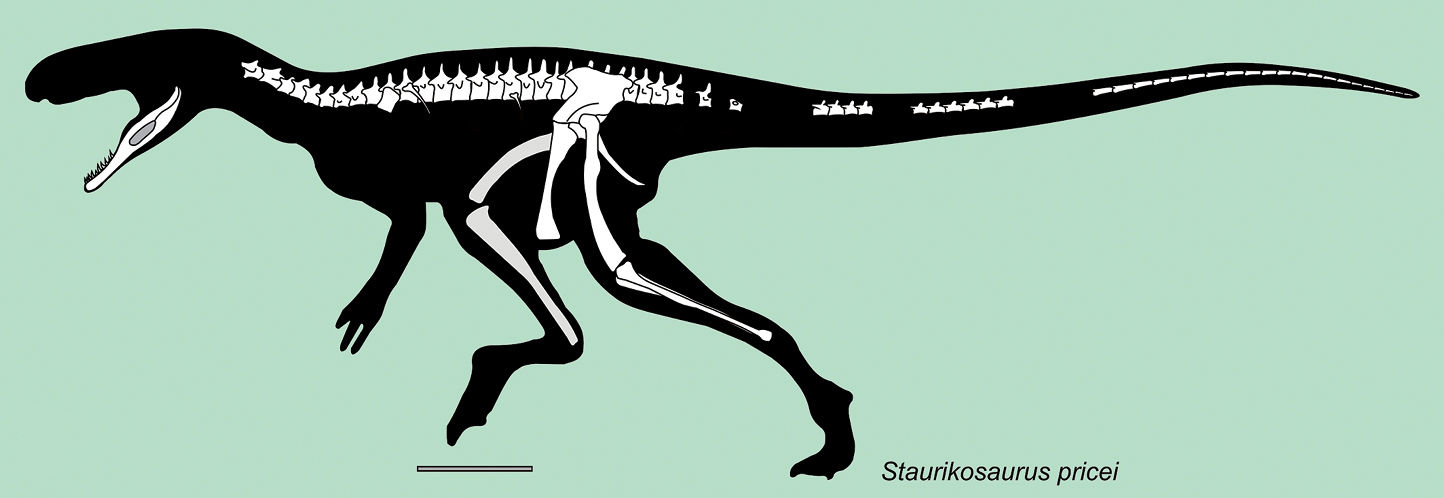
Staurikosaurus was named in 1970 and discovered a while before that; 1936 to be exact. Edwin Colbert, the American that named the dinosaur, had the fortune of having the specimen loaned to him for study. His description and comparison with other materials lead to the discovery that this "archosaurian reptile" was one of the earlier dinosaurs of the Triassic. He named his new discovery after the Southern Cross, a constellation, and after the man responsible for the collection of this and many other discoveries in the Brazilian Triassic soils. His initial description of the material is very in depth and contains some nice plates; there is a combination of illustrations and photographs in the paper. Another paper which may warrant attention is a slightly newer paper by D.B. Brinkman and Hans-Dieter Sues. Their paper identifies and describes a Staurikosaurus sp. from Argentina's Ischigualasto formation. They also describe the relationships between Herrarasaurus and Staurikosaurus as sister taxa as well as confirm the placement of Staurikosaurus within the dinosaurs. There are a few other papers out there, but I think these two are good for one day as they are both a bit heavily detailed.


29 April 2013
Fun with Art Snippets
28 April 2013
Staurikosaurus for Kids
Staurikosaurus has links for kids, which is pretty neat for a little understood early dinosaur. Thankfully, the Dinosaurs for Kids site has a nice quality page that is easy for kids to garner information from. Coloring pages are a little bit lacking, but that may have more to do with the fact that Staurikosaurus is still a little known dinosaur. The Dino Directory from the Natural History Museum of London also has a page set up for some facts that are easy for kids to read. Their size chart looks a little bit off, though; the Staurikosaurus is a bit larger than it probably should be.
27 April 2013
The Completed Incomplete Skeleton
 |
| Oscar Alcober, Ricardo Martinez; retrieved from Wikipedia |
 |
| ©Dmitry Bogdanov |
 |
| ©Nobu Tamura |
26 April 2013
Journeys in the Triassic

25 April 2013
Panoplosaurus the Loved
 |
| Japan loves dinosaurs! |
24 April 2013
Lambe's Next Discovery
As has been discussed multiple times here, Lawrence Lambe was a prolific discoverer and describer of dinosaurs. Fortunately for him any rivalries he was a part of were not nearly as high profile as Marsh and Cope, which allowed him to focus a bit more on accuracy than volume; I think of the Marsh and Cope volumes of descriptions as having "machinegun accuracy" as opposed to the idea of one shot, one kill. Lambe was not, however, more often correct than Marsh or Cope, as the science has tweaked even his discoveries and ideas over the past century. Regardless, the point of bringing up Lambe is that we have his initial descriptions of this animal and can therefore look at the material secondhand rather than via many other sources. Over 200 scutes of armor, a good portion of a fore and a hind limb, a good portion of the cervical vertebrae articulated with the skull, pelvic and shoulder girdles and thoracic vertebrae were discovered together and delivered to Lambe. Lambe, however, did make an interesting mistake by placing Panoplosaurus, now known to be a Nodosaur, in the Stegosaur family (Stegosauroidea); he also assigned Euoplocephalus, another ankylosaur, to the stegosauria. Contained in the in depth descriptions of the skull we find that Lambe measured individual teeth in the skull and compared them to Stegosaurus, leading, in part, to his justification of this nodosaur as a stegosaur.
Lambe was not completely off, though, as the current convention holds that Stegosauria and Ankylosauria make up the clade Thyreophora as the Eurypoda (Scelidosauridae is also included outside Eurypoda but within Thyreophora). Lambe's attention to the detail of the armored scutes probably provided some of the best evidence, in later years, for the partitioning of the Eurypoda into Stegosauria and Ankylosauria, interestingly. I wish I had an exact paper to point to in reference to this change. Alfred Romer's 1956 Osteology of the Reptiles is widely considered, however, to be the definitive text for establishing Ankylosauria as a suborder within Thyreophora (Coombs and Maryanska. He divided the over 200 scutes into 7 major divisions; 1) Large plates; 2) Medium sized variable dimensions; 3) Moderately small keeled; 4) Small rectangular; 5) Small polygonal; 6) Small keelless; and 7) Irregularly shaped ossicles. He also included plates of the scutes, but my favorite plate is of the skull looking from front to back. Check it out:

References for today:
Lambe was not completely off, though, as the current convention holds that Stegosauria and Ankylosauria make up the clade Thyreophora as the Eurypoda (Scelidosauridae is also included outside Eurypoda but within Thyreophora). Lambe's attention to the detail of the armored scutes probably provided some of the best evidence, in later years, for the partitioning of the Eurypoda into Stegosauria and Ankylosauria, interestingly. I wish I had an exact paper to point to in reference to this change. Alfred Romer's 1956 Osteology of the Reptiles is widely considered, however, to be the definitive text for establishing Ankylosauria as a suborder within Thyreophora (Coombs and Maryanska. He divided the over 200 scutes into 7 major divisions; 1) Large plates; 2) Medium sized variable dimensions; 3) Moderately small keeled; 4) Small rectangular; 5) Small polygonal; 6) Small keelless; and 7) Irregularly shaped ossicles. He also included plates of the scutes, but my favorite plate is of the skull looking from front to back. Check it out:

References for today:
Coombs, W.P. and Maryanska, T. (1990). Ankylosauria. In Weishampel, D. B., Dodson, P., & Osmólska, H. (Eds.). . The Dinosauria. (456-483) Univ of California Press.
Lambe, L. M. (1919). Description of a new genus and
species (Panoplosaurus mirus) of armored dinosaur from the Belly River
Beds of Alberta. Transactions of the Royal Society of Canada series, 3(13), 39-50.
23 April 2013
Systematics and Panoplosaurus
Kenneth Carpenter wrote, a few years ago (1992 was the original publishing year), an article in a text collectively called Dinosaur Systematics: Approaches and Perspectives. The text as Carpenter writes it, though you cannot read it all online, uses Edmontonia and Panoplosaurus as examples for Ankylosaur systematic arguments. Carpenter has published many other writings concerning Ankylosaur systematics as well and discussed Panoplosaurus in many of the articles. Most of his published articles, unfortunately, appear in edited anthologies and are therefore unavailable online. Coombs and Maryanska also discuss Panoplosaurus' anatomy in the original edition of The Dinosauria; the newest edition Ankylosauria section is penned by Vickaryous, Maryanska, and Weishampel and, of course, still mentions Panoplosaurus. Paul's Princeton Field Guide to Dinosaurs also mentions Panoplosaurus and that it enjoyed forested floodplains, swamps, and marshes. While the cartoon yesterday noted that Tyrannosaurs were the main threat to Panoplosaurus, Paul makes note that the main threats to Panoplosaurus were most likely Daspletosaurus and Albertosaurus. Not many scholarly papers are uniquely geared toward Panoplosaurus, which is okay, but still gives us little to read if we do not own one of these books.
22 April 2013
Earth Day Post!
21 April 2013
The Children's Nodosaur
Panoplosaurus is a child-friendly dinosaur. Not only does it look as though it would make a great pet; in the human world this is the sort of dinosaur that would undoubtedly be selectively bred as a lap-dog. Perhaps that is the reason they are so well represented in the child-friendly web pages around the internet. Our favorite child-friendly fact page at Kids Dinos has page set aside with quick facts. Additionally, the coloring page needs of children, and adults, can be taken care of over at Enchanted Learning. As usual, the site allows for online coloring as well as printing the picture and coloring offline; I hate the waste of paper, but I love the feeling of colored pencils, so I am typically torn equally when presented with the option. There is not much in the form of toys/models available for sale, but for our friends that know how to crochet, and I wish I did right now, you can make your own toy Panoplosaurus with these crochet patterns available for purchase. Grandmas usually love knitting and crocheting, not that younger people do not, and they would probably love to make one for you, and with you even, if they know how to do those things!
20 April 2013
A Long Day Ended
 |
| ©Brian Franczak |
19 April 2013
A Panoply of Armor
 |
| Uncredited (I am on the lookout for it) |
18 April 2013
A Good Giant Raptor Week
 |
| Looks a little naked though |
17 April 2013
Close Cousins?
 |
| Utahraptor on top, Achillobator below. Used with permission as noted on the image. Taken from A Field Guide to Mesozoic Birds and Other Winged Dinosaurs |
Achillobator was an Asian animal, in modern context, and had a different landscape for a home. The Mongolia of 90 Mya was a semiarid desert, kind of like some of it is today. The Utah of Utahraptor, which is considerably older at 125 Mya, was a marshy mud flat with open tracts of land. The squatness of both animals was most likely an adaptation that favored the reduction in length of hindlimb to produce the ability to hide closer to the ground in the low scrub environments in which they lived. Utahraptor lived in a time devoid of large predators; allosaurids, ceratosaurids, and megalosaurids had all disappeared from the landscape during the existence of Utahraptor. Large carnosaur reintroduction into the landscape likely led to a loss of niche and subsequent dwindling of population and eventual extinction of Utahraptor. Achillobator lived alongside many other carnivores, though. Until we have a better range of existence data for Achillobator we cannot really surmise the events leading to its disappearance from the fossil record.
Reference of the day:
Martyniuk, M. P. (2012). A Field Guide to Mesozoic Birds and Other Winged Dinosaurs. Pan Aves.
16 April 2013
Books, Birds, and Elusive Papers
Scientific writing. I am still trying to wrap my brain around it. Over my lifetime I have developed a style, and it can be seen here quite well, but lately I have been tasked with writing scientific papers and they have not been pretty. One would think the more I read the better I would get at writing in that style, but not quite so yet. That makes the days I discuss papers that much more important in my own personal development. Today I, unfortunately, do not have many papers to share. I still have not found a way to get the original naming paper, not by the end of this week at least, but there are other essays and papers that refer to Achillobator in them. There are two papers that discuss evolution in Gondwana of dromaeosaurs and a paper on evolution of the dromaeosaur tail. The paper on Gondwana also describes a new Patagonian theropod (as of 2009). That theropod was named Austroraptor cabazai in the paper. The paper on dromaeosaur tail evolution also discusses and names a new dromaeosaur from Utah. Two specimens were not named but the third specimen was name Yurgovuchia doellingi. Achillobator comes into play in these papers in that the discussion of evolutionary lines in both papers mention Achillobator. Both Greg Paul's Princeton Field Guide to Dinosaurs and Matt Martyniuk's recently released Field Guide to Mesozoic Birds and other Winged Dinosaurs contain entries on Achillobator. Martyniuk's entry is longer and speculates a little on behavior inferred from the skeleton. Additionally, Martyniuk has illustrated a squat little Achillobator to accompany the entry (Martyniuk's "field guide" is much more like a modern fauna field guide in respect to illustrated specimens with entries).
15 April 2013
Not A Video Day
 |
| ©Jaime A. Headden (cropped for today) |
The legs of Achillobator, despite the overall size of the animal, are quite small. Tibia and tarsus both are extremely short compared to the femur, though, admittedly, the heads of the tibia and tarsus both appear to be either missing or broken and chipped (though I have to admit I am going off of 2nd hand illustrations still). Shorter legs generally require higher energy consumption than longer legs to cover equal distances. The Achilles' tendon of Achillobator, obviously lending itself to the name, was reported as having to have been rather large, however, even on the shorter leg. The large tendon and the short leg most likely packed a rather large punch, causing great damage through the arc of the swinging motion of the leg. Not possessing as much speed but, rather, being more like the muscle laden Utahraptor, Achillobator was probably much more likely to wrestle and bring down prey with power than tiring it out in pursuit. This, then, would also make it much more likely to be an ambush predator like a lion rather than a pursuit predator like a cheetah. Of course, this is not necessarily the view put forth by the paper, but I cannot state the author's viewpoint as I still do not have a copy of the paper.
14 April 2013
A Nice Day for Coloring
After a very windy night I am quite happy to say I have quite a few good things to share today. I do not want to go into anatomy today; I know I said a few days this week I may not do the "normal" themed topics of the day. Today is not one of those days. I have quite a few good links and pictures for today. First, let me say that there are quite a few bad links too. The Natural History Museum of London, for instance, has a pretty good set of information, until you get to the specific epithet, which is wrong. It could just be a spelling error, so let us not dwell on it! Another almost awesome fact site is found at AgeofDinosaurs.com. The only issue with their facts is that they do not tell the whole story of the discovery, instead using the year of publication as the year of discovery. Putting the two sites together and ignoring the two little mistakes makes for a good collection of facts. Combine those with these two coloring pictures and you have a good day to explore a new dinosaur with your loved ones:


 |
| Artist's Page |
13 April 2013
Looking at Skeletons
 |
| ©Jaime A. Headden |

 |
| ©Jaime A. Headden Key to pelvises: A, Deinonychus antirrhopus; B, Adasaurus mongoliensis; C, Unenlagia comahuensis; D, Achillobator giganticus; E, Microraptor zhaoianus; F, Velociraptor mongoliensis; G, Sinornithosaurus millenii; H, Rahonavis ostromi; I, Bambiraptor feinbergorum; J, Archaeopteryx lithographica; K, Sinovenator changii. |
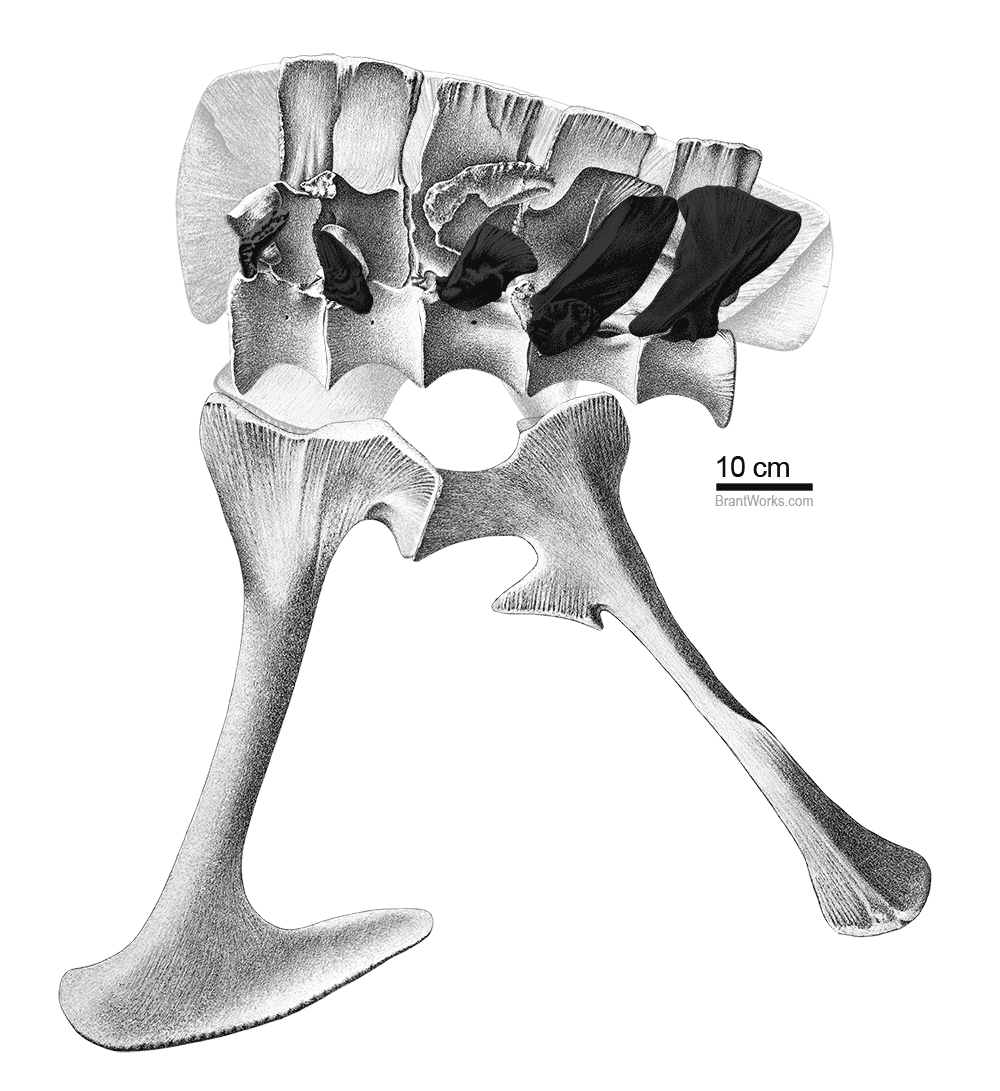
References
Headden, J. A. (2002). Achillobator: Theropod
Puzzle. Retrieved April 13, 2013, from Qilong:
http://qilong.8m.com/Achillobator.html
12 April 2013
Tackling Another Tough Opponent
Long time readers know that I enjoy, perhaps even love, taking on difficult cases from time to time around here. This is actually becoming slightly more normal as we get lower in the popularity barrel of dinosaurs. When we first started out the Triceratops and T. rex icons still stood before us and there were vast fields of papers, opinions, models, and other research to draw upon. Then we found our first few "iffy" animals; dinosaurs that were in doubt or, like Monoclonius, had actually been relegated (reassigned) to other genera and referred to other species. This week we shall continue looking at a problem child, in some eyes still despite some positive arguments for the validity of the subject, of the dinosaur world. At approximately 16 feet (4.9m) long and possessing bones that seem to make it drift up and down the family tree of the maniraptorans, this week's dinosaur was called Achillobator giganticus. The animal was named based on the fact that the Achilles' tendon would have been enormous in this animal and the word "bator" in Mongolian means hero. The specific epithet giganticus kind of speaks for itself, I think, in relation to what we will see of it and how it related to other maniraptorans. The trouble that has surrounded this large animal is that the bones, those bones that cause its relationship to winnow up and shimmy down the family tree, are characteristically in many different positions of expected development and this has led to the cry of "CHIMERA!" by some in the paleontology community over the years. During this week we will look over these bones and hopefully by the end of the week (I may need to tweak some of the days' themes to cover everything unique about this animal), we will all be able to form our own thoughts on the validity and perhaps even a generalized relationship of Achillobator with other maniraptorans.
 |
| ©Matt Martyniuk |
11 April 2013
The Charismatic Stego
From How to Draw Incredible Dinosaurs to its inclusion in Dinosaur King, Gigantspinosaurus has been made quite welcome in the popular culture of the world. Considering that it is little understood and the exact physical orientation of its namesake spikes are still debated in many circles, it is interesting that it is popular already. In part it owes its face to the public to the fact that it has been around as long as it has even with its "dubious" name being out there for the first half of its existence (in our knowledge that is of course). Strangely, however, I cannot seem to find toys and models of Gigantspinosaurus, and we can all admit that that would make a fantastic toy/model. There are a myriad of Dinosaur King cards that depict Gigantspinosaurus, but that is a little bit different; a card game is not the same as a 3-D model. There was this promotional piece from Dinosaurs Unearthed, but that does not really qualify as a mass market toy. Spore, though I could not find videos this week, does have some creators that have engineered little Gigantspinosaurs, like the one found in this image.
Subscribe to:
Posts (Atom)