
STL Science Center

30 June 2013
Gentle Paralititan


29 June 2013
Planets of Dinosuars
 |
| Screen capture from Planet Dinosaur |
 | |
| Illustrator unknown |
28 June 2013
Tidal Giants
 |
| ©Dmitry Bogdanov |
27 June 2013
Fossil for Sale
The arguments for and against the sale of fossils are all over the map; much like any other debate ranging from guns to religious freedom and beyond. Deltadromeus is one of those dinosaurs that have teeth for sale online. Despite anyone's stance on fossil ownership, that is pretty interesting. The teeth are expensive as well. Considering that a skull has yet to be found it raises a few eyebrows and important questions the most important of which is probably something akin to "How do we know that they belong to Deltadromeus?" Apparently the authenticity paper that comes with the teeth is proof enough for some people, but without a skull I am a bit skeptical. If we did not know what a dachshund's teeth looked like I could pull a retriever's tooth and sell it as a genuine dachshund tooth. Enough of that though, bring on the video game dinosaurs!
Spore creators are some of my favorite people these days. They always have the dinosaur we are talking about. They are not always the best models ever, but they are gallant efforts usually and generally are fairly good representations. Some are off a bit; today I found a Deltadromeus that looked like it had been lifting weights the past 100 million years. There is also the hyperactive version shown on the episode of Dinosaur King shared earlier this week. The same animation appears in the Dinosaur King video game and on the cards used in the "analog" version of the game. Toys and books, video games, fossils for sale; Deltadromeus is actually a very popular African dinosaur though its name is less well known than some other dinosaurs.
26 June 2013
How Do We Hunt?
 |
| ©Dmitry Bogdanov |
25 June 2013
Deltadromeus Learns to Type
Deltadromeus is mentioned in quite a few books on African dinosaurs and is, as seen on Sunday, the titular dinosaur in at least one of those books. The naming paper for Deltadromeus is also available for reading thanks to a link through The Theropod Archives and the hosting of the paper by Dr. Jeffrey Wilson at the University of Michigan. The paper not only details the discovery and differentiation of Deltadromeus from other dinosaurs of the Sahara, but also details the discovery of other material discovered in the Sahara's Kem Kem region of Morocco. It is a good paper on a very successful expedition into the desert and well worth the read. The illustrations of the Carcharodontosaurus skull that was uncovered are wonderful, though off topic for the week. The image of Deltadromeus remains from the paper are impressive though.
 |
| Deltadromeus remains recovered as depicted in Sereno et al 1996 |
Today's paper:
Sereno, P. C., Dutheil, D. B., Iarochene, M., Larsson, H. С., Lyon, G. H., Magwene, P. M., Sidor, C. A., Varricchio, D. J., & Wilson, J. A. (1996) Predatory Dinosaurs from the Sahara and Late Cretaceous Faunal Differentiation. Science, 272(5264), 986-991.
Sereno, P. C., Dutheil, D. B., Iarochene, M., Larsson, H. С., Lyon, G. H., Magwene, P. M., Sidor, C. A., Varricchio, D. J., & Wilson, J. A. (1996) Predatory Dinosaurs from the Sahara and Late Cretaceous Faunal Differentiation. Science, 272(5264), 986-991.
24 June 2013
The Running Deltadromeus
Deltadromeus was a runner. How many videos show a running Deltadromeus? The answer is very few. Dinosaur King has a few battle scenes from the video games that people have recorded and posted online. The dinosaur that is given the name Deltadromeus is a rather nondescript theropod and has very exaggerated orbit ridges above its eyes. It is also portrayed as lightning fast, which is obviously an embellishment of the video game industry, but is also interesting. Deltadromeus also appears in two Dinosaur King episodes. The dinosaur in the cartoon is identical to the one in the video game series. Apparently Deltadromeus really enjoys swimming with princesses in the Ganges:
There are also a few tribute videos, but, as usual, these are still illustrations of a dinosaur set against music. There is one very short clip of an animatronic Deltadromeus, which is about as close as we have to a running dinosaur. The model is fairly good. The speculative orbit ridges are very subtle in this model but the hands remain rather large and the digits are lengthy compared to the palm of the hand. Tail and legs are not shown well in the clip well and are therefore it cannot be said whether or not they are accurately portrayed. They appear rather average, as in what we see in any theropod model available; in other words, fairly interchangeable between models.
There are also a few tribute videos, but, as usual, these are still illustrations of a dinosaur set against music. There is one very short clip of an animatronic Deltadromeus, which is about as close as we have to a running dinosaur. The model is fairly good. The speculative orbit ridges are very subtle in this model but the hands remain rather large and the digits are lengthy compared to the palm of the hand. Tail and legs are not shown well in the clip well and are therefore it cannot be said whether or not they are accurately portrayed. They appear rather average, as in what we see in any theropod model available; in other words, fairly interchangeable between models.
23 June 2013
Running for Children
I suppose it is more likely that Deltadromeus would run after children rather than for children. If dinosaurs were around like in Dinotopia cancer runs would raise ridiculous amounts of money I bet though; I like to think dinosaurs had more stamina than the average person. Anyhow, Deltadromeus is a fairly kid friendly dinosaur. There are a number of child oriented fact pages online; About and Age of Dinosaurs have the best ones for today. Kids that cannot put down electronics can play some Dinosaur King with Deltadromeus or they can pick up the card game and play with Deltadromeus in a slightly less animated manner. Children that would rather use all of their imagination instead of letting the electronics do some of it for them could grab a Deltadromeus model/toy crafted by Safari LTD; though it is designed for the Carnegie collection which means that its up a little higher in the price world. The Safari LTD model is skull ornamentation free, another interpretation of what the skull may look like should we ever find one. If your young ones would rather read there is a book called Deltadromeus and other Shoreline Dinosaurs out there that they could pick up and read through. There are a lot of resources for kids to enjoy for Deltadromeus.
22 June 2013
Speculative Crania

 |
| ©Mineo Shiraishi |
21 June 2013
Running Through the Delta
 |
| ©Nobu Tamura |
20 June 2013
Vaguely Popular
 |
| Kind of a big Iguana until you get to the head |
19 June 2013
Everything is Bland

In terms of where those little tusks/fangs were seated in the skull we are talking about the caudal body of the premaxilla. The bone itself is adjusted so that the teeth sit comfortably into the notch, or diastema, that is formed by this adaptation of the bone. The maxilla itself joins the premaxilla in a way that forms the caudal wall of the diastema where the tusks are situated. The skull is actually, despite the images shared showing the skull earlier in the week, not as exaggerated as we have assumed. Reconstructed in three dimensions, this formation in the skull that houses the tusks is really little more than a narrowing of the solid oral cavity in the area where the teeth are pronounced upward into the mouth. See below:
 |
| From The Dinosauria |
Weishampel, D. B. and Witmer, L. M. (1990). Heterodontosauridae. in Weishampel, D. B., Dodson, P., & Osmólska, H. (Eds.). Pgs. 486-497. The Dinosauria. Univ of California Press.
18 June 2013
Heterodontosaurus on the Newsstand
 |
| Artist uncredited |
More recently two articles have been published, still a small number considering the research done on other organisms, that detail cranial anatomy as well as morphology. These are good papers and, the paper on juvenile cranial anatomy I can say for certain, because it is a JVP article so I could access it and read it, is quite informative and not a bad read at all. The other paper, focusing on morphology and cranial anatomy is available through Wiley's publication of the Zoological Journal of the Linnaen Society. The article was published in 2011 and was inspired by notes and illustrations of Alan Charig that were passed on to the lead author David Norman after Charig's passing in 1997. That makes it a touching story behind an interesting anatomical discussion I think.
17 June 2013
Scary Flesh
The fleshed model of Heterodontosaurus that you my see in timelapse images of the construction of the model is a little frightening. The horror of it is no doubt due in part to the rather mammalian appearance of the model at first glance. Actually watching the video takes away from the creepiness of the model a tiny bit, but only because you get to see the feathering and skin details get placed on the model. It should also be made apparent that the model in that video is actually of a different genus of dinosaur related to Heterodontosaurus (Pegomastax africanus is depicted by the model). While a different dinosaur it is closely related to Heterodontosaurus and provides the only fleshed out model that accurately represents the family at the time being; hopefully better models of Heterodontosaurus will be created independently at some point. For that time being, however, enjoy, or at least try to not be freaked out by, this Heterodontosaurid model being created:
16 June 2013
Little Dinosaur for Little Kids
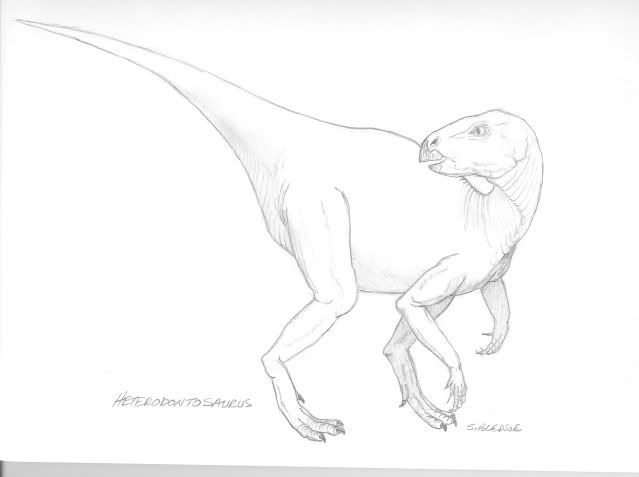
Heterodontosaurus was a little dinosaur. Little kids like little dinosaurs, but that is not all of the appeal. The appeal is also that it is just an interesting little dinosaur and there is a lot of information out there for kids. It is always nice to have a lot of information out there to share on kid friendly fact pages. Sadly, today, there is not a really good coloring page. However, there is this really neat looking Steve Bledsoe drawing, but I did not ask permission to post, so you only get a link today. Get out there and enjoy Father's Day. Doodle your own Heterodontosaurus with dad and if you like, send it over this way and I will post it. I would like to make a folder (and continuous blog post) for all the drawings kids do, that would be nice.
15 June 2013
Heterodontosaurus Tusks!


14 June 2013
You and Your Strange Teeth
 |
| ©Nobu Tamura |
13 June 2013
Statues and Electronics
 |
| From the Jurassic Park Wiki, artist uncredited |
Then there are the people that build the Suchomimus, or other dinosaurs, from the ground up as much as is possible without building their own wireframes and code. These are always fun to see and interesting because the tools are set and it takes a lot of ingenuity and ability to accurately use them to create a known dinosaur. I have a healthy respect for the Spore creators that post fairly nice creatures they molded. I picked the one I think is the best out of a very big list, for a dinosaur in Spore, of Suchomimus models:
12 June 2013
Jaws and Families
 |
| ©Scott Anselmo, right maxilla |
The hand claws and much of the general shape of the animals are what have tied them closely together. However, Sereno et al (1998) detailed characters that were unique to Suchomimus and separated the two genera. One such character was the number of teeth. Baryonyx possessed 96 teeth in its jaws while Suchomimus houses approximately 130. Our mouths are not designed anything like these giant fish seines. Despite the image of spinosaur mouths as tooth lined nets do not forget that some of the diet of Suchomimus and others in the family tree probably came from carrion as well as fresh caught fish. What is the notch for in the jaw though?
 |
| ©Scott Anselmo,mandible |
Reference for the day:
Sereno, P.C.; Beck, A.L.; Dutheil, D.B.; Gado, B.; Larsson, H.C.E.; Lyon, G.H.; Marcot, J.D.; Rauhut, O.W.M.; Sadleir, R.W.; Sidor, C.A.; Varricchio, D.D.; Wilson, G.P; and Wilson, J.A. (1998). "A long-snouted predatory dinosaur from Africa and the evolution of spinosaurids". Science 282 (5392): 1298–1302
11 June 2013
Prowling for Beachgoers
 |
| ©Walter Myers (www.arcadiastreet.com) |
Subscribe to:
Posts (Atom)