STL Science Center

STL Science Center

30 June 2013

Gentle Paralititan

Sauropods are typically depicted as gentle giants. They were probably as aggressive as any modern animal toward a threat, but like many modern herbivores they were probably a little calmer than their predators. The depictions of certain dinosaurs as gentle giants goes a long way toward making them more kid friendly animals. That friendly image goes a long way, as can be evidenced by the number of kid friendly information pages. These pages range from public institutions to "citizen science" entries (like what we do here technically) to education dedicated sites; some of these are dinosaur centered sites. Regardless of the type of site there is a wealth of information out there to be found on Paralititan; some of it is duplicated between sites, but that is not a big deal. In terms of something to color for today there is nothing official to be used. Today would be a good day to play outside with some toys though. Playing in my limestone driveway when I was little was what really got me into fossils as there were bits of shell and other items in the rocks of my driveway all the time. Why not send the kids out to play in the wonderful weather, and if you do not have a fossil laden driveway, take some toys out!

29 June 2013

Planets of Dinosuars

Screen capture from Planet Dinosaur
Models of Paralititan and illustrations have been made by many different artists. In all of these images one thing is similar regardless of the artist; Paralititan is a supremely large dinosaur. Large sauropods are fairly uniform in their depiction. Over time things have changed, as with other dinosaurs, such as the removal of sauropods from the swamps and altering the feet on both hindlimb and forelimb. Paralititan, as an illustrated dinosaur, missed a great deal of these incorrect versions since it was only unearthed, described, and named fairly recently. As such, it appears like many other sauropods, particularly the other titanosaurs that it is related to, in illustrations, computer models, and statue representations. One thing that Paralititan does tend to reverse in terms of modern illustration is the habitat in which it lived. The swampy habitats of the past have been generally forgotten and abandoned, but Paralititan, in life, lived in mangrove friendly areas. Essentially, this means that Paralititan lived along shores and, potentially, in swampy estuarine environments.
Illustrator unknown
The trouble and terror of living near a shore is that there are terrible threats not only on land, often in the form of Carcharodontosaurus, but also in the water. The Tethys Ocean at the time of Paralititan's existence was filled with sharks and giant reptiles including, close to shore, large crocodiles.Though large crocodiles probably would not have been able to pick off and drown the largest Paralititan adults, juveniles and sub-adults were probably on the menu. Crocodiles have not picked a new way to hunt or kill in hundreds of millions of years and thus the takedown of something large like a gnu was probably somewhat similar, though obviously scaled down many times over, to the takedown of a Paralititan. This illustration shows that attack being carried out and, scavenging of an already dead Paralititian can be seen in the middle ground on the right side by some feathered friends of the crocodiles.

28 June 2013

Tidal Giants

©Dmitry Bogdanov
In the Bahariya Formation of Egypt in the early 1900's Ernst Stromer von Reichenbach was a prolific discoverer of dinosaurs. In 2001 Joshua Smith et al. named a tetrapod, the first discovered in the area since 1935, after Stromer. They named this supersized sauropod Paralititan stromeri (meaning Tidal Giant). The humerus of Paralititan measures approsimately 5.54ft (1.69m) making it the longest sauropod humerus discovered thus far. The total length, based off of the skeletal remains, is about 85ft (26m). Giant humeri and a long body placed body mass estimates at approximately 59 tonnes. This weight places Paralititan into a weight range like that of modern Right Whales. The skeleton was discovered in a tidal mangrove area; fossil mangrove remains were discovered near the remains of the skeleton as well. Mangrove biomes are not typically rife with herbivorous fossil animal remains, making Paralititan one of the few, and perhaps only, herbivores evidenced to have lived in a mangrove shoreline area.

27 June 2013

Fossil for Sale

The arguments for and against the sale of fossils are all over the map; much like any other debate ranging from guns to religious freedom and beyond. Deltadromeus is one of those dinosaurs that have teeth for sale online. Despite anyone's stance on fossil ownership, that is pretty interesting. The teeth are expensive as well. Considering that a skull has yet to be found it raises a few eyebrows and important questions the most important of which is probably something akin to "How do we know that they belong to Deltadromeus?" Apparently the authenticity paper that comes with the teeth is proof enough for some people, but without a skull I am a bit skeptical. If we did not know what a dachshund's teeth looked like I could pull a retriever's tooth and sell it as a genuine dachshund tooth. Enough of that though, bring on the video game dinosaurs!

Spore creators are some of my favorite people these days. They always have the dinosaur we are talking about. They are not always the best models ever, but they are gallant efforts usually and generally are fairly good representations. Some are off a bit; today I found a Deltadromeus that looked like it had been lifting weights the past 100 million years. There is also the hyperactive version shown on the episode of Dinosaur King shared earlier this week. The same animation appears in the Dinosaur King video game and on the cards used in the "analog" version of the game. Toys and books, video games, fossils for sale; Deltadromeus is actually a very popular African dinosaur though its name is less well known than some other dinosaurs.

26 June 2013

How Do We Hunt?

©Dmitry Bogdanov
At an estimated 26.2 ft (8 m) long Deltadromeus was a fairly long ceratosaur. Majungasaurus, one of the largest ceratosaurs in body size, was only about 23 ft (7 m) from tip to tail and Ceratosaurus was even shorter at 20 ft (6 m) long. Despite its larger size Deltadromeus appears to have maintained a rather sleek figure; its muscle mass and body mass have been estimated to be average for a theropod of its size but minimal enough that the body appears to have been fairly agile, hence the specific epithet agilis. Such a physique also influenced the name Deltadromeus, meaning "Delta Runner", as the agile yet powerful hindlimbs seem to have been specially adapted for speed. Given what appear to be weak hands, in terms of grasping, it makes sense that speed rather than grappling with the hands would be an important predatory trait of this dinosaur. However, we are missing the skull and many clues could potentially lie in the structure of the cranium. Taking cues from other members of the ceratosauria, we may assume that the jaws of this animal were not its strongest feature; the long and slender teeth found in many ceratosaurs indicate weaker bite force potential. We may also make the assumption that Deltadromeus may have had small family units or mate pairs that hunted together, as this idea has been put forth with regard to Ceratosaurus hunting techniques. However, since we do not have either the hand claws or teeth of Deltadromeus, and we also lack evidence of pairing, we cannot for certain say whether it would have sliced at prey with hands or teeth and that mystery creates a large void in what we know of the biology of Deltadromeus. Hopefully, as with all fossil animals, there will be future expeditions and discoveries so that we have more definitive proof how Deltadromeus hunted.

25 June 2013

Deltadromeus Learns to Type

Deltadromeus is mentioned in quite a few books on African dinosaurs and is, as seen on Sunday, the titular dinosaur in at least one of those books. The naming paper for Deltadromeus is also available for reading thanks to a link through The Theropod Archives and the hosting of the paper by Dr. Jeffrey Wilson at the University of Michigan. The paper not only details the discovery and differentiation of Deltadromeus from other dinosaurs of the Sahara, but also details the discovery of other material discovered in the Sahara's Kem Kem region of Morocco. It is a good paper on a very successful expedition into the desert and well worth the read. The illustrations of the Carcharodontosaurus skull that was uncovered are wonderful, though off topic for the week. The image of Deltadromeus remains from the paper are impressive though.
Deltadromeus remains recovered as depicted in Sereno et al 1996
Today's paper:
Sereno, P. C., Dutheil, D. B., Iarochene, M., Larsson, H. ะก., Lyon, G. H., Magwene, P. M., Sidor, C. A., Varricchio, D. J., & Wilson, J. A. (1996) Predatory Dinosaurs from the Sahara and Late Cretaceous Faunal Differentiation. Science, 272(5264), 986-991.

24 June 2013

The Running Deltadromeus

Deltadromeus was a runner. How many videos show a running Deltadromeus? The answer is very few. Dinosaur King has a few battle scenes from the video games that people have recorded and posted online. The dinosaur that is given the name Deltadromeus is a rather nondescript theropod and has very exaggerated orbit ridges above its eyes. It is also portrayed as lightning fast, which is obviously an embellishment of the video game industry, but is also interesting. Deltadromeus also appears in two Dinosaur King episodes. The dinosaur in the cartoon is identical to the one in the video game series. Apparently Deltadromeus really enjoys swimming with princesses in the Ganges:

There are also a few tribute videos, but, as usual, these are still illustrations of a dinosaur set against music. There is one very short clip of an animatronic Deltadromeus, which is about as close as we have to a running dinosaur. The model is fairly good. The speculative orbit ridges are very subtle in this model but the hands remain rather large and the digits are lengthy compared to the palm of the hand. Tail and legs are not shown well in the clip well and are therefore it cannot be said whether or not they are accurately portrayed. They appear rather average, as in what we see in any theropod model available; in other words, fairly interchangeable between models.

23 June 2013

Running for Children

I suppose it is more likely that Deltadromeus would run after children rather than for children. If dinosaurs were around like in Dinotopia cancer runs would raise ridiculous amounts of money I bet though; I like to think dinosaurs had more stamina than the average person. Anyhow, Deltadromeus is a fairly kid friendly dinosaur. There are a number of child oriented fact pages online; About and Age of Dinosaurs have the best ones for today. Kids that cannot put down electronics can play some Dinosaur King with Deltadromeus or they can pick up the card game and play with Deltadromeus in a slightly less animated manner. Children that would rather use all of their imagination instead of letting the electronics do some of it for them could grab a Deltadromeus model/toy crafted by Safari LTD; though it is designed for the Carnegie collection which means that its up a little higher in the price world. The Safari LTD model is skull ornamentation free, another interpretation of what the skull may look like should we ever find one. If your young ones would rather read there is a book called Deltadromeus and other Shoreline Dinosaurs out there that they could pick up and read through. There are a lot of resources for kids to enjoy for Deltadromeus.

22 June 2013

Speculative Crania

The cranial elements of Deltadromeus are missing entirely. It is certainly not rare for skeletal elements of dinosaurs to be missing and skulls are high on the list of frequently AWOL skeletal elements. An interesting question of taphonomy can be posed when we consider this. What happens to all of those heads that are missing from the fossil record? Are heads washed away easily when the flesh is gone or are they dragged away by scavengers that do not wish to share the brains ("zombie" dinosaur scavengers)? Did heads get buried less frequently than other elements of the body? Whatever the reason, it has led to the recovery of Deltadromeus specimens made up entirely, to this point, of post-cranial material. Thus, all of the representations of the head of Deltadromeus are speculations based on presumably related taxa. Typically this means that the skulls are based on other ceratosaurs. This has led to a variety of ornamentation on the skulls of illustrated and mounted Deltadromeus. Typically a ridge of material has been placed above each orbit, similar to those seen in Ceratosaurus.

©Mineo Shiraishi
The cranial ornaments change over time. They are basically all very similar, but the positions, angles, and overall shape of the crests above the orbits change over time and between illustrators and model makers. This reflects not only personal preferences but changing hypotheses concerning the exact nature and potential construction of the skull of Deltadromeus. It is still not certain that Deltadromeus is a ceratosaur also and the skull may therefore have absolutely no ornamentation at all. It is even conceivable that Deltadromeus, as a very basal ceratosaur may lack crests on the skull entirely for that reason. Regardless, there are certain elements of the body of Deltadromeus that are known fairly well. These include the legs and the majority of the caudal vertebrae. The legs and caudal vertebrae are similar to those found in ceratosaurs, thereby aiding the justification that Deltadromeus is a ceratosaur. Seeing as how that is the best evidence and the best fit for known remains, that is where it is positioned in the dinosaur family tree, for now; the legs and may not be telling all there is to know about this interesting dinosaur.

21 June 2013

Running Through the Delta

©Nobu Tamura
Basal ceratosaurs, and advanced ceratosaurs, happen to be some of my favorite theropods. Unfortunately, some of them tend to be missing large portions of their remains; the same can be said of any group of dinosaurs of course. Large African theropods seem to be typically missing large portions of their remains, which is regrettable and sad. However, advances in understanding African theropods have really been quite well documented in the past 20 years or so. In 1996 Paul Sereno, spending a lot of time in African during the late 90's, was busy documenting some of these advances in our knowledge. Throughout the 90's teams he led dug out important fossils all over the southern hemisphere and around the equator, but in 1996 he published a paper that separated some of those remains from a genus that Ernst Stromer, in 1934, had assigned as Bahariasaurus. The separation was based on other remains that had been discovered by Sereno and his team and then compared with remains of Bahariasaurus and other African dinosaurs. The exact phylogenetic position of the separated species, now known as Deltadromeus agilis is still up to some debate, and the lack of cranial material does not aid the taxonomic struggle at all. The fact that Deltadromeus may still be a junior synonym to Bahariasaurus still lingers in the background also. For the time being it will be treated as an independent genus however.

20 June 2013

Vaguely Popular

Kind of a big Iguana until you get to the head
Heterodontosaurus is only popular in a few circles. Good days bring us links from all over the internet; those were mostly the days when I was first getting this list of animals started however as I was discussing giants of the dinosaur world such as Triceratops. We have seen that Heterodontosaurus appears in museums as models, book chapters, and even that it is popular enough that children's websites have fact pages dedicated to the little dinosaurs. They have even caught on to the feather craze (I say craze because it seems to me that every single dinosaur is slowly developing feathers or quills the past two or three years regardless of what is definitively known about the animal in question). I am not against them having quills or feathers, I just really enjoy the older illustrations that show it more as a dinosaur from my childhood. Regardless, Heterodontosaurus is one of those dinosaurs that is nondescript enough that it shows up in random tubes and dollar store packages of dinosaurs as the skinny little creature with fangs that may be Coelophysis or Heterodontosaurus or even a Hypsilophodont. This week that dinosaur is Heterodontosaurus, but they are probably all equally correct answers. It has also been modeled many times over in Spore. Sometimes with the prominent teeth showing and sometimes with the teeth modeled correctly. I think we have to admit that the teeth make it a more formidable dinosaur when they are showing. There we have a good summary for the week of Heterodontosaurus: typical non-scary dinosaur unless you can see those teeth, then it gets a little more respect. That is probably exactly how it lived its life as well; minding its own business until it had to get mean.

19 June 2013

Everything is Bland

Heterodontosaurus, aside from the tusks and other two types of teeth, is a very typical little dinosaur. Heterodontosaurus was small enough to be compared to a modern retriever and would have been susceptible to attacks from larger dinosaurs but also animals as small as Coelophysis (not that Coelophysis was the smallest predatory dinosaur ever). The little tusks, or fangs as they have been alternately described, would have come into play in predator-prey situations. Undoubtedly the tusks could be used as defensive weaponry against attackers; however, the idea that the tusks represent a characteristic of a sexually dimorphic tradition in Heterodontosaurus means that the females of the species (or males if we reverse the assumption of dimorphism) were much less able to defend themselves in terms of anatomical weaponry.

In terms of where those little tusks/fangs were seated in the skull we are talking about the caudal body of the premaxilla. The bone itself is adjusted so that the teeth sit comfortably into the notch, or diastema, that is formed by this adaptation of the bone. The maxilla itself joins the premaxilla in a way that forms the caudal wall of the diastema where the tusks are situated. The skull is actually, despite the images shared showing the skull earlier in the week, not as exaggerated as we have assumed. Reconstructed in three dimensions, this formation in the skull that houses the tusks is really little more than a narrowing of the solid oral cavity in the area where the teeth are pronounced upward into the mouth. See below:
From The Dinosauria
Reference to check out today:
Weishampel, D. B. and Witmer, L. M. (1990). Heterodontosauridae. in Weishampel, D. B., Dodson, P., & Osmรณlska, H. (Eds.). Pgs. 486-497. The Dinosauria. Univ of California Press.

18 June 2013

Heterodontosaurus on the Newsstand

Artist uncredited
Heterodontosaurus has been dormant for a while in research circles it appears. While the 1970's have given us literature resources concerning Heterodontosaurus, not much has been published since that time about this genus specifically. There have been other studies done on other heterodontosaurids, but we are not interested in that today. Of particular note today is a 1976 article on a skeleton of Heterodontosaurus which describes a great deal of the anatomy of the dinosaur as it was a complete skeleton. Complete skeletons, I do not think we really need to mention, are few and far between for dinosaurs in the grand scheme of things, and such a find and the paper detailing it are therefore of great importance to the science. However, the article was published in Nature and, while Nature is a premier publication even now, that means that your options for procuring the article pretty much come down to going to a library big enough to have old copies of a myriad of different magazines or shelling out some money (you can buy the article for $32 or "rent" it for $2.99). The naming article written by Crompton and Charig is also published in Nature and can therefore be obtained in the same fashion. Interestingly, both articles consider Heterodontosaurus to be a Late Triassic rather than Early Jurassic dinosaur.

More recently two articles have been published, still a small number considering the research done on other organisms, that detail cranial anatomy as well as morphology. These are good papers and, the paper on juvenile cranial anatomy I can say for certain, because it is a JVP article so I could access it and read it, is quite informative and not a bad read at all. The other paper, focusing on morphology and cranial anatomy is available through Wiley's publication of the Zoological Journal of the Linnaen Society. The article was published in 2011 and was inspired by notes and illustrations of Alan Charig that were passed on to the lead author David Norman after Charig's passing in 1997. That makes it a touching story behind an interesting anatomical discussion I think.

17 June 2013

Scary Flesh

The fleshed model of Heterodontosaurus that you my see in timelapse images of the construction of the model is a little frightening. The horror of it is no doubt due in part to the rather mammalian appearance of the model at first glance. Actually watching the video takes away from the creepiness of the model a tiny bit, but only because you get to see the feathering and skin details get placed on the model. It should also be made apparent that the model in that video is actually of a different genus of dinosaur related to Heterodontosaurus (Pegomastax africanus is depicted by the model). While a different dinosaur it is closely related to Heterodontosaurus and provides the only fleshed out model that accurately represents the family at the time being; hopefully better models of Heterodontosaurus will be created independently at some point. For that time being, however, enjoy, or at least try to not be freaked out by, this Heterodontosaurid model being created:


16 June 2013

Little Dinosaur for Little Kids

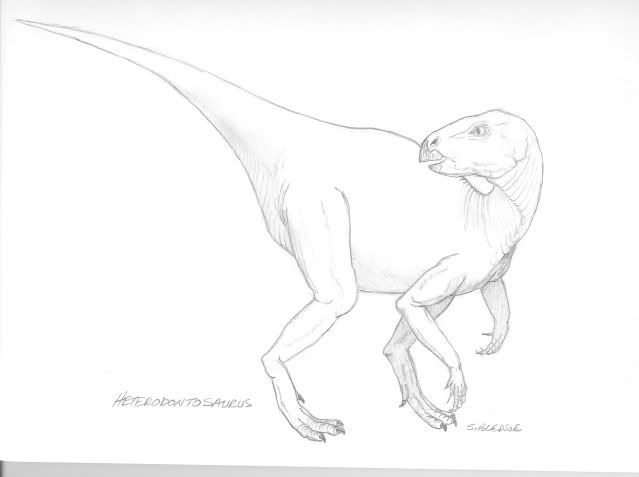
Heterodontosaurus was a little dinosaur. Little kids like little dinosaurs, but that is not all of the appeal. The appeal is also that it is just an interesting little dinosaur and there is a lot of information out there for kids. It is always nice to have a lot of information out there to share on kid friendly fact pages. Sadly, today, there is not a really good coloring page. However, there is this really neat looking Steve Bledsoe drawing, but I did not ask permission to post, so you only get a link today. Get out there and enjoy Father's Day. Doodle your own Heterodontosaurus with dad and if you like, send it over this way and I will post it. I would like to make a folder (and continuous blog post) for all the drawings kids do, that would be nice.
15 June 2013

Heterodontosaurus Tusks!

Does sexual dimorphism exist in Heterodontosaurus specimens? The tusks may be a good indication of sexual dimorphism if many more specimens of varying ages (developmentally not geologically) are recovered. Tusks in extant animals, in addition to serving dietary and defensive purposes, are sometimes used to differentiate between sexes. Males with bigger tusks could be seen as older, fitter, or just more handsome in general to the females that are usually impressed by such ornamentations. The tusks of Heterodontosaurus are not enormous though they are a decent and respectable size for a dog sized ornithischian. In a range from warthog to walrus they are much closer to warthog sized teeth. Their position in the skull allows them to have been used in intraspecific rivalries, interspecific fighting, and even to crack open the tougher staples of the Heterodontosaurus diet such as termite mounds.

The skull even appears to have adapted to seating the tusks within the mouth, mostly, as opposed to the way tusks in most extant animals are situated. Picture a walrus or a warthog, even an elephant's tusks and how they protrude from the skull and mouth in a way in which they are never actually concealed by lips, cheeks, or any other fleshy anatomy. The tusks of the Heterodontosaurus were modest enough that they could have been concealed within the cavity of the cheek provided it was stretched that far forward on the skull. Those little tusks even appear to have a position within the junction of the maxilla and premaxilla to accommodate them. Biting down on something seated in that notch with the tusk piercing it from the other side could have caused great trauma, to the limbs of other animals especially, or destruction, in the case of the termite mounds mentioned before. There would have been great risk to the Heterodontosaurus itself, however. Much like any other animal with a tusk it risked breaking the tusk when using it for any activity. Unlike mammals, however, dinosaurs have batteries of teeth, so it is plausible, though perhaps unknown at this time to my knowledge, that the tusks of Heterodontosaurus could have been regrown if broken.

14 June 2013

You and Your Strange Teeth

©Nobu Tamura
The "Different Toothed Lizard", or Heterodontosaurus tucki, was a small, about the size of a golden retriever, mostly herbivorous ornithischian. Possessing three forms of teeth, leaf and stem stripping teeth at the front of the mouth, large canine shaped tusks behind these and tall square grinding and chewing teeth in the rear of the mouth, it is likely that Heterodontosaurus had a varied diet. The front teeth are designed to tear and strip plant matter more than anything else and was the most likely use for them. The tusks  have been indicated as fulfilling display purposes as well as being used to break open more difficult to get into food sources, such as termite mounds. A fleshy cheek is proposed to have existed to help the rearmost teeth do their job of grinding and crushing food items. Additionally, the hands of Heterodontosaurus were special in that they had five fingers and seem to have had opposable digits, giving them hands much like ours which can manipulate and hold food items. Heterodontosaurus was discovered in South African and is an early Jurassic dinosaur (existing approximately 199 million years ago). It has quite a few characters that resemble more advanced dinosaurs but also has many older characters which we will discuss.

13 June 2013

Statues and Electronics

From the Jurassic Park Wiki, artist uncredited
There are a lot of Suchomimus out there in the world. There are statues and video games and many other popular culture pieces. One was shared on the Facebook page at the beginning of the week as well. There are a ton of different references for video games and toys and even some books and magazines that are geared more toward an audience that already possesses some knowledge of dinosaurs and their workings; magazines are, as opposed to journals, always more general in the assumed knowledge of the reader of course. Some of the best references outside the statuary and literary worlds are the video games. Toys looked to as models of dinosaurs are spotty in their accuracy and those that are accurate are good for modelling and playing around but they suffer the curse of being static. One of the benefits of having the electronic media we have in this day is that we can see Suchomimus models interacting with other dinosaur models and even hunting/fishing. Sometimes these are somewhat unlikely, but artistic license and knowledge of modifying existing models to have a Suchomimus is enough for me to overlook that.


Then there are the people that build the Suchomimus, or other dinosaurs, from the ground up as much as is possible without building their own wireframes and code. These are always fun to see and interesting because the tools are set and it takes a lot of ingenuity and ability to accurately use them to create a known dinosaur. I have a healthy respect for the Spore creators that post fairly nice creatures they molded. I picked the one I think is the best out of a very big list, for a dinosaur in Spore, of Suchomimus models:


12 June 2013

Jaws and Families

©Scott Anselmo, right maxilla
Suchomimus was a well equipped dinosaur. As a smaller spinosaur it was still equipped with a dorsal ridge (sail, hump, flap, etc), though the anatomical feature on Suchomimus was clearly much smaller than on on Spinosaurus. The dorsal ridges, neural spines, of the vertebrae that formed this proposed feature were short but evident and were confined to the lumbar-sacral vertebrae. That simply means the ridge was above the hips of Suchomimus. Problematic points with this ridge are that the skeleton shown to posses this is thought to be a subadult, meaning that perhaps a radiation of growth during and after this stage of life may have elongated the ridge extensively (thus making Suchomimus a young Spinosaurus and nothing more); however, this idea has not been published or extensively researched as far as I can tell. The more likely synonymization of Suchomimus has always been with regard to the genus Baryonyx.

The hand claws and much of the general shape of the animals are what have tied them closely together. However, Sereno et al (1998) detailed characters that were unique to Suchomimus and separated the two genera. One such character was the number of teeth. Baryonyx possessed 96 teeth in its jaws while Suchomimus houses approximately 130. Our mouths are not designed anything like these giant fish seines. Despite the image of spinosaur mouths as tooth lined nets do not forget that some of the diet of Suchomimus and others in the family tree probably came from carrion as well as fresh caught fish. What is the notch for in the jaw though?

©Scott Anselmo,mandible
That notch in the jaw was far from vacant. In fact, a number of the largest teeth in the mandible fit snugly into the groove of the maxilla at that point. The teeth in the maxilla are correspondingly small where the mandible teeth are oversized; Suchomimus would have a horrendous dental problem if there were large teeth at the top and bottom where the notch is. The notch is not just a random feature of the bone either. The anterior portion of the notch consists of the posterior ventral edge of the premaxilla and the posterior edge of the notch is made from the anterior most section of the maxilla itself. Essentially that means that it is the point at which two bones of the jaw meet but do not form an even edge the entire length of the jaw; the bulbous indentation of the notch is found mainly in the premaxilla however. We see this in other spinosaurs but also in a more basal family; the Dilophosauridae. Are the two families more closely related than we think at present or is there an evolutionary jolt that caused two very separate families to develop similar jaw anatomy (though not overall skull shape)?

Reference for the day:
Sereno, P.C.; Beck, A.L.; Dutheil, D.B.; Gado, B.; Larsson, H.C.E.; Lyon, G.H.; Marcot, J.D.; Rauhut, O.W.M.; Sadleir, R.W.; Sidor, C.A.; Varricchio, D.D.; Wilson, G.P; and Wilson, J.A. (1998). "A long-snouted predatory dinosaur from Africa and the evolution of spinosaurids". Science 282 (5392): 1298–1302

11 June 2013

Prowling for Beachgoers

©Walter Myers (www.arcadiastreet.com)
A number of papers have been written about research focusing on Suchomimus. Whether it is comparing the furcula of Suchomimus and Tyrannosaurus or announcing its discovery to the world (scroll down just a bit to the 2nd Sereno paper), Suchomimus has seen a bit of ink. It even appears in a respectable number of books. Fairly universal in the papers and the books is the consensus that Suchomimus is a unique genus with traits that set it apart from Baryonyx and other spinosaurs, but there are detractors to every hypothesis. This only proves that more evidence is needed to genuinely place Suchomimus beyond any doubt. More expeditions and research (and therefore money raising!) will have to be undertaken in order for that to happen. However, until that time, the beach going and probably quite piscivorous Suchomimus will continue to be one of the best represented and mildly debated spinosaurs in the family.