 |
| © Julius Csotonyi |
STL Science Center

31 March 2016
Toys and Games
There are more mentions of Lambeosaurus in games and toys than there are in any other popular media of any sort. They appear in books from time to time and documentaries even more frequently, but their appearance as toys far outpaces either of these other two pop culture modes of expression. To share just how prevalent Lambeosaurus is as a toy, consider these videos:
Also consider the fact that Lambeosaurus has appeared in fewer documentaries than many other hadrosaurs, but when it does, it is often not named. This gives the appearance of fewer Lambeosaurus documentaries but only the appearance; there are far more Lambeosaurus mentions in science based documentaries than people realize. This is also the case for mural sized artwork such as this:


30 March 2016
Crest Conundrum
 |
| Adapted from Nobu Tamura |
29 March 2016
The Papers Remain Similar
Lambeosaurus has not been a hot topic in recent studies. The reason is not that Lambeosaurus has been entirely researched and figured out. Instead, Lambeosaurus has simply not been a big player in recent research. Hadrosaurs are very interesting creatures but are not so interesting that they are heavily researched in a multitude of lab groups. Even if they were, there are a lot of different hadrosaurs in the fossil record and Lambeosaurus is just one of those many taxa. The papers and research that has been done on Lambeosaurus in the time since the dinosaur was initially discovered are extensive and cover a variety of topics. There are always simple descriptions of remains that are published as they are discovered. The remains in question here are some of the newest remains that have been recovered, relatively considering the history of Lambeosaurus. Descriptions often lead to systematic reviews, such as that by Ostrom which lead to the reassignment of Hadrosaurus paucidens as Lambeosaurus paucidens. In order to discuss systematics and to adequately describe the dinosaur there need to be papers on the anatomy of the dinosaur as well. Luckily for everyone here, those papers also explicitly exist concerning the anatomy, specifically, of Lambeosaurus. Many times we have to make do with a similar animal, but having a description of the anatomy of the animal in question is very fortunate. Putting all three of these topics together we can then delve into more specific anatomical questions such as craniofacial ontogeny and even postcranial locomotor studies (we do not study those sorts of things in our lab so much, but they are interesting topics and fun to consider and important to understand).
28 March 2016
Movies Arrive
Since 2011 (the last time we covered Lambeosaurus) a lot of short videos and tribute slideshows have been put together for Lambeosaurus and posted online. The majority of these are newer videos are groups of photos put together over irrelevant music; the assumption I hold here is that the music is like by the person that put the video together and they have no real thought other than that behind the coupling of a dinosaur they like and music that they choose. These include videos like the one posted directly below here.
I hope to find someone some day that will make more insightful choices with their pairing of dinosaurs and music. Until then we will have to be happy with the fact that in addition to these music slideshows there also exist educational videos. These videos are not entirely limited to English language videos, as many dinosaur videos tend to be. This video is narrated and describe in Spanish which appears to be the second most likely language of educational videos on the internet (definitely a personal observation with no real scientific basis behind it).
Aside from videos like these, the most popular videos of Lambeosaurus are based on toy reviews of many different company's Lambeosaurus models. We will look at some of these on Wednesday when we look at the different types of crests that have been attributed to different species of Lambeosaurus.
27 March 2016
Learning About Lambeosaurs
Lambeosaurus, as a genus, is a well known group of dinosaurs and has been well represented online in kid-friendly venues since there were dinosaur pages on the internet. There have been Lambeosaurus books, documentaries, and educational toys since long before the internet. Lambeosaurus has been a very popular dinosaur for a very long time, nearly a full century actually. The last post of Lambeosaurus facts (we have covered this dinosaur before, but back then there were very few links online) was very short and consisted of only a few short links and videos. Instead of posting simply the end of the Dinosaur Train episode in which Lambeosaurus appears, the entire episode can be seen on YouTube now.
Some of the pages that have been generated since the last Lambeosaurus fact day are not the greatest fact pages that exist, but they are helpful. The links found on the old post are still good. Sites like Dinosaur Jungle have increased the number of sites we see for Lambeosaurus. They do have an image that looks vaguely like a kangaroo though. Most of those facts are contained on the images of the fact trading cards shown below however.


26 March 2016
Back and Changing
I am altering the schedule of posts a very slight amount from the normal schedule. Instead of starting every week on Friday, from now on we will end our weeks on Friday. The day had only been the starting point prior to now because the first post had been on a Friday. The way the weeks are set up on the calendar a day like Saturday, Sunday, or Monday makes more sense as a starting point. We are going to go with Saturday here at Dinosaur of the Week because the start of the weekend is a good place to start your dinosaur fix of the week!
This week is the last full week of March. The last week of the month is the Brynn Metheney calendar week. This week's dinosaur, and March's calendar dinosaur, is the large crested herbivore Lambeosaurus. Lambeosaurus is named after the prolific Canadian paleontologist Lawrence Lambe. The material of the type species, Lambeosaurus lambei Parks 1923, was discovered and recovered by Lambe in 1903 and described and named by William Parks in 1923. Charles Sternberg described a second species that is still recognized, L. magnicristatus, in 1935 and a third species was added in 1964 by John Ostrom who reassigned Hadrosaurus paucidens Marsh 1889 as the material was inconclusive as Hadrosaurus and more closely resembled Lambeosaurus. The distinctive features of the genus Lambeosaurus include the large hadrosaurine body in addition to a head crest that acted as a resonating chamber and potentially as a space that could aid in regulating the temperatures of air entering and leaving the body. This may not be important for Brynn Metheney's astronaut version of the dinosaur, but in an environment with any type of variation in atmospheric temperature, the regulation of respired air was, and is, important to endothermic organisms.
This week is the last full week of March. The last week of the month is the Brynn Metheney calendar week. This week's dinosaur, and March's calendar dinosaur, is the large crested herbivore Lambeosaurus. Lambeosaurus is named after the prolific Canadian paleontologist Lawrence Lambe. The material of the type species, Lambeosaurus lambei Parks 1923, was discovered and recovered by Lambe in 1903 and described and named by William Parks in 1923. Charles Sternberg described a second species that is still recognized, L. magnicristatus, in 1935 and a third species was added in 1964 by John Ostrom who reassigned Hadrosaurus paucidens Marsh 1889 as the material was inconclusive as Hadrosaurus and more closely resembled Lambeosaurus. The distinctive features of the genus Lambeosaurus include the large hadrosaurine body in addition to a head crest that acted as a resonating chamber and potentially as a space that could aid in regulating the temperatures of air entering and leaving the body. This may not be important for Brynn Metheney's astronaut version of the dinosaur, but in an environment with any type of variation in atmospheric temperature, the regulation of respired air was, and is, important to endothermic organisms.
 |
| ©Brynn Metheney |
23 March 2016
Types of Fossils
The type species, Chalicotherium goldfussi, is known from the Miocene and Pliocene of Europe. Factoring in the Late Oligocene fossils that are attributed to other species, Chalicotherium can be said to have existed for a rather long time, as far as giant mammals are concerned. This is said considering that the "typical" species exists for somewhere between 5 - 10 million years given accepted extinction rates but there are certainly outliers on both ends of that spectrum. The total time in the fossil record for which we know of Chalicotherium fossils totals approximately 24 million years (28.4 - 3.6 mya); clearly this genus could potentially represent an outlier from the accepted generalization. The type species is from the Upper Miocene of Germany (around 12 - 5.4 mya) and is estimated to be approximately 1500 kg and 2.6 m tall at the shoulder. The other two species are similarly sized and were initially known from around a contemporaneous geological era. Chalicotherium salinum was originally known from the Lower Pliocene (5.3 - 3.6 mya) in Pakistan and India also making it the youngest of the Chalicotherium species. All of these species are extremely large and were highly adapted for herbivory; gigantic herbivores is a commonly reoccurring theme in the history of life. Some of these adaptations include the horse-like head with a muscular set of lips capable of grasping vegetation and taking it into the mouth. The apparent loss of the incisors and canines throughout ontogeny has been linked to this cropping action in that the muscular lips are hypothesized to have worked against the resulting gumline to successfully crop vegetation more efficiently than the canines and incisors. The remaining teeth were molars that were squared in appearance. These teeth possessed low crowns suited for grinding vegetation passed back by the tongue from the muscular lips and gumlines.
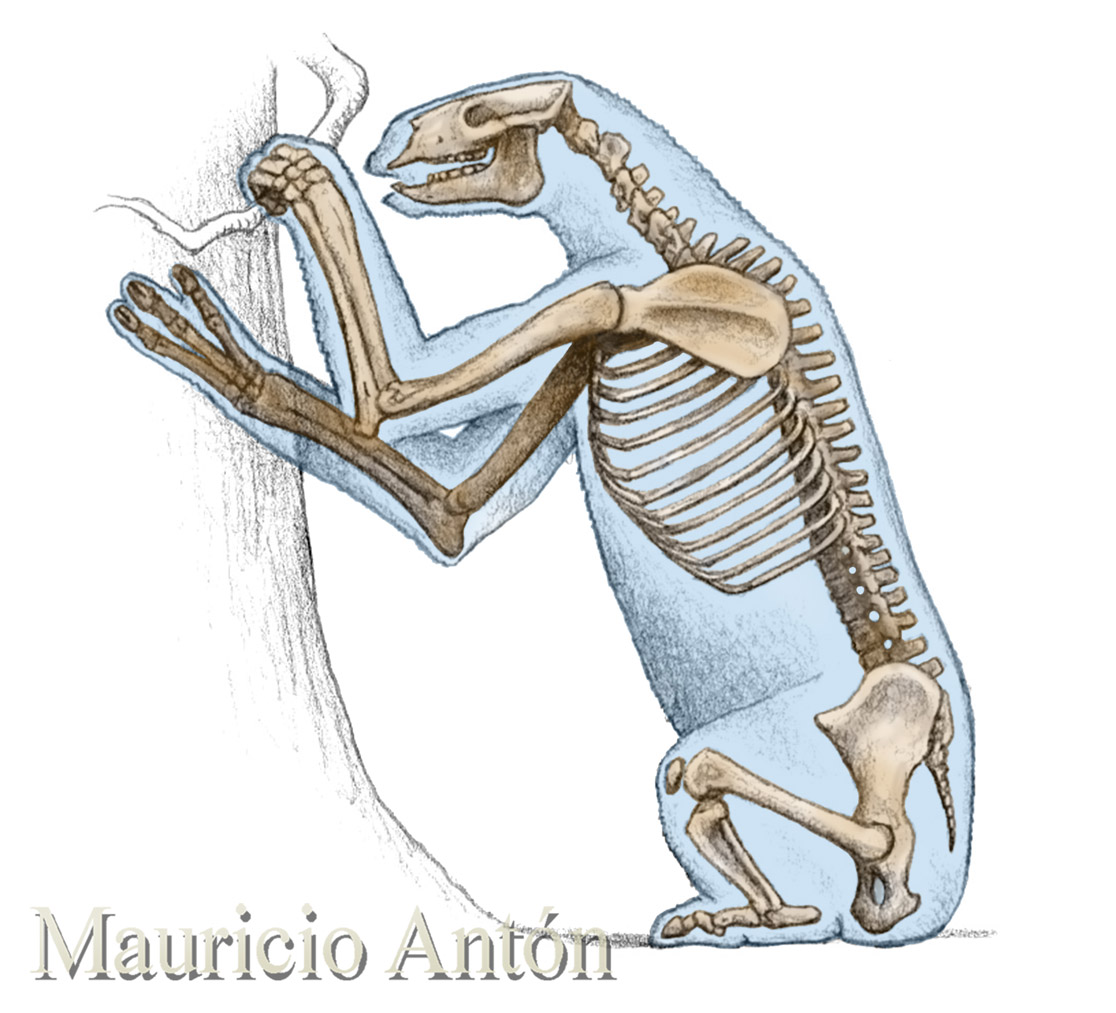
While doing all of this processing and cropping of leaves, Chalicotherium did an extensive amount of lounging about and loitering. That loitering is preserved in callouses on the ischium where all of the weight of the mammal was situated as it sat under trees eating and processing. We can kind of think of Chalicotherium in terms of modern pandas and sloths.
While doing all of this processing and cropping of leaves, Chalicotherium did an extensive amount of lounging about and loitering. That loitering is preserved in callouses on the ischium where all of the weight of the mammal was situated as it sat under trees eating and processing. We can kind of think of Chalicotherium in terms of modern pandas and sloths.
 |
Museu Geològic del Seminari de Barcelona
|
22 March 2016
A Wisened Beast
The gravel beasts are well studied. The fossil history of Chalicotherium is well known across two continents and has been well known for nearly two centuries now. In that time many papers have been written ranging from simple anatomical descriptions (sometimes in their native languages because they are older) to complex ecological descriptions. New Chalicotherium material is still recovered in places like Mongolia and China but so far these new discoveries have not led to any all encompassing studies beyond description that I have found online. There are a few older papers on biomechanics of the vertebral column that reference Chalicotherium in passing, as there should be given the extreme curvature of the vertebral column that is often depicted in mounted skeletons and illustrations. Curvature of this animal's spinal column is actually quite intriguing and, despite following the normal quadrupedal arching theme of vertebral columns, appears to be exaggerated. Although we are a little let down in that study not discussing Chalicotherium more we can always be sure, with mammals, that we will have more than enough biomechanics and wear patterns of teeth to read about. This is not a negative, it just happens that mammalian teeth, no unlike dinosaur teeth, are pervasive in the fossil record and many studies have been conducted using teeth to examine enamel, wear patterns, and many other topics.
21 March 2016
Giant Beasts and Video Games
Chalicotherium appears in many different kinds of videos because it is a very popular giant mammal. The more radical the animal the more likely it is that the animal will be shown in documentaries or movies and modeled in video games and other venues. The number of videos from the game ARK overloads the search for Chalicotherium, making it difficult to find videos from the Walking With Series and any other documentary that might happen to exist. ARK is a survival game set in various prehistoric eras that overlap; the setting is a made up world filled with dinosaurs, prehistoric mammals, and even hostile human players. The game has been in development for a few years and beta testing has allowed us to see animals like Chalicotherium for a while; the game is set for official release in June of this year. The videos of Chalicotherium from ARK, like that below, are mostly narrated by players and enthusiasts of the games.
The Walking With Series is much more entertainment than it is documentary; however, there is a respectable amount of science behind the series even when the entertainment is more pertinent than that science in an episode or portion of an episode. The episode of Walking With Beasts that features Chalicotherium is still online; BBC does tend to take these down when they can find them, so if you have not seen this episode and are interested I urge you to watch it as soon as possible. The episode is centered around the life story of an Indricotherium but does have a sizable (pun intended) portion showing Chalicotherium.
The Walking With Series is much more entertainment than it is documentary; however, there is a respectable amount of science behind the series even when the entertainment is more pertinent than that science in an episode or portion of an episode. The episode of Walking With Beasts that features Chalicotherium is still online; BBC does tend to take these down when they can find them, so if you have not seen this episode and are interested I urge you to watch it as soon as possible. The episode is centered around the life story of an Indricotherium but does have a sizable (pun intended) portion showing Chalicotherium.
20 March 2016
Kids and A Giant Everything Mammal
Chalicotherium has convergent characteristics with a large suite of extant mammals that have taken over many different niches that were not necessarily occupied by Chalicotherium or any of its contemporaries; the world is not exactly the same as it was then and some of those niches may not have even existed at that time. These are not, though, the topics presented in most of the fact files. The sites do mention the convergent evolution, just not always the the extant analogies. The best site for all around discussion of Chalicotherium is About which does make mention of gorillas. Prehistoric Wildlife presents a little more in depth information, but is still not exhaustively comprehensive. The best thing about the site is that it presents some of the same information at a slightly higher reading level. The most simplistic, but still filled with facts, of all of the sites available is the site that is associated with the Walking With Series in which Chalicotherium features in the "ice age" series. A number of the facts are also present on this handy little image/trading card:


19 March 2016
The Skeleton Game
18 March 2016
Digging Into Mammals

17 March 2016
Prestosuchus In Our Minds

16 March 2016
Rauisuchian Bulldog
Prestosuchus had a skull that was deep and stout. Relatively long and filled with teeth, the body caudal to that skull was long and gracile in comparison to large archosaurs that would come after it, but strong and robust compared to most of its contemporaries, especially its prey items. Give that Prestosuchus had a strong body that was built much more like a wrestler than a runner, the hypothesized niche of Prestosuchus has been described as that of an ambush predator of large prey items in particular. This makes sense considering that Prestosuchus was the largest of the Rauisuchians, supposedly, with the exception of Saurosuchus. Because it was so large in comparison with many of its contemporaries, including the fledgling groups of dinosaurs, Prestosuchus was highly likely to take large prey, defend it, and eat as much as it wanted prior to abandoning it completely to scavengers. That sort of hypothesized behavior can be seen in the image below.
 |
| (C) Maurílio Oliveira |
15 March 2016
The Missing 1940's
Prestosuchus was named by well known German paleontologist Friedrich von Huene in 1942. He discovered the fossil near Sao Pedro do Sul in Brazil in 1938, thus explaining how a German scientist was able to name a fossil from half a world away during the height of World War II in Europe. Von Huene named the genus for Brazilian paleontologist Vincento Prestes de Almeida who was a self taught scientist. The paper initially describing Prestosuchus does not appear online and the first paper recording the name at all in the Biodiversity Heritage Library is from 1957 (it is mentioned in an article on Triassic footprints in New Jersey). More modern papers do exist and are more entertaining for our purposes though. These include a discussion of the braincase from Mastrantonio et al. (2013) that uses the complete braincase to assess phylogenetic relationships with other Rauisuchians and archosaurs in general. The paper concludes that there are still phylogenetic issues to be worked out but that Rauisuchians are closer to crocodylomorphs than they are to aetosaurs and phytosaurs. Liparini and Schultz (2013) move away from the brain to discuss the muscles of the thigh that appeared to be rather unique. One of the reasons that the thigh muscles in particular were important in discussions of locomotion of Prestosuchus is that the same muscles in Poposaurus, which is a bipedal pseudosuchian archosaur, were very well adapted for bipedality by being shortened despite having the same general arrangement of pillar-erect gait as other pseudosuchian and Rauisuchian animals. There are a number of other papers (Prestosuchus is very well studied and written on) but these two are plenty for one day as they are rather in depth.
Today's papers:
Today's papers:
14 March 2016
In Motion
Prestosuchus does not have videos regular videos associated with the archosaur. There are a few lower end fact "movies" that are not much more than slideshows, but these are encouraged even if they are not entirely useful for our purposes. There are even Vines with Prestosuchus. The point of Vine is beyond me; maybe I'm too old or maybe they were just the precursor to Apple's "moving pictures" (that is called a video Apple, we are not all gullible), but they can be useful for short introductions to a Prestosuchus skeleton, as that particular one is. The lack of narration is fine, but shorts like that with narration are also generally useful, such as this one.
13 March 2016
Kids and Almost Crocodiles
 |
| Photo by Ryan Hadley |
12 March 2016
Not a Dragon
 |
| (C) Dmitry Bogdanov |
 |
| (C) Nobu Tamura |
11 March 2016
Difficulty in Ancestry
The skulls of some animals are strangely similar to animals that they are exceedingly distantly related to. We can understand the similarities in the context of convergent evolution; animals that require extreme biting forces develop similarly strong muscles and similarly shaped skulls to house the attachments of those muscles. Generally we only discuss the morphologies as how they occur and are similar and not the time at which they occur, geologically speaking. Therefore, we can discuss how an animal like Prestosuchus chiniquensis living in the Triassic of Brazil has a skull that looks considerably like that of a Cretaceous tyrannosaurid. Prestosuchus is only related to tyrannosaurs in that they are both archosaurs as the dinosaurs, and therefore tyrannosaurids, diverged from the early suchians, ancestors of modern crocodilians. The skulls of tyrannosaurids and Prestosuchus are deep and filled with large serrated teeth and have been mistaken for one another many times because of their similarities. The skull of Prestosuchus is not as air filled and lightweight (relative to size) as a tyrannosaurid skull, however. Skulls of Prestosuchus are clearly strong and beginning to show some of the solidifying characteristics of its descendants. Prestosuchus as a genus belongs nestled with Rauisuchia (by some accounts a wastebin group), a group of early Triassic archosaurs within Pseudosuchia that contains some fierce looking reptiles that, unlike their descendants, stood with a specialized erect posture and were definitely much more terrestrial than their descendants would eventually become.
 |
| AMNH, photo by Vince Smith |
10 March 2016
Popularity and the Plated Dinosaur
Stegosaurus is popular because it was one of the first widely known North American dinosaurs with highly complete skeletons. Having very interesting anatomy always helps dinosaurs to become very well known also. Stegosaurus has appeared in many of the avenues of popular culture that we think of when we are trying to find out how popular dinosaurs are (this may just be myself as I write about the popularity of a given dinosaur every week). There are kids books and television shows and there are documentaries and movies. Stegosaurus has appeared in video games and even as wine bottle holders. The fact that we see Stegosaurus, as a genus, everywhere is tied directly to its prominence as one of the big recognizable symbols of dinosaur life. That set of dinosaurs includes the dinosaurs that I once got on a birthday cake: Stegosaurus, Triceratops, a sauropod often labeled Brontosaurus (even now), and Tyrannosaurus.
Subscribe to:
Posts (Atom)