The constituent parts of Riojasaurus are interesting. As a prosauropod, if we agree that prosauropods were a building block in sauropod evolution and not a convergently evolving group of animals, it makes sense that the body of Riojasaurus, being a later Triassic prosauropod, would be bulking up as it evolved traits more often found in its later descendants the sauropods. These of course included the traits easily visible from afar such as a long neck and a long tail. They also include rather thick strong bones in the legs as well as other parts of the body such as the ribs which made the living animal a massive, heavily built, and strong dinosaur. Another trait found in both Riojasaurus and later sauropods is that their vertebrae were pocked by hollow cavities which lightened the bones. This makes sense for a number of reasons.
One reason of course would be to lighten the neck and tail as well as the back itself so that the weight of the animal was not too much for the legs to handle; the heavily built legs more than likely could have withstood the additional weight of solid bones regardless. The second reason that this makes sense is that had it been able to rear up, current speculations say that this was not possible on account of an extra sacral (pelvic) vertebrae and the near identical length of fore and hind limbs as well as the solidity of their makeup, this would have lightened the pressure on the hips and balancing tail, should that have ever met the ground in the process. There is also the possibility, of course, that nerves and blood vessels inhabited the cavities and helped relay messages and nutrients along the length of the body in a more protected manner, given that they were in the bone for some of their journey.
The skull shows serrated leaf shaped teeth with 5 aligned in the front and 24 behind them in a short mouth that ends under the eyes. Additionally, the eyes possessed sclerotic rings, the small bones that are found around the actual eye ball in a lot of animals, mammals and crocodiles being notable exceptions. The sclerotic rings of Riojasaurus show evidence that this dinosaur was rather sloth-like in its daily activities, taking long breaks from activity and being active at short intervals in daylight.
STL Science Center

15 August 2012


14 August 2012
Papers All Over
 |
| Riojasaurus and her cousin Plateosaurus from 2010 South Korean stamps |
13 August 2012
Movie-less Mondays
Given that Riojasaurus is from Argentina and that it is a Triassic animal it comes as little surprise that there is not any kind of documentary about it. Triassic animals are seldom fully understood and southern dinosaurs are still being heavily studied and discovered; they have yet to reach the stage of study in which all the long established theories are sometimes tossed out like we have seen recently in some northern dinosaurs. However, scientific upheaval is a good thing sometimes because it invigorates the scientists involved to approve new theories, disprove new theories, or re-investigate animals that have long been considered overly researched. However, I digress, a lot. Riojasaurus is still relatively new to the paleontology community and that means that anything that is published about it right now is likely to be a new idea, but there just are not that many new ideas yet about the animal that constitute an entire documentary being needed. Someday perhaps a giant prosauropod to sauropod evolution video series may be made and Riojasaurus will be a star for an episode, but without that existing for now we will just have to make do with tribute videos and the like. I cannot be sure that Linkin Park is exactly the music for Riojasaurus, but it is today if you watch this, so enjoy.
12 August 2012
A Good Day to Be A Kid
It is wonderful when a dinosaur reaches a point where enough of the world knows about it that the world tries to educate children about it. There are quite a few sites that have kid oriented education messages teaching the children of the world something about Riojasaurus. There is one of our favorites to mention on this blog, Kids Dinos, as well as the popular but never possessing a scientifically accurate dinosaur drawing, Enchanted Learning. Enchanted Learning does have the bonus of having a coloring sheet built into their page so that your children and other loved ones can color online if you are low on ink or paper or just do not like to print coloring sheets. Additionally, there are more coloring sheets, one found on Flickr that you should ask permission from the holder if you want to post your art work online after you color it; always try to get permission, it will save you and your parents a lot of hassles in the future kids! Also, this image below comes from Arthur's Dinosaur Clipart, where Arthur got it I cannot say. One last thing before I go today. A while back I mentioned a wonderful little up and coming site called Dinosaur Days that is geared more toward the younger ladies in our families but can be enjoyed by the boys as well. If you or someone you know has a subscription (which is only $5 for the online and $7.25 for online and a cd which is not bad at all as far as education websites go) to Dinosaur Days there is information on it as well about Riojasaurus.


11 August 2012
The Way Riojasaurus is Built

 |
| © Øyvind M. Padron |
 |
| ©Greg Paul found via Science Blogs |
10 August 2012
Rioja Lizard
 |
| ©John Negan |
09 August 2012
A Nice End to The Week
Indosuchus has had a difficult week here. There was the unfortunate lack of children's material on Sunday, which was excluding something to be presented shortly which can be for anyone any age, and then the lack of documentary and movie roles for our poor Indian dinosaur. Wednesday saw a skeleton that is so marked with missing members and overall generic that there really was not anything worth discussing as "new" to out knowledge of dinosaur anatomy; this can be considered false when you think of it from the point of view that any dinosaur has anatomy that is new to us of course. Today, what could I possibly have that we have not yet seen about Indosuchus? Is there a new Dinosaur Train, Dino Dan, brand new toys? Not at all, what I have, what we have not seen for a few weeks at least, is Dinosaur King. I know some people do not get excited about card games, I have a huge collection of Magic: The Gathering cards still- I am nerdy, I know it- but Dinosaur King does do a great service to our dinosaur friends in that it involves as accurately portrayed specimens as possible of any dinosaur it can get its hands on and with the combined cartoon and card game, it has introduced dinosaurs, or card games and cartoons conversely, to a lot of children that would have had no interest in dinosaurs previously (almost like the imbecilic Dinobots did in Transformers). Regardless, Dinosaur King, as a game, not a cartoon, has put out three versions of Indosuchus cards, seen below. I am happy to say that the cards show the stunted abelisaurid hands also, not bunny handed T. Rex arms!
 |
| All Dinosaur King cards are the property of SEGA and Upper Deck, an unlikely combination I admit, but an interesting one. |
08 August 2012
Not A Lot New Here
Indosuchus, being that nearly run of the mill abelisaurid, really does not possess wonderful to discuss body designs. The fact that large portions of the skeleton are missing also does not help this conversation any. The remains of the skull indicate that Indosuchus had a flattened crest on its head. Regardless, it was a large predator that probably fed on small sauropods of India as well as other smaller dinosaurs. If we had a full skull or more of the remainder of the skeleton we could probably tell a lot more about how it hunted and what dinosaurs it was more closely related to, which would also help us to draw up some educated guesses about its habits and behaviors.
07 August 2012
Paper Everywhere!
Indosuchus may not make a documentary star list or be in your child's next book on dinosaurs, but it certainly has had its share of ink. Thanks to The Theropod Archives we can read the original paper of von Huene and Matley from 1933 that names both Indosuchus and Indosaurus as well. Be warned, however, this is a comprehensive study of all dinosaurs found and described to the 1933 date in India making it a small book unto itself about the Central Provinces of India and their dinosaurs. You will certainly need to scan and skip if you are only interested in Indosuchus. The Indian Academy of Sciences has since had its own scientists redescribe Indian dinosaurs, perhaps to gain a domestic view on one hand and to update old findings within the country on the other hand, and has released a shorter glossing over of the subject as written by Ashok Sahni on its website. While shorter and much more a summary, it is important to see how Indian attitudes and culture affect the view of the creatures which come from its own soil and, as it is short, it is not too laborious a read. Jose Bonaparte also got in on the describing of large quantities, why this is a trend I do not know, of Indian dinosaurs in a single paper in 1999. We have Bonaparte to thank for the placement of Indosuchus as part of the abelisaurid family and his summary of the region's dinosaurs is worth reading as much as the original paper and Sahni's paper.
06 August 2012
That Asian Movie Issue
Just because India is India does not, for a certainty, mean that it does not suffer the curse of Asian dinosaurs as a whole, though we have talked about mainly Chinese dinosaurs when discussing Asian dinosaurs, in terms of lack of documentary, movie, and cartoon mention. There is no Dinosaur Train to board for this guy. There are Dinosaur King references, but no episodes or anything like that to use as videos. We do have the typical tribute videos as well as this guy giving out some facts on Indosuchus; he seems a bit hyper to me, but there's nothing wrong with that. I hate days when there is not much to say about our animal for the week, but sometimes, the videos just do not exist.
05 August 2012
Limited Information
As with many of our lesser known dinosaurs, Indosuchus has not really been highlighted in the market of youth knowledge, or sales for that matter. There is a book called Stone Eggs about two young Indian children who discover some strange stones in their grandmother's back yard and then presents some facts about Indian dinosaurs, Indosuchus included. The above link is a very short review of the plot of the book, and it can be purchased at the Tulika Books site; Helen Rundgren, the author, seems to write a lot of kid's books about anything, and most are in Swedish. In the area of education online, there is only the simplified Natural History Museum's Dino Directory available that is kid friendly. It's also the only place that we find anything resembling a coloring page today.
04 August 2012
The Incomplete Indosuchus
 |
| Unknown |
 |
| ©M. Shiraishi |
 |
| ©Sergey Krasovskiy |
03 August 2012
Traveling the Subcontinent

02 August 2012
Famous in Asia
Hypacrosaurus is a somewhat famous dinosaur. People have seen it, whether they know it or not. However, the only animatronic display came from Japan. The toys are proudly made in China. Hypacrosaurus images go well into the 20th page on Google, a very rare feet for any dinosaur not named Tyrannosaurus, Triceratops, Stegosaurus, or Brontosaurus (whether you still call it that or not). There are a ton of mentions of Hypacrosaurus worldwide in postage,

video games,
shirts,
and also phone cases.
Hypacrosaurus is a fairly well known dinosaur overall, and that's pretty fantastic really.

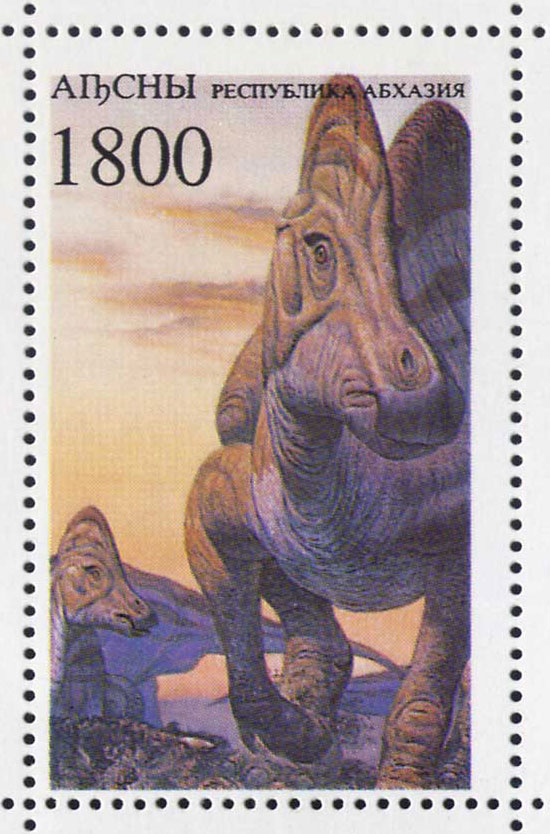 |
| Russian Stamps |
 |
| From Jurassic Park Park Builder |
 |
| From Zazzle.com |
 |
| From Zazzle.com |
01 August 2012
Hypacrosaurus the Mysterious
Okay, not really mysterious. Actually, we know quite a bit about Hypacrosaurus. This comes from extensive study of Hypacrosaurus and its cousins Corythosaurus, Nipponosaurus, and Olorotitan, just to name a few; Corythosaurus and Olorotitan are its closest cousins. We know that the crest that I mentioned was barely even forming, let alone noticeable, in hatchlings did not possess an S-shaped curve like many other hadrosaurs. At about 30 feet (9.1 meters) long and 4 tonnes, it was a fairly large dinosaur with a high back profile, thanks to those tall neural spines. Its crest was helmet shaped, much like Coryhtosaurus, but has a bone spur facing backwards from the base, more like Lambeosaurus. This and many other findings have led some researchers to conclude that Lambeosaurus came first, then H. stebingeri appeared and was transitional between Lambeosaurus and H. altispinus.
The first Hypacrosaurus found was a postcranial skeleton of H. altispinus unearthed in 1910 by Barnum Brown. Three years of preparations and study later announced a new genus to the world, still without cranial elements. Eventually these would be found as well, 5 to 10 now exist as articulated specimens (sometimes it is hard to tell if one skull is the left to another's right depending on the fossilization of course), which range in age from juvenile to adult. The other species, H. stebingeri, is known from an indeterminate number of individuals from embryo through adult, showing, as stated before, that ever important growth and maturity cycle. Speaking of which, a study was done using growth markers in bone which showed that reproductive maturity was attained within 3 years of hatching and full adult size by the end of a decade or 12 years about. This growth and early reproduction age, H. stebingeri has been found with nearly circular eggs that hold 60cm (23.6inch) long embryos, allowed for a lot of individuals of either species to exist at the same time. This in turn, helped perpetuate the species by sheer volume as the carnivores of the spans of the two species, Daspletosaurus, Albertosaurus, Troodon, Bambiraptor, Saurornitholestes, Chirostenotes, and even egg stealing mammals must have played havoc on the herds from that vulnerable egg up to the 4 tonne adult.
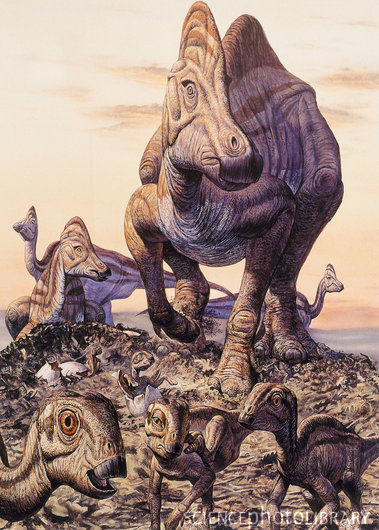 |
| ©Mark Hallett |
31 July 2012
Interesting Papers Today
Hypacrosaurus is one of those dinosaurs that is still actively studied and new findings pop up now and again that are interesting thanks to all of that study. Earlier this year, for instance, Bailleul, Hall, and Horner released a paper on PloSONE.org that announces what they contend is the first evidence of secondary cartilage ever found in a fossil dinosaur, from a Hypacrosaurus. The trio took thin histological samples from the facial areas of hatchling Hypacrosaurs to determine whether or not secondary cartilage could be found in dinosaurs and have released figures in their paper which show where they found the cartilage and how that compares to a modern bird's cartilage placement. It is a very interesting find and quite intriguing when anything, even something this small is newly discovered.
The second paper I found that is interesting is the original 1913 paper by Brown describing and naming the genus and species of Hypacrosaurus. Barnum Brown's paper about a new trachodont dinosaur is not the most exciting paper ever, but papers that name new animals are always interesting and fun to read, as fun as scientific literature can be, keep in mind. The last paper, a 2008 paper by Cooper, Lee, Taper, and Horner, is more specifically about the growth rates of predators and prey, but it does discuss the growth rates of Hypacrosaurus in its overall study of the predator prey relationship. The Royal Society website hosts the paper freely, which is a great service to amateur readers, much like PloSONE, and so if you are interested in the entire paper on growth, you can actually read it all, not like some papers we share here.
The second paper I found that is interesting is the original 1913 paper by Brown describing and naming the genus and species of Hypacrosaurus. Barnum Brown's paper about a new trachodont dinosaur is not the most exciting paper ever, but papers that name new animals are always interesting and fun to read, as fun as scientific literature can be, keep in mind. The last paper, a 2008 paper by Cooper, Lee, Taper, and Horner, is more specifically about the growth rates of predators and prey, but it does discuss the growth rates of Hypacrosaurus in its overall study of the predator prey relationship. The Royal Society website hosts the paper freely, which is a great service to amateur readers, much like PloSONE, and so if you are interested in the entire paper on growth, you can actually read it all, not like some papers we share here.
30 July 2012
Hypacrosaurus In Motion
29 July 2012
Laura and the Kids
Laura is a juvenile Hypacrosaurus. Not only Laura, but a lot, of other Hypacrosaurs are available to kids to educate them about this rather tall dinosaur. My favorite, as always, Kid's Dinos, has a page on Hypacrosaurus and I always love sharing that with the children who read this or are the children of readers. Enchanted Learning also has one today and thankfully it does not have one of its scary drawings up. Hypacrosaurus is one of those hadrosaurs found with hatchlings that immediately is shared with children by toy makers, book publishers, and other forms of media because, it seems, that babies make children more interested in purchasing things; at least that's what it seems to sound like. Regardless, I found a good coloring page also which you can find below or at this link to Education.com.


28 July 2012
Very Tall Pictures
 |
| ©Nobu Tamura |
 |
| ©Raul Martin |
 |
| ©Michiel Gilissen |
27 July 2012
An Almost Tall Enough Lizard
|
| Almost, but not quite as tall. Artist unfound so far. |
26 July 2012
Popular Roosters
 |
| They're a little hard to see from here, but a real Buitreraptor would be, since it's so small. |
25 July 2012
Weird Anatomy?
Buitreraptor is noticeably different from the Laurasian, or Northern, dromaeosaurs, as are all Southern, or Gondwanan, dromaeosaurs. That makes sense though; large birds have evolved in Australia as well as Africa but they are very different also, as one of many many living examples. Regardless, this small chicken sized dinosaur was very different from what we visualize when we think of "raptors" from North America and Asia. The differences stick out from first glance in some prominent ways, the most prominent being the shape of the body, nose to tail. Buitreraptor is shaped like other dromaeosaurs, however, it looks as though it was laid on its side and gently pressed flat compared to other robust and deep faced and barreled chested raptors like Utahraptor or Deinonychus. The skull and the torso of Buitreraptor are very thin and elongated by dromaeosaur standards. That skull also houses different teeth; grooved recurve teeth are there instead of the expected serrated and meat tearing teeth of other dromaeosaurs. Obviously there was a reason for the body to take shape in this way, but as of yet there are conjectures and theories, but no single "Aha!" idea. The fact that two of the original four found skeletons remain undescribed probably has something to do with that, though not as much as the fact that this is an extinct dinosaur; more description helps of course, but we have to remember it can only take us so far before a little educated guessing from environmental context clues and, dare I say it of scientists?, a little bit of a healthy imagination also.
As far as the feathers of Buitreraptor are concerned, so far, that is an educated guess based on other raptors. There has been no evidence unearthed thus far that points toward the inclusion of feathers on a Buitreraptor frame. It's not a bad guess though, considering the evidence found on other dromaeosaurs, but we also have to remember this was an animal that evolved in the Late Cretaceous far away from those other raptors and as such may be vastly different even where feathers are concerned. Another thing that is strange about Buitreraptor is that its toes and fingers aren't we have come to expect from dromaeosaurs either. In fact, the hands of Buitreraptor have three fingers that are almost all the same length, which is very strange for a dromaeosaur, along with the arms being shorter than its cousin's arms. That killing claw on the foot we expect to be large, curved, and thin like a knife blade was actually somewhat broad and much shorter proportionately to those of larger dromaeosaurs. All said and done the anatomy of this dinosaur was rather unique and very interesting as well as not very well understood yet.
 |
| He may be tiny, but I've been chased by a rooster, and it had fewer weapons and I was still scared like a little girl |
24 July 2012
Articles Everywhere
Since 2005 articles have popped up quite often about Buitreraptor, its diet, or the general state of dromaeosaurs in the Southern Hemisphere. At least one of them refers mainly to the area in which Buitreraptor was originally found, an area of Argentina called La Buitrera. One of the articles that deals more with the area than specifically Buitreraptor all the way through it is from earlier in 2012 and is titled Cretaceous Small Scavengers: Feeding Traces in Tetrapod Bones from Patagonia, Argentina and is coauthored by one of the men, Apesteguia, who coauthored the original 2005 paper with Makovicky which announced Buitreraptor to the world. This newer paper traces out the evidence that points to Buitreraptor, and other small dinosaurs of the area, being scavengers at least in part if not as their whole diet. The original paper, however, appeared in Nature in October 2005 and described the small Argentinian dromeaosaur for the first time. Unfortunately, only the abstract of the article is available free from Nature.
In 2009 Novas, et al., delved further into the entire southern dromaeosaur family by exploring a new dinosaur, Austroraptor cabazai, and then describing the evolution of Unenlagiinae, the group to which this new animal and Buitrreraptor belong to. One of the figures presented in the paper compares known dimensions of some of the bones of group members for comparison; very interesting information. Makovicky and Apesteguia worked on another paper together recently, in 2010, in which they went over the teeth of Buitreraptor in detail and also discussed the teeth of other Gondwanan dromaeosaurs as well. Anyone as interested in dromaeosaurs as I tend to be will find all of these articles very interesting given that they are about the newest found populations of dromaeosaurs. The southern, Gondwanan, dromaeosaurs are still relatively unknown, so the number of papers available to learn from is both fantastic and amazing, given how hard it is to find good articles on even famous dinosaurs sometimes.
23 July 2012
Movieless Mondays
Buitreraptor, like so many relatively new dinosaurs, and Southern Hemisphere dinosaurs, does not have any dedicated documentaries or passing mentions in any other documentaries. It is sad, of course, but at least Buitreraptor has some mentions in videos. One very short clip shows the entirety of the skeleton in a closeup pan over, which is great if you cannot get to a museum where a cast is mounted to look at the strange skeleton of this animal.
Additionally, there are the typical "tribute" videos even for Buitreraptor, but since it is so new and relatively unknown, there is only one of those.
This tribute is not too over the top as we have seen in the past and is not infused with "screamo" music either, instead it has rap, so if you hate rap mute that thing up and just watch the slideshow!
22 July 2012
Little For A Sunday
Buitreraptor is a small animal, and its involvement in areas of world culture which promote kids to learn about it, are equally small. There is the mounted skeleton shared on Friday in the Field Museum, and so we know that any children lucky enough to go see it can learn something about it. As far as coloring and fact files, the only place it seems we will be able to get either is from the Natural History Museum in London. Some of the images on the page could serve as improvised coloring pages, which is nice. One other good place to find the info would be in the National Geographic Dinopedia, the page for Buitreraptor is available online.
21 July 2012
Different Versions of A Diminuitive Dromaeosaur

 |
| ©Vladimir Nikolov |
 |
| ©Mike Keesey |
20 July 2012
Rooster Sized Terror in the South
First and foremost, for all of those that missed me I am back. Those of you who did not, that's okay, but I missed writing this thing every morning! I'm finally settled enough into the new place that my internet is up and running;three cheers for cheaper than ATT wifi connections! Anywho...
Once upon a time in Cretaceous Argentina there was a terror lurking in the shadows of the land, almost literally. While the large theropods and sauropods of the Southern Hemisphere flitted about there was, in their shadows, Buitreraptor. Buitreraptor gonzalezorum was discovered in 2005 and is only the size of a robust rooster. However, Buitreraptor was still a terrible predator due to the fact that, despite being one of a very few southern dromaeosaurs, it possessed large claws on both hands and feet and had a strong, but elongated muzzle filled with small grooved and recurved teeth. The size of this animal, given the relative sizes of other contemporary dinosaurs, makes him fit into the niche of lizard and mammal hunter better than any other category. Scavenging is another possibility, though not as heavily supported. Buitreraptor has many strange anatomical differences that separate it from its Northern, and even Southern, cousins. Its hands are constructed differently in terms of finger length, its "killing claw" is certainly different, and its body, snout included, was very long for how small it was. Tomorrow we will look at how all of those body parts come together to form and impressive, yet strange little dinosaur.

Once upon a time in Cretaceous Argentina there was a terror lurking in the shadows of the land, almost literally. While the large theropods and sauropods of the Southern Hemisphere flitted about there was, in their shadows, Buitreraptor. Buitreraptor gonzalezorum was discovered in 2005 and is only the size of a robust rooster. However, Buitreraptor was still a terrible predator due to the fact that, despite being one of a very few southern dromaeosaurs, it possessed large claws on both hands and feet and had a strong, but elongated muzzle filled with small grooved and recurved teeth. The size of this animal, given the relative sizes of other contemporary dinosaurs, makes him fit into the niche of lizard and mammal hunter better than any other category. Scavenging is another possibility, though not as heavily supported. Buitreraptor has many strange anatomical differences that separate it from its Northern, and even Southern, cousins. Its hands are constructed differently in terms of finger length, its "killing claw" is certainly different, and its body, snout included, was very long for how small it was. Tomorrow we will look at how all of those body parts come together to form and impressive, yet strange little dinosaur.

12 July 2012
Famous Dinosaurs
Einiosaurus, with all of its evidence of herding behavior and ample evidence of existence that has allowed for in depth study has become somewhat famous for more than just having a strange nasal horn. It has appeared in documentaries, cartoons, and even the Dinosaur King card game. Despite the debate over the placement of Einiosaurus in the tree of life, Einiosaurus is definitely agreed into which family and clade it fits. The "fame" of this dinosaur is well documented and specimens, despite being a Montana only dinosaur living in a range of 500,000 to a million years of history, are still available to be found and unearthed which means here is always the chance of another great Einiosaurus find.
Next week we will be in the process of moving homes and so the blog my be down until next Friday. I have tried with all my ability to avoid this, but it doesn't look like I'll be able to unfortunately.
Next week we will be in the process of moving homes and so the blog my be down until next Friday. I have tried with all my ability to avoid this, but it doesn't look like I'll be able to unfortunately.
11 July 2012
The Strange Placement of Einiosaurus
Sampson's 1995 paper supports the position that Einiosaurus, Pachyrhinosaurus, and Anchelosaurus are all closely related. The other theory that has been put forward is that Einiosaurus is closely related to Styracosaurus and Centrosaurus. Part of the determining factor in each theory is the construction of the skull. All of the above animals have similar horny frills. The frill of Einiosaurus, Pachyrhinosaurus, and Anchelosaurus all have two large horns of bone that extend from the top central area of the skull frill. Styracosaurus however, has multiple horns extending from the frill and Centrosaurus possesses two small inward curving horns of bone at the top of the central area of the frill. Therefore, Einiosaurus can logically fit in either family group as an intermediate frill design between Pachrhinosaurus and Anchelosaurus and between Centrosaurus and Styracosaurus on the other side of the debate.
In terms of nasal horns, however, the debate changes a little bit. The horns of Styracosaurus then Centrosaurus, and then finally Einiosaurus, in this line of the debate, slowly began, and ultimately did, curve forward as the species evolved from one another. The horns on the other side of the debate start with Einiosaurus as the earliest species, and the nasal horns gradually were lost to a prominence like a shield boss much more than a horn covered bone. This change from horn to rough boss are endorsed by Horner's research as well as Sampson's paper. Supraorbital horns on all five mentioned dinosaurs are nominally present as either small knobs of bone or by being absent entirely from the skulls.
Given the arguments, it seems, and this is entirely my opinion, that both theories may actually be one theory. The nasal horn of Styracosaurus curves in a slightly posterior facing manner, whereas the Centrosaurus nasal horn faces somewhat forward. It makes sense, that the nasal horn of Einiosaurus curving even more forward, which must have had some special reasoning or function, could certainly come next in this line. Continued evolution could certainly then follow into the next proposed line where the nasal horns adapted into the rough bosses of the Pachyrhinosaurus and then Anchelosaurus as well. It's just a thought, but I think it is one worth looking into if no one has before, and since I have not found a paper that says it has been looked at, it certainly should be looked at.
In terms of nasal horns, however, the debate changes a little bit. The horns of Styracosaurus then Centrosaurus, and then finally Einiosaurus, in this line of the debate, slowly began, and ultimately did, curve forward as the species evolved from one another. The horns on the other side of the debate start with Einiosaurus as the earliest species, and the nasal horns gradually were lost to a prominence like a shield boss much more than a horn covered bone. This change from horn to rough boss are endorsed by Horner's research as well as Sampson's paper. Supraorbital horns on all five mentioned dinosaurs are nominally present as either small knobs of bone or by being absent entirely from the skulls.
Given the arguments, it seems, and this is entirely my opinion, that both theories may actually be one theory. The nasal horn of Styracosaurus curves in a slightly posterior facing manner, whereas the Centrosaurus nasal horn faces somewhat forward. It makes sense, that the nasal horn of Einiosaurus curving even more forward, which must have had some special reasoning or function, could certainly come next in this line. Continued evolution could certainly then follow into the next proposed line where the nasal horns adapted into the rough bosses of the Pachyrhinosaurus and then Anchelosaurus as well. It's just a thought, but I think it is one worth looking into if no one has before, and since I have not found a paper that says it has been looked at, it certainly should be looked at.
10 July 2012
Einiosaurus in Writing
In 1995, after multiple specimens, and herds actually, had been unearthed in the 1980's and after a number of years of study, Scott Sampson unleashed upon the world his description of both Einiosaurus and Anchelosaurus. The Dinosaur Society helped pay for the appearance of the scholarly paper in the Journal of Vertebrate Paleontology (Vol. 15 No. 4). The JSTOR version of the paper can be accessed through the members pages of the SVP. Additionally, there is a book on horned dinosaurs, by David West, called Triceratops and Other Horned Herbivores that does a very good job of describing the attributes and explaining the life of not only Einiosaurus but also many other horned dinosaurs in a way that a younger audience will understand. The book preview is actually fairly in depth compared to most previews one can get online, which is very nice. I especially like how the contents compare each animal to a modern white rhino.
09 July 2012
Einiosaurus in motion
08 July 2012
Einiosaurus is One Friendly Dinosaur
There are a lot of instances online for you and that child, or inner child, in your life to play games and have child related fun today. First of all, there is no Kid's Dinos page, but there is the Dinosaur Train Field Guide, which I always like as much as Kid's Dinos. There is an entry there because in an episode called "Have You Heard About the Herd?" which may look familiar if you watched the episode about Hesperornis because they're two halves of the same episode. I have to admit though, I am far more excited today about the Einiosaurus puzzle I found online, the illustration used is by Walter Myers, and the coloring pictures below, even if they aren't necessarily coloring pages. Enjoy having family fun today!
The second image I am waiting on the permission of the artist, but I'll get it up here as soon as possible! You can find it here though.
Update:
I got permission finally, so feel free to use this one as well!

 |
| Larger version not available right now, but I'm going to check back |
Update:
I got permission finally, so feel free to use this one as well!

07 July 2012
Herded Animal Images
 |
| Courtesy Natural History Museum London, copyright holder not found |
 |
| Skeletons for auction in 2009 of Einiosaurus |
06 July 2012
Eini Minie Moe
 |
| ©James Gurney and courtesy of USPS |
05 July 2012
Nothing Famous About Presbyornis
Truly, the title says it all. I still have no unearthed any toys, dedicated books, sections of books, videos, songs, or anything else which would create awareness of Presbyornis in the general public. In its own way that is pretty funny and amazing at the same time. This is an ancestor of the living inhabitants of the order anseriformes who make going to the park with a loaf of stale bread oh so much fun, but it shares almost none of the fame and love that its descendants get. A three foot tall duck would probably be a frightening park pond inhabitant anyhow, but I bet it would still love stale bread. I declare that today should be a day for everyone to go to their local pond or park where ducks, and geese, live and throw them some stale bread, cereal, and crackers in memory of Presbyornis!
04 July 2012
Some Notes on Presbyornis' Anatomy
I think I have touched on most everything in terms of the anatomy here and there for Presbyornis at one point or another this week. However, there are always some glossed over pieces of information which are worthy of looking back over and since we have discussed the majority of the anatomy, in short spaces here, you know there is more to say. The first thing we should cover though is not so much about the bird as it is a man named Alexander Wetmore. Typically in the early 20th century and late 19th century we know all the names of all the paleontologists who made discoveries, but, to this point in the blog, this is the first contribution to the field by Alexander Wetmore. What's more, Wetmore was not some here then gone scientist but a prominent old man, he lived to be 92 and died in 1978, who was the sixth secretary of the Smithsonian, worked with the Department of Agriculture, and has had quite a few birds named after him; which he deserves given his lifetime of avian research.
 One thing I did not discuss in too great a detail was the skull of Presbyornis. Sure it was made for dabbling, like its modern duck cousins, but it was also extremely duck-like for such an ancient and basic duck ancestor. However, if it is not broken do not fix it applies in situations like this very well. The shape of the bill was, and is still in geese and ducks, perfect for scooping up items out of the water and nipping vegetation, though it has obviously seen adaptations and repurposing depending on individual species' needs over the millenia since this animal strutted about. The skull is visibly lightweight, even my amateur self can tell looking at it that it would not be a heavy skull, and I am sure in this animal it would have had adapted blood vessels and nerves in it to counter the height from which it would be bending to dabble about in the vegetation and shallow waters.
The legs of Presbyornis, remember, were not typically of duck and goose length, but more like their cousins the cranes and herons. This led to that height change and a need for blood flow regulation; think about when you bend over for a long time and then stand back up straight. Imagine a very tall duck with a head rush from bending over on its stilt like legs. It would probably be pretty funny actually. Now if we only had the soft tissue to study the mechanics of how it would work to not get dizzy and fall over. I personally do not know the best modern analog to this, however, I bet a giraffe's ability to bend over and drink and a flamingo's ability to feed by bending over are fairly good modern examples of the types of mechanics we would expect to see in this animal. Conversely, maybe it didn't need to feed with its head below its belt at all. Perhaps it used those long legs, rather unlike a crane, to wade into belly deep water (negating the space and milliseconds of advantage in distancing below surface predators speculated on earlier) and fed at a much more comfortable angle. All of this is speculation however as I have not read or found anywhere solid proof positive feeding habits of Presbyornis and have come to what are basically, my own conclusions and conjectures.

The legs of Presbyornis, remember, were not typically of duck and goose length, but more like their cousins the cranes and herons. This led to that height change and a need for blood flow regulation; think about when you bend over for a long time and then stand back up straight. Imagine a very tall duck with a head rush from bending over on its stilt like legs. It would probably be pretty funny actually. Now if we only had the soft tissue to study the mechanics of how it would work to not get dizzy and fall over. I personally do not know the best modern analog to this, however, I bet a giraffe's ability to bend over and drink and a flamingo's ability to feed by bending over are fairly good modern examples of the types of mechanics we would expect to see in this animal. Conversely, maybe it didn't need to feed with its head below its belt at all. Perhaps it used those long legs, rather unlike a crane, to wade into belly deep water (negating the space and milliseconds of advantage in distancing below surface predators speculated on earlier) and fed at a much more comfortable angle. All of this is speculation however as I have not read or found anywhere solid proof positive feeding habits of Presbyornis and have come to what are basically, my own conclusions and conjectures.
03 July 2012
Prebyornis Papers Prove Problematic
The issue with finding papers today has not so much been that there are no papers that mention or discuss Presbyornis available so much as there are not very many that are specifically about Presbyornis on account, in part, due to the fact that most of the genus and species specific papers were written long before the internet and scanners were available. There are a number of papers which reference or discuss Presbyornis, such as this paper on evolutionary radiation during the Cretaceous, which give a lot of good insight into the genus and species. There have been new fossils found which are compared to Presbyornis or belong in its family and the papers on those are available. The Olson and Feduccia paper of 1980 is a paper I wish I could find to share on here, instead, all I have is an image from the paper:
02 July 2012
Special Evening Update
My wife created this design for my car slowly over the past four months. I rarely do evening updates, but I thought that the finishing of the design was well worth the post. It started out that she had wanted to put my name on the car, a very big Southern tradition it would seem, and I was pretty firmly against it. When she got the ability to cut out dinosaurs in vinyl I softened a great deal to decorating my car, because I'm a nerd. I figured that she would want to represent herself, so we sat down and decided how we would make a boy and girl dinosaur out of the two she could cut with her machine, she takes orders for custom vinyl cut outs, by the way, and we then got them onto the car.
 A little later on she got a program to cut out a volcano, and every dinosaur needs a volcano.
 And then lately, because I have seen a lot of cars that have memorials to loved ones plastered all over them, I asked "Can't we make a memorial to dinosaurs?" Everyone should remember dinosaurs, they were a pretty big deal for a long time after all. Anyhow, the design is now done and I thought everyone should share in my happiness at the finishing of the entire piece.


Short Entry Monday
There is not much in the way of videos for Presbyornis, but there is an interesting image from Witmer's lab at Ohio University which compares the olfactory sections of some brains, one being Presbyornis which is pretty interesting and so, without much in the movie category today, I will certainly share that one around.
As you can see in the clip the olfactory senses of Presbyornis actually have a fairly spacious are of the brain available to them, which most of us probably would not associate with ducks, however, if they did not have an area as small as a pigeon's they certainly must have still been using it and needed it.
01 July 2012
Ancient Ducks For Modern Children
I have a good resource for us today that I found over a month ago and got permission for and everything. This is the kind of thing I love to share that will allow the children to use their imaginations, and the adults too, and have some fun coloring and sharing family time. What we have is a make your own Presbyornis activity:
In the case of Presbyornis there is no children related page, toys, or children's books, unless you count Currie and Sovak's book mentioned yesterday. So instead of worrying about a lot of facts today with the children in your life, just have fun imagining and creating stories. We do a lot of reading, watching clips, and artistic things on the "family days" around here, so why not change a little and make this a day you can create a story together, right a little, perhaps even create your own story book!
 |
| ©http://archaephoenix.deviantart.com/ |
Subscribe to:
Posts (Atom)