STL Science Center

STL Science Center

20 May 2013

Almost A Repeat

Last week there was an Australovenator puppet and informational videos. This week is much the same with one major exception; the puppet video is from the Natural History Museum of Los Angeles and not Australia. The informational video is from Latrobe University once again. Enjoy both videos.


19 May 2013

Kids Know Minmi

In Australia there seems to have, at least recently, been a big push for knowing all of the animals around the continent on which you live. Steve Irwin and a lot of other things come to mind that targeted children specifically in terms of education about  Australian wildlife. That is not a bad thing at all and it seems as though the push to know your wildlife has extended to dinosaurs as well (remember the many child-oriented Australovenator presentations we saw). Many sites that we frequent have good Minmi information that is kid friendly, but there are even more that are based specifically in Australia as well. Kids Dinos, Science Kids, and Enchanted Learning all have pages dedicated completely to Minmi. The National Dinosaur Museum of Australia also has a page dedicated to Minmi and clearly has one on display as well. There are not any dedicated coloring pages, but this image would serve if anyone just had to color today:


18 May 2013

Minmi the Turtle?

Photo by Matt Martyniuk
Minmi was a small ankylosaur. As a basal member of the family it was not diagnostic in appearance when compared to Ankylosaurus or other members of other families (such as Stegosaurus or Tyrannosaurus). The turtle-like beak of Minmi was actually less acuminate than the beaks of later members of its family; that made the beak more tortoise-like in appearance than snapping turtle-like. The eyes, like other ankylosaurs, were rather small meaning that there are two behavioral situations that are more plausible as living scenarios: 1) Minmi may have been an extraspecies member of other herds (such as hadrosaur herds) to survive or 2) Minmi may have been a loner (like other ankylosaurs) that used a heightened sense of smell to overcome poor eyesight.

©Oyvind M. Padron
Ossified scutes and an array of spikes were preserved with the two nearly complete specimens as well as in the varied remains that have been discovered as bits and pieces. Regardless, the evidence for the placement of the ossified scutes exists and the assembly of the completed skeleton can be created with a fairly good amount of accuracy. As with other ankylosaurs the rib cage and gastralia are compressed into a small anteriorly placed thoracic basket. The belly of the beast, so to speak, was not as small as the skeletal drawing implies; the belly most likely ballooned out laterally like a modern interpretation of Ankylosaurus (check out episode 6 of Walking with Dinosaurs).

17 May 2013

Former Champion

©Mariana Ruiz
Once the shortest name in the business, Minmi paravertebra, has been replaced by dinosaurs with three letter names. Still, the short name is fairly unique. As is often the case with fossil animals, Minmi was named after the location from which it was taken; Minmi Crossing in Australia. Minmi was a somewhat small Ankylosaur, reaching about 9.8ft (3m) in length. It is also one of the more well known Australian dinosaurs. An initial nearly complete find in 1964 and a number of subsequent discoveries, including a second nearly complete skeleton, make the available material for study of Minmi some of the best in the world for any dinosaur. Minmi is a case in which quality certainly has won out over the quantity of some other finds, but an herbivore of this size, even if a loner and not a herder, probably has left other individuals fossilized in the Australian soil; it is just a matter of finding them.

When conducting your own searches for Minmi be sure to add the term "dinosaur" to your search or you may end up listening to Japanese pop music.

16 May 2013

Already Thursday

I feel as though Australovenator had a short week. In part that is due to it being finals week I have no doubt. It also has to do with the fact that I have just been busy in general, finals or no finals, and that makes for a short week. Regardless, I saved my favorite video for last and I feel that the thumbnail prior to pressing play does enough; the other two are okay videos. This is one popular puppet though, as we can tell from the number of videos. If you were looking for more information or fun with Australovenator you should check out Dinosaurs in Australia: Mesozoic Life from the Southern Continent as well as your toy shelves (or ebay).


Scenes of terror as carnivorous dinosaur puppet, Australovenator goes wild at Cringleford Primary School, Norfolk from Norwich Puppet Theatre on Vimeo.

15 May 2013

Behavior From Nothing
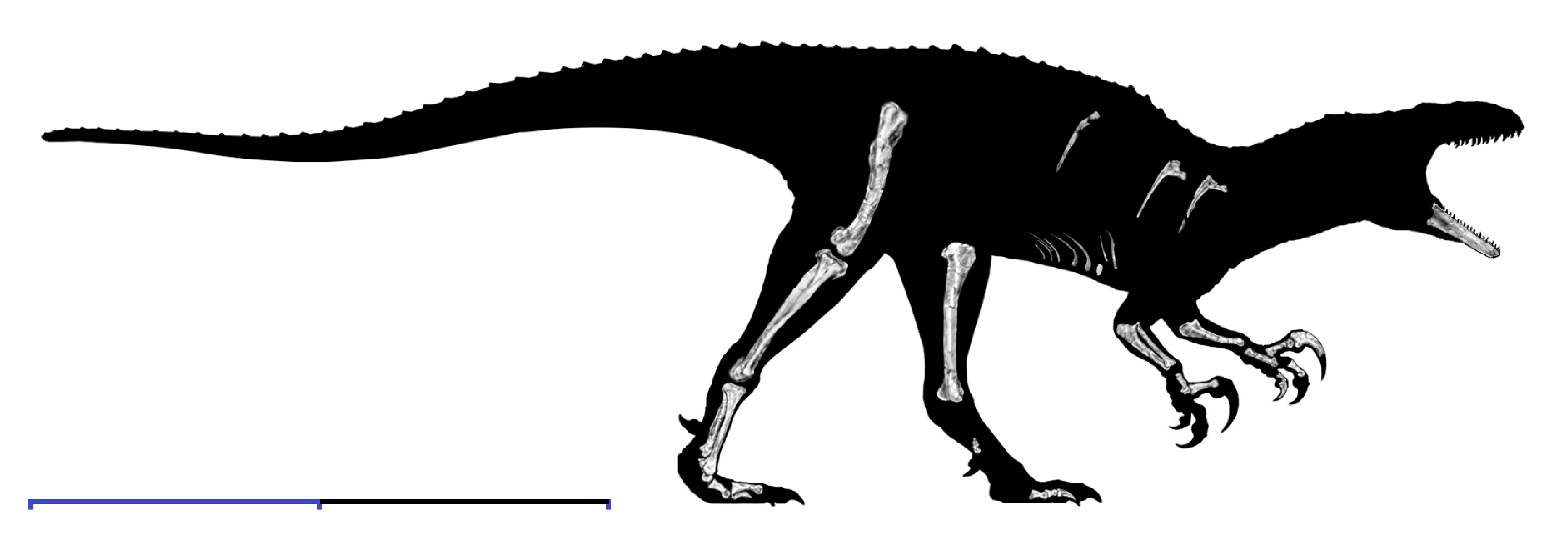
I have already posted this once this week, but it is always nice to look at the skeletal remains of our dinosaur for the week more than once. As we have seen Australovenator is a dinosaur of very fragmentary evidence. The lack of pelvis and shoulder girdles as well as the majority of the skull are missing and, of course, that means an enormous amount of detail and information are missing. The skull alone would be a wealth of information that we are missing out on. The illustrations and general idea of the skull appear to favor a rather slender skull that looks average in its musculature. This interpretation is built off of the design of the legs and hands that we have evidence for. The Allosaurid appearance of the skeleton accounts for this interpretation of the overall build of the dinosaur as well. Assuming that the hand claws were not all built like the one claw we do have evidence for, the hand would have been fairly peculiar like, this was mentioned previously, that of Baryonyx. Feet, we have little to no clues about and the agility of the remainder of the body is also a bit of a mystery at present. I personally hope for a sleek body frame that uses a little speed along with that claw. Actually, I would not be surprised if all of the hand claws were built like the one that has been recovered. That would make for an interesting predation toolset.

14 May 2013

Paper Dinosaurs

Momentary break from studying here, bringing everyone some dino-papers to read in your free time. Australovenator, for a slightly lesser known dinosaur, is doing quite well in the "being researched" category. Multiple papers are available on a fair number of different aspects concerning Australovenator. New discoveries have been described in detail. These new discoveries are concerned with forearm material associated with the skeleton. It is always nice to have new discoveries adding to the knowledge of the animal being discussed. There are also papers that question the tracks attributed to dinosaurs in the area where the bones of Australovenator were discovered. While the tracks have been attributed to different animals than Australovenator, they help to describe the world in which Australovenator was living. That is important in understanding the lives of the animals we discuss here.

The clade is also written about as a larger group. The reassignment of the group did not actually occur that long ago, relatively speaking. There are some interesting characters authoring that paper also; Benson is a name I find in a lot of my plesiosaur research, for example. The majority of these papers look at large scale relationships and sets of remains. The last paper compares metacarpal I of Australovenator and another dinosaur and discusses their taxonomic relationship. The fact that a single small bone is the topic of a paper, given that there are other bones available, is fairly interesting and unique. Enjoy the papers, I have to go back to studying now.

13 May 2013

A Dinosaur To Discuss

There are two videos I would like to highlight today (with a third video to be shared on Thursday). I like both videos, but I am not going to say a lot about them because I honestly need to study and I do not want to take a lot of time away from that this week. Tomorrow I will still take some time out of my day to read papers and pass them along, but for today enjoy this test animation and then a short video with a bit of introduction to Australovenator.


12 May 2013

Kept Very Short to Help You Enjoy Your Day

As I sometimes do on holidays, here is a small contribution to the blog so you can get out and enjoy your Mother's Day (after you have read these to your mom of course!). Something to color with mom:
Picture Credit: Everything Dinosaur
Something to read to mom.
Something mom would probably enjoy doing to with her kids.

11 May 2013

This is What Happens with Little Material

©T. Tischler
I am not sure who is in charge around here, but images are not uploading. I keep having to go and find the original URL's and that is obnoxious. It is also potentially dangerous on some sites because URL's can be changed to something horrendous; it has happened in the past. At any rate, we have here the material initially collected and described for Australovenator. As we can see here, there was no lying about the material being of a fragmentary nature and leaving a lot of unanswered questions. However, this is a fair bit of material compared to some other named and even well known dinosaurs, so it is not that amazing that a dinosaur has been described from it. Obviously the height estimate, which was made to the hip, was based off of actual evidence and the overall body shape was determined by extrapolating existing clues into the body we see in other illustrations.

©T. Tischler
The overall composition of most illustrations of Australovenator is that of a fairly nondescript theropod dinosaur with an almost Barynoyx-like claw on the hand. Whether this claw lead to the distinguishing of the megaraptors I could not honestly say; however, it is very "raptor-like" when we compare it to the pes claws of the deinonychosauroid maniraptorans (I may have just made up a word there, excuse my invention please). Regardless, as one of the surviving diagnostic features of the animal, it is a large indicator of the presence of an Australovenator skeleton. The general thought with a claw like that on the hand would be its employment as a weapon possibly akin in use to the pes claw of the maniraptorans that possessed a slicing/grappling claw. That would make this one heck of a grappling specialist bu without solid evidence of the dental structure of the animal we cannot say for sure that grappling and biting would have been a predation strategy. Perhaps, however, grappling and wrestling prey to the ground may remain a viable strategy; we need more evidence of muscular structure for this hypothesis though.

©Sergey Krasovskiy (http://atrox1.deviantart.com/)
Anyone notice the recurring theme with the orientation of Australovenator today? It really is not that subtle, but it is there. There is more depth and muscle structuring in this Australovenator. We can really see the agility and strength of the animal coming to life here. Subtle colors and striation of pigments along the back, for camouflage or species markings, and a nice overall look of strength seem to exude from this interpretation of the animal. Just look at the wonderfulness of it; soak it in.

10 May 2013

Southern Hunters

©Smokybjb (Anyone that finds a real name for me gets a free smiley)
Things (animals, plants, and the environment) have been trying to kill one another in Australia since time began. This week's dinosaurs are proof of that. Hunting the southern continent, Early Cretaceous dinosaurs like Australovenator wintonensis is considered a megaraptor. Megaraptors are a clade of the Neovenator family that we are only recently starting to fully understand. Australovenator, for example, was initially named in 2009 and has had subsequent studies performed on its forelimbs and reported on in 2012. The remains of Australovenator are minimal when compared to some of its other family members; however, a lot of assumption have been put forth based on those remains. At an estimated 6.6ft (2m) at the hip this was a medium sized carnivore for its time and its large hands indicate an animal that was more adept at slashing its victims than most other contemporaries. Almost nothing can be said about the other methods of killing prey, teeth or with pes claws, because the skull and the hindlimbs of Australovenator are not well known at this time; a mandible without teeth and a foot that ends in tarsals with one pes claw are a part of the remains that have been recovered.

09 May 2013

More Popularity Please

I think we need more popularity amongst dinosaurs. Albertaceratops has a very small amount of popular cultural references. Dinosaur King, which hits many different dinosaurs and makes them more known amongst the viewers/players of the game, has a couple of cards devoted to Albertaceratops. I would love to say that the cartoon featured an Albertaceratops heavily, but I cannot say such a thing. Dinosaur Train has no references that I have found as yet either. Albert the Albertaceratops would be a wonderful character too. They are just simply missing out on things. There are also no toys to speak of; we all know toys are good at spreading popular references of dinosaurs. There are not many mentions in books either. Sadly, this is another dinosaur that has a rather shallow entry on the popularity day. Poor Albertaceratops.

08 May 2013

Skulls As Shown
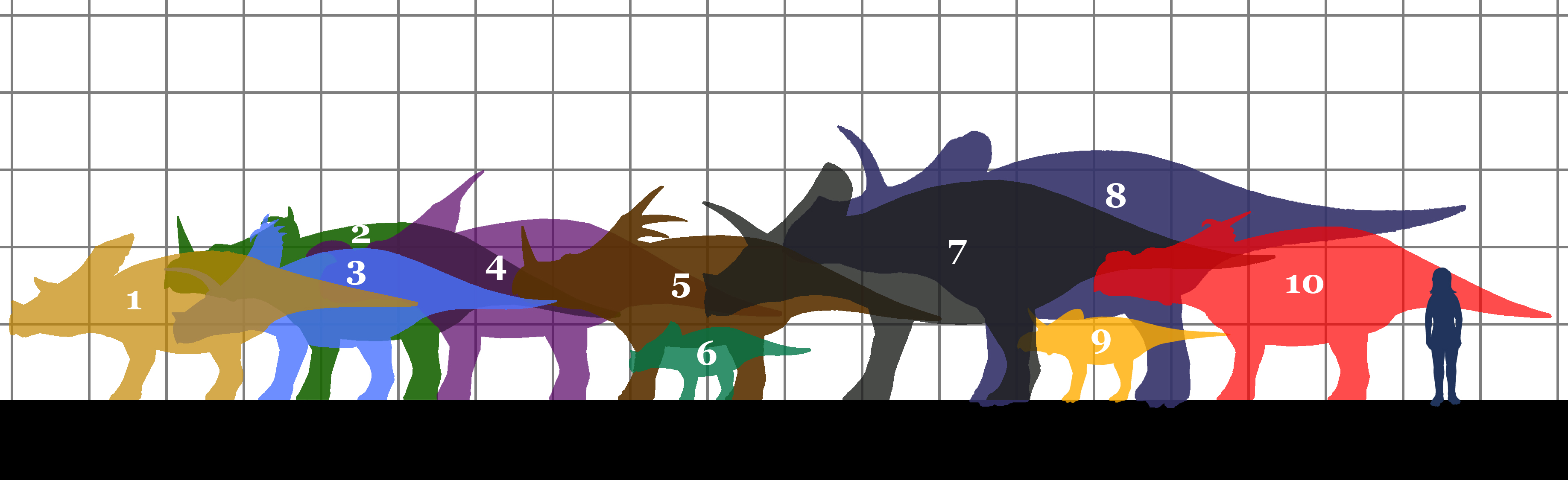
©Conty; Size comparison between different ceratopsoid dinosaurs and a human. 1. Chasmosaurus, 2. Centrosaurus, 3. Pentaceratops, 4. Einiosaurus, 5. Styracosaurus, 6. ?Avaceratops, 7. Triceratops, 8. Eotriceratops, 9. Zuniceratops, 10. Pachyrhinosaurus.
Yesterday I posted an image of the skull of Albertaceratops that looked fairly puny, considering it was being held by human hands (belonging to Michael J. Ryan) and not a forklift; perspective is everything remember. That, in conjunction with images from the other day of a size relationship with a human being, seemed to bring into question the validity of the size relationship of Albertaceratops to things that we can picture, such as ourselves. That sort of size relationship, ceratopsids being rather larger than human beings, is actually fairly typical within the overall clade. Albertaceratops is not in the image above, but they would have been somewhere in the mix with Pentaceratops and the other four up front. Overall, that is a fairly large animal; they cannot all be as cow-sized as Zuniceratops after all. Centrosaurs are on the smaller end of the clade though, so skepticism of its size makes sense. Being a basal centrosaur, closer on the family tree to Zuniceratops than Pachyrhinosaurus, also makes a skeptical view make sense. However, all said and done Albertaceratops is considered to be a fairly "average" sized centrosaur meaning that it would about the height of a tall horse, maybe a little taller, at the shoulder (Friesian horses measured at the whithers, between the shoulders, are on average 63 in.). I think the posture of the size comparison in question may have been a little weird and/or may have use a slightly smaller human figure that it should have been, in retrospect.

07 May 2013

All the News

In terms of the normal papers I find to present, descriptions and short communications about some basic aspect of life as, for example, a Velociraptor, I am going to present very little this week. However, there is a great deal on Albertaceratops in the book New Perspectives on Horned Dinosaurs, a book I have referred to before. There is a nice paper on cranial ornamentation evolution that I would suggest is worth reading. It mentions nearly every horned dinosaur, including Albertaceratops of course, and makes it a little less species specific than normal, but it is of high quality. The paper also names a new dinosaur, which we will not worry about right this second and may visit again some day in the future.

06 May 2013

Albertaceratops in Motion?

Sometimes even the most popular groups of dinosaurs run low on material now and again. At some times it could be because there is no information out there and some times it is simply because no one has thought to create something for that dinosaur. In this instance, the only videos online appear to be put up by companies making models of dinosaurs and are, therefore, not free to share. That alone is kind of a letdown, but companies have to make money somehow, right? The thing that is the saddest, I think, is that this means no one has found an animatronic version of Albertaceratops; it is pretty much an unwritten rule of the internet that animatronics are filmed and posted on YouTube. There is a German "wikivideo" for Albertaceratops. I am not sure exactly how many people reading this speak German though, so it may or may not be helpful. Sadly that is not too good for a day that should be brimming with videos.

05 May 2013

More Well Known Ceratopsians

Albertaceratops, as with many others of its ilk, have well established roots that allow for many different types of outlets for information about them. As the number of outlets increases and the information is written in many different ways, the more child friendly information sources we have the ability to find. Albertaceratops has information that is easy for children to read hosted at the Natural History Museum of London, Prehistoric Wildlife, and About, to name a few. There really is not much in the way of devoted coloring pages or anything else of that nature, but there is plenty to read and, if you really want to color today, you can always draw your own!

04 May 2013

To Elephant Feet Or Not

©Nobu Tamura
"Elephant feet" is a common complaint of the scientific community. That my be why this illustration has slowly been phased out and replaced by Nobu Tamura's other image of Albertaceratops. Elephant feet aside, Albertaceratops was a fairly typical ceratopsian. The post cranial elements that have been unearthed, and thankfully some have, attest to the "vanilla" body plan of ceratopsians. Business, intimidation, and strange beauty in the front; cow/rhino/elephant body in the back. Albertaceratops, though, has a very interesting position still as a fairly basal centrosaur; not as basal as the initial interpretation given that other skulls and studies on the family have been done since it was first described. The skull really does point at those basal characters while retaining the centrosaur chracters as well.

© Andrey Atuchin
Sometimes the characters that stand out, such as the supraorbital horns, stick out like crazy, however. Really, with this illustration it is just the angle at which the skull is aligned, but this angle gives a very nice look at the curvature of those horns and just how big they really are compared to the overall size of the skull. This is something that is difficult to see in some other head on and even lateral views of the animal, so it is very nice to have that new angle from which to view the dinosaur. I think one of the best aspects of this illustration is that the eyes have all but disappeared in the shadow of the horns, which appears to accent the truly "eyebrow" nature of their position on the skull.

03 May 2013

The Great White North

©Nobu Tamura
It seems that we spend a lot of time in Canada. Not as much recently, even though we have discussed two animals from Canada in the past three weeks if you count this upcoming week. Conveniently, since I may potentially discuss them this evening, we are talking about Albertaceratops. Albertaceratops nesmoi was named after Alberta and the rancher that helped get the skull and skeleton of Albertaceratops out of the ground (a guy named Cecil Nesmo). When it was discovered, in 2001, and originally described it was considered the most basal centrosaur that had been found to date. It possessed a highly centrosaurine aspect to the actual skull but retained rather large supraorbital (or eyebrow) horns. The problem this posed is that it was rather peculiar; other centrosaurs lack these supraorbital horns, replacing them with small nodules or bony plates, entirely while maintaining ornamented frills and small nasal horns or bony plates. A centrosaur skull had never been found with impressive horns like these above the eyes; we have discussed one later discovered centrosaur that did have this type of horns though. The approximate weight and size have not, to my knowledge, been estimated but the age of the fossils places these animals as having lived approximately 77.5 million years ago. As basal centrosaurs, and with a good handful of species following, that means that the centrosaurs were a fairly short lived line in terms of dinosaur clades.

02 May 2013

Game Popularity

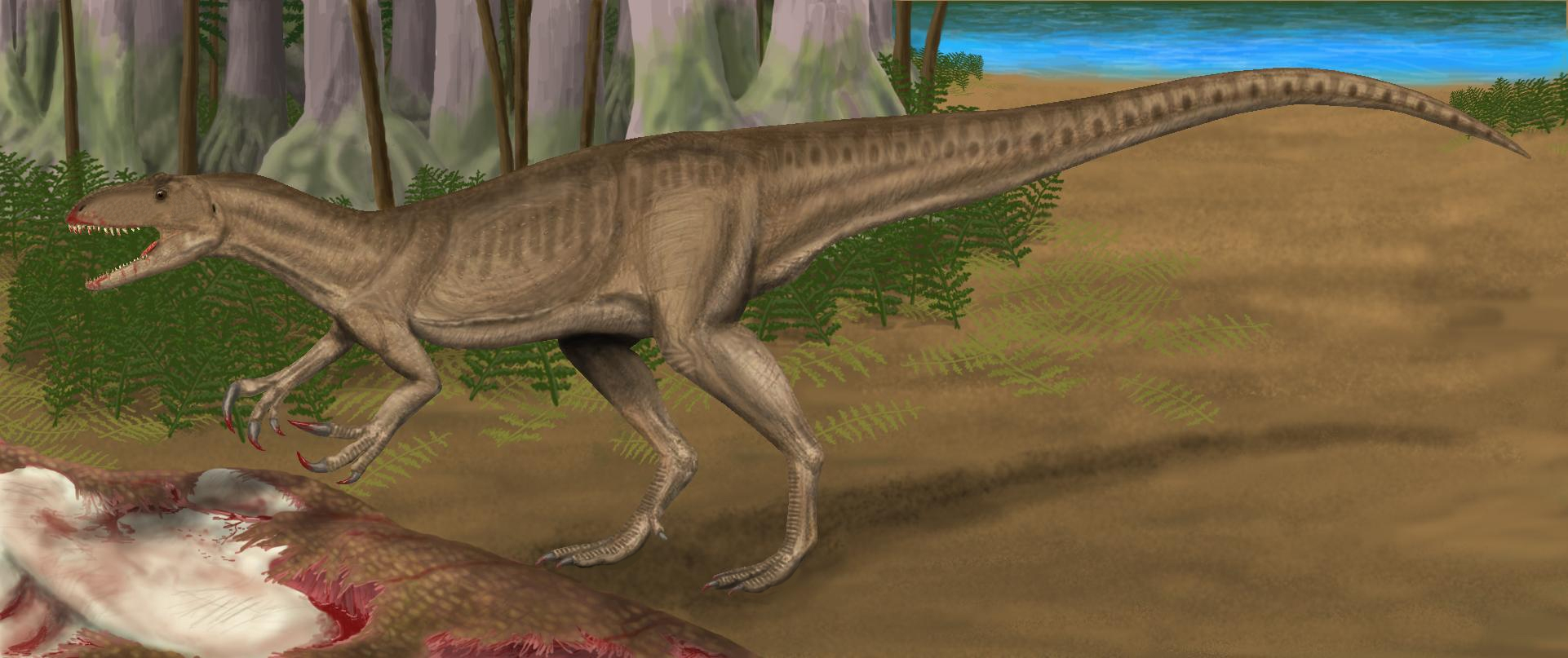
Surprisingly, or perhaps not, Staurikosaurus has appeared in a few video games. Granted those in Spore videos are made by the people that put them into the game, it still counts. The enterprising video that I have included here even gave Staurikosaurus some offspring and, presumably, the parental care genes that keep this individual from eating its offspring. That is a pretty powerful assumption to make for pretty much any animal (any animal without the human ethical code at least anyhow; take that Swift). All kidding aside, this Spore creation deserves some pretty high praise given its accuracy for the remains we have and the fact that the person that created this had the imagination, or maybe knowledge, to create offspring that are fairly believable as well as the parenting instinct to not eat the little creatures. I am pretty sure creatures "eat" each other all the time in the Spore universe, so that is a pretty tall order in and of itself.

Additionally, Staurikosaurus shows up in other video games such as this Dinosaur Safari clip. Strangely enough, I have to say, the Zoo Tycoon people at Microsoft have always gone with Herrerasaurus rather than Staurikosaurus, which is okay, but somewhat sad based on the fact that people that play it, like me, love variety in our dinosaurs. Apparently, and I did not find this Monday for movie day, Staurikosaurus has also made an appearance in a documentary I have not heard of called Animal Armageddon. Considering the fact that I watch everything that ever comes out about dinosaurs no matter the accuracy, it is pretty rare that I have not heard of a dinosaur documentary. I should put out a caveat to myself though; I have not had cable/satellite television since 2006 in my home, so sometimes I learn about things a ways after they are out on television. Regardless, the episode in which Staurikosaurus appears is on YouTube. There are no toys to speak of and, very sadly, no plush or crochet toys (like last week). Staurikosaurus is clearly fairly popular though, and that is a start.

01 May 2013

The Tidbits on Hand

A great deal of paleontology is often done, and we have seen this many times over, with fragmentary evidence. Sometimes, as we have seen, little more than a few phalanges are discovered in any one dig and, sometimes, these very few bones are used to identify an entire animal. That is by no means impossible, but some remains' identifications seem quite improbable. Luckily for Staurikosaurus its initial skeletal remains were enough to justify a new species even though they were still fragmentary enough to still have detractors. Both sides of the arguments would make sense if we step back and look at the evidence from each viewpoint. On the one hand we have a fairly clearly early theropod dinosaur that has very few derived characters but enough to justify its classification as a primitive dinosaur rather than just another archosaur. The opposite view, while not popular or even represented to my knowledge at present, would hold that Staurikosaurus is simply an archosaur that lived alongside dinosaurs or just prior to the earliest dinosaurs. The defining line between archosaur and dinosaur sometimes gets fuzzy (depending on the source of the definition), so any confusion of the placement of Staurikosaurus is probably due to this grey area. Just for our purposes, we can treat archosauria as a crown group that contains only extant animals such as crocodiles and birds. Thus Staurikosaurus being considered a dinosaur means that it is not a bird or a crocodile, in the simplest of terms; one can see where the confusion occurs. Regardless, Staurikosaurus possesses some very nice basal dinosaur traits such as its minimal sacral vertebrae (only 2 exist) and elongated cervical vertebrae. Despite being as basal as Staurikosaurus is, it is thought to have evolved in the theropod line after sauropods had already begun to evolve differently in the saurischian branch. Staurikosaurus and its sister taxa (Herrerasaurus chiefly) certainly warrant more investigation than I have given here this week. Hopefully very soon even more material will be discovered (in Argentina or Brazil) and more studies can be conducted. Not really my cup of tea as far as an academic project is concerned though, so it probably will not be my thesis work!