 |
| Paraceratherium herd: Elizabeth Rungius Fulda 1923 |
STL Science Center

19 November 2014
What About That Head?
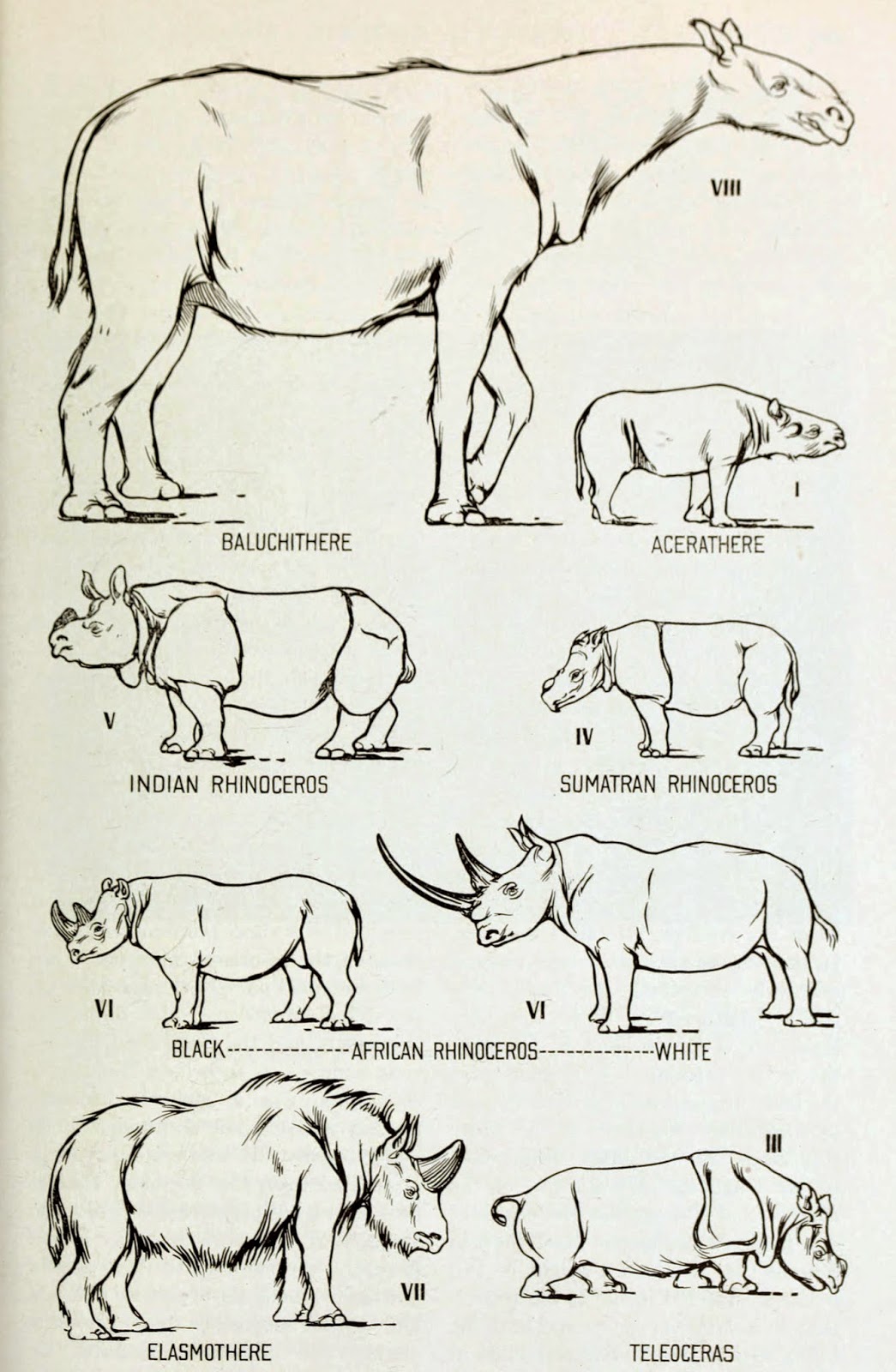
The head of Paraceratherium on the cover of that book yesterday got me thinking. What does the head of a giant rhinoceros ancestor look like exactly? Is it fantastical to have elephantine ears? The simple answer is that we will never really know and artistic license can do whatever it wants to the head. The fact that the illustrator of that book cover went with the head design he did, maybe at the behest of Donald Prothero, only backs up that point. To be fully honest though, that idea is much more innovative than the rhino-on-a-giraffe-neck design that is typically depicted. There is nothing wrong with the usual interpretation because it is usually aligned to the paleontological interpretation of the skull, but with the ears not being preserved on any specimens, to my knowledge, and they could have looked like anything. The open mouth and down-turned lip is sort of mandatory, because of the skull, so the interpretation of that does not often change. Regardless of whether you liked it or not, the new and old interpretations both have merits and you have to admit the idea of a rhinoceros head on a giraffe sized neck is interesting. Seriously though, look at that rhino head on a giraffe neck!


18 November 2014
A Tome of Knowledge
I love original descriptions. That has probably been said many times over. I hate when they are not available for free to anyone and everyone (because it is hard to get articles for some of our younger readers). Despite that happening, there is an absolute mountain of work out there on Paraceratherium. This is due in part to the fact that there are more than a handful of junior synonyms for this animal, meaning that there are a fair number of initial description papers for these now dubious names. There are also new remains still being discovered and described under the currently accepted generic name as well. Rather than listing out hundreds of papers today though, I am encouraging the audience to instead check out, inter-library loan, or even buy a book! This is not because I love mammal paleontology or specifically the work of the author (though anyone into fossil mammals knows the name Prothero), but because anyone that is really interested in Paraceratherium and its family would enjoy and get a lot from Donald Prothero's book Rhinoceros Giants: The Paleobiology of Indricotheres. The first link to the book is a Google powered preview, but this link right here goes to the Indiana University Press. Why would I encourage anyone to buy directly from the publisher instead of shopping around (assuming that purchasing is the intent)? The answer is actually a matter of savings. The publisher is offering the book electronically for $8 less. I love the smell and feel of a new book (almost as much as an old book), but sometimes less is more. You can carry an electronic copy more easily as well. Regardless, I cannot say I have read through this entire book, but the reviews I have seen and the snippets I have previewed point to it being part historical, mostly technical, but very informative overall. As a collector of subject literature (e.g. I get books about birds and dinosaurs whenever I can to compare the information presented regardless of author) I have to say, even if you do not agree with the author, this is a comprehensive work on the animals we have been discussing all week and well worth the investigation on your part! Plus, check out the head on the Paraceratherium on the cover. Pure gold!
17 November 2014
See the Models
16 November 2014
Teach That Memo
Most of the time when a name changes it takes a few years for the internet and sometimes even technical literature to adopt, accept, and print that change. Some of the pages of facts for younger readers today never changed their information and still list animals under their junior synonyms like Indricotherium and Baluchitherium. Any way you pull them apart though, these are all the same animal, Paraceratherium. Enchanted Learning is the biggest offender in that regard, but if one were to go through all of the synonymous names and read the descriptions there would be a wealth of information at their hands. About and the BBC have their naming conventions better put together than Enchanted Learning does however, which is a bit nicer and vastly more convenient. The BBC, of course, uses stills and information from the Walking With Series while About does an even shorter version of what we take all week to do here; integrating technical science and popular sources as much as possible to make the information readable.
15 November 2014
Giants and Their Babies
 |
| ©Roman Uchytel 2010 |
14 November 2014
He Without Horn
 |
| Henry Fairfield Osborn, 1923 |
13 November 2014
A Long Horned Devil
I may not have said this this week, but Teleoceras means "Long Horned One". As one of the most common large mammal fossils of North America, Nebraska especially, Teleoceras is also one of the more popular of the "Ice Age" megafauna with the general public. As such, it does appear in a few popular cultural areas including Spore and Zoo Tycoon. The rhinoceros does not appear in many books, strangely enough, and it also does not appear in any documentaries or other video programs. Small rhinoceros toys have been altered by collectors to look like Teleoceras. Unfortunately, that is the extent of the toy presence. Most of the wonderful things about Teleoceras that we have seen this week are exactly how we have seen them; online and in the world of physical fossils only.
12 November 2014
Most Common Fossil in Nebraska?
Teleoceras is considered the most common fossil in Nebraska's Ashfall Fossil Beds. Considering that, one would imagine that the information around Teleoceras would be more plentiful. Wikipedia's page is less than a printed page. Regardless, the point today is that the fossil amount in Nebraska is copious enough that the building housing the fossils is called the "Rhino Barn". The state park is home to largely complete specimens, which is even more amazing than simply stating that there are so many remains that there is a building dedicated to housing them. The story of the Ashfall Beds is detailed very well on the park's website. The site is maintained by the University of Nebraska at Lincoln, which may explain why the site is well maintained, in part at least.
11 November 2014
Humble Opinions
 |
| Scan from the Time-Life book North America (Jay Matternes) |
10 November 2014
Motion Capture-less
Unlike last week's popular Elasmotherium that has charmed its way onto television (and then the internet), Teleoceras has somehow not managed to do so as yet. In fact, it has not managed to make it into any motive media at all. The only mention of it is in a short video of someone showing a Teleoceras molar. It probably is not worth viewing for anyone unless one is that interested in the molars of extinct rhinoceroses (I say this knowing someone that is in fact that interested in that very subject).
09 November 2014
Hippo-like for Your Enjoyment
Teleoceras, as mentioned, was an extremely short built rhinoceros. The hippo-like qualities make it much more accessible, or likeable at least, to children, I have found. Regardless, the education component of this post is taken care of in these two PDFs below (Yay for educational material when it is available!). They are actually quite short, but they give students/children something to think about in terms of Teleoceras and extant rhinoceroses rather than just having them color a picture or watch a video. It is a quality endeavor and different versions are available for up to 3rd grade and up to 6th grade. There is one other resource that I like today. The East Tennessee State University Natural History Museum has a neat little page on their site where one can look at the bones of a rhinoceros (labelled Teleoceras sp.). It gives some information about the bones that are being looked at and is generally pretty interesting and worth a few moments of time.
08 November 2014
The Weird Eyed Rhino

07 November 2014
Game of Teleoceras
06 November 2014
Chinese Unicorns
 |
| E. sibiricum ©Dmitry Bogdanov, 2006 |
 | |
| E. caucasicum ©Dmitry Bogdanov, 2009 |
 |
| First published restoration (1878) of E. sibiricum, by Rashevsky |
 |
| E. sibiricum ©Philip72, 2002 |
 |
| E. sibiricum ©Stanton F. Fink, 2011 |
05 November 2014
Rhinoceros Horns

 |
| NHM London specimen User: Ghedoghedo |
04 November 2014
Elasmotherium on Paper
A multitude of Elasmotherium studies have been conducted since the naming and describing of the initial materials. Limb bones have been described and there have been ecological studies conducted. Geographic populations have been described for areas like China and Kazakhstan. The phylogenetics of the genus have even been studied, probably multiple times to be honest. The original description of the Moscow Mandible and Fischer's inferences about the ancient rhinoceros are lost to the internet, as far as I can tell. That is, of course, rather unfortunate given how important naming and describing articles are to the history of any fossil species and the study of them. Fortunately, however, Zoya Bessudnova recently tackled the history of Fischer in 2013, describing his scientific endeavors in Russia and upholding his fame as the "Russian Cuvier", a term for Fischer I was not familiar with. The most interesting fact about that statement is that Johann (Grigory) Gotthelf Fischer Von Waldheim was German born (1771 in Saxony) and moved to Russia in 1804. Either way, his description of Elasmotherium sibiricum is not in our hands today, but many other quality papers about the animal are available for reading!
03 November 2014
Lack of Evidence
02 November 2014
Not so Much a Dinosaur
Dinosaur Jungle hosts a page describing Elasmotherium that looks fairly whimsical. However, it also looks fairly accurate, so there are not any really large complaints about this either. Even more important, Enchanted Learning has a short synopsis and a coloring sheet. It is not the best, as we typically expect from Enchanted Learning, but it is a rather nice thing to have all in one place.
01 November 2014
History in Pictures
 |
| Moscow mandible, J. Fischer |
 |
| Heinrich Harder, 1920 |
Over the decades many things changed surrounding the knowledge of Elasmotherium, including the addition of many more complete, but still fragmentary, specimens of all three species of the genus. The shape of the body and the giant horn took shape. The horn, easily explaining some forms of unicorn legends (though of course these are probably not localized to any one region or type of animal), was enormous and, despite recognizable placement on the skull, was often illustrated in a much more unicorn-like posture. Newer images, we will see during the week, have become much more reminiscent of extant rhinoceroses but older images were significantly horse-like in appearance. This could be partially because of the then emerging knowledge of the relationships between horses and rhinoceroses or it could also be because the body simply appeared that way to earlier illustrators and scientists. Either way, the first full body illustrations were rather interesting because of the horse-rhinoceros cross over of the body shape.
Fischer, J. (1809). "21. Sur L'Elasmotherium et le Trogontothérium". "Memoires de la Société Impériale des Naturalistes de Moscou". Tome II. Moscou: Imprimerie de l'Université Impériale. p. 255.
MacFadden, Bruce J. 2000. "Origin and evolution of the grazing guild in Cenozoic New World terrestrial mammals". In Sues, Hans-Dieter. Evolution of Herbivory in Terrestrial Vertebrates: Perspectives from the Fossil Record. Cambridge: Cambridge University Press. pp. 223–244
31 October 2014
The Sad Plight of Rhinos
 |
| 1878 - Rashevsky, under supervision of A.F. Brant |
The first Rhino, in no implied terms of evolutionary descent, is Elasmotherium. Three species make up the genus Elasmotherium: E. caucasicum, E. chaprovicum, E. sibiricum Fischer 1808 (type species). As mammalian charismatic megafauna of the last 3 million years (2.6 to ~50,000 years ago) a lot is known about these animals. In fact, so much is known that a simple weekly opening post could be a book unto itself. Instead, to keep this short, know that there are three species of Elasmotherium recognized and that they have enormous horns on their heads. We will look more in depth at them in some posts that will be dated for Saturday.
30 October 2014
Famous Displays in History
Epidexipteryx is well known in the public domain and in the scientific community. As such it is a taxon that we can comfortably call charismatic fauna. This sort of label is typically heard when discussing larger dinosaurs, birds, mammals, etc and is usually called megafauna, because of the size. Epidexipteryx, however, bucks the trend in terms of not being a large animal and instead became well known for a number of other reasons including its relatively new discovery, good press coverage, and use in the BBC's Planet Dinosaur program.
29 October 2014
Hu's Feather
 |
| Artist not credited, though it appears to bear a resemblance to the work of Jaime Headden |
28 October 2014
Reading About Feathers
The paper describing Epidexipteryx was published in 2008 in Nature by Zhang et al. Rather than addressing the dinosaur as a paravian theropod the authors set out to describe what they called a new "bizarre Jurassic maniraptoran". To sum it up, Nature released a short news release that is available to the public. The article is a good read, but it is more regulated in its access. Reading the press release is a good substitute, so be sure to at least check this out!
27 October 2014
26 October 2014
The Kids Displayed Feather
There is a rather goofy looking Epidexipteryx on a nicely organized fact page that is very kid friendly. The reason it appears somewhat odd looking is that the jaws of the dinosaur have been illustrated closed and with a rather enormous overbite. That page happens to be part of the Dinosaur Jungle site, which has been pretty reliable in the past for the quality of its information. The BBC, because of their use of Epidexipteryx in Planet Dinosaur, maintains a page on their site that details some information on the dinosaur and a short video as well.
25 October 2014
Jurassic Peafowl

24 October 2014
Epidexipteryx The Almost Bird
 |
| ©Nobu Tamura |
23 October 2014
Ultimate Fame
Usually when a paleontologist is immortalized in the name of some taxon it is as part of the specific epithet. Once in a while paleontologists are remembered at the generic level (e.g. Drinker, Othnielia, Bennettazhia) or animals are named after family members (e.g. Timimus, Leaellynosaura). Gasparinisaura falls into the former category, being named after Zulma Brandoni de Gasparini, one of the premier female paleontologists of South America. Does being named after the second woman to chair the Paleontological Association of Argentina make the dinosaur famous all on its own? How well known, in North America, is Zulma Brandoni de Gasparini honestly? Regardless, there is a rather tiny South American dinosaur named after her and it is famous because it is tiny, named after a famous paleontologist, was on television, and was even featured in a dinosaur "how to draw" book. It is a rather wonderful little dinosaur and well known all over. Gasparinisaura has also introduced a renowned and well rooted Argentinian paleontologist to people unfamiliar with her career.
22 October 2014
Short and Light

21 October 2014
Written Dinosaurs
 Gastroliths in dinosaurs are well known from many different genera and many different time periods. They are somewhat rare, as are all fossils, but they are most definitely well known. Gasparinisaura are one of those dinosaurs that have well documented gastroliths. In 2008 those gastroliths were discussed by Cerda. His paper describes the stones, their purpose, and the implications they provide to the diet of Gasparinisaura. The image at left is from the paper and has been released on Wikipedia. Cerda is a professional when it comes to Gasparinisaura. He also had a hand in describing the microstructure of Gasparinisaura bone in Cerda and Chinsamy (2012). The original knowledge of the dinosaur came to the general public through the work of Coria and Salgado (1996), but new material has been unearthed since that time. That new material was again described by these two scientists, but in Salgado et al. (1997). The latter two papers kind of speak for themselves and do not need to be detailed ahead of time.
20 October 2014
Under the Feet of Giants
Planet Dinosaur almost features Gasparinisaura in its 5th episode. However it does not actually feature Gasparinisaura but it does feature Argentinosaurus. Under the feet of Argentinosaurus lived small dinosaurs, quickly darting in and out under the larger dinosaur's body. Those dinosaur do appear in the show and they happen to be Gasparinisaura. So far this entire paragraph has been a very convoluted way of saying that Gasparinisaura shows up in Planet Dinosaur as a speck beneath the lumbering giant that is Argentinosaurus. We should probably just watch it scurrying around rather than talking about it.
19 October 2014
Gasparinisaura's Lonely Link
Gasparinisaura appears on the internet very sparingly. We do have three quality sites that address our three normal levels of reading ability. The Dino Directory addresses the lower level readers and supplies an illustration and size comparison. Enchanted Learning actually rests in the middle level position with more detail taxonomically and guides for pronunciation. The third level is adequately filled by the Dinosaur Wiki. That page details more about the discovery, anatomy, and properties of the dinosaur. Unfortunately, that is where our road ends in the pursuit of educational links. There are no coloring sheets or videos for today.
18 October 2014
Looking Basal
 |
| ©Nobu Tamura |
17 October 2014
Gasparini's Dinosaur

16 October 2014
First Dinosaurs
Saltopus was famous at some point but is not famous anymore, not as famous as it was before at least. The videos that we saw earlier in the week exist, as do the numerous websites we saw. There are, however, little to no remaining pieces of evidence. That has not stopped people from knowing about Saltopus. Part of the reason that it is known is that it has lived on through literature, including a small book called Saltopus and Other First Dinosaurs. This book is a pretty good introduction to Saltopus, but it does contain a somewhat unsubstantiated remark about the hunting habits of the dinosaur. However, rather than tell you what the book says, you should all check it out.
15 October 2014
Weak Bones

14 October 2014
Fees All Around
In the future it may be possible to read Cambridge Journals articles at home, without subscription or access to a library with access, but that day is not today. That is okay, despite when I complain about the cost of single articles. I do frequently wonder how many people drop $45 on single articles, but it must happen now and again considering the price remains. That being said, it is wonderful when articles are online, regardless of how old it is. The original von Huene article is available online through the Cambridge Journals site (though articles that old are typically much more widely available and disseminated online). An article 100 years after von Huene's description and naming was written by Benton and Walker which revisits and redescribes Saltopus. To make a long story short, for those that cannot read the articles from home, Benton and Walker (2010) stated that: "[Saltopus is] one of a radiation of small pre-dinosaurian bipedal archosaurs in the
Triassic found so far in North and South America and in Europe."
Benton, M. J., and Walker, A. D. 2010. Saltopus, a dinosauriform from the Upper Triassic of Scotland. Earth and Environmental Science Transactions of the Royal Society of Edinburgh, 101(3-4), 285-299.
13 October 2014
Dinosaur Days
There is a software program out there online known as Dinosaur Days that is not entirely free, but some times the videos from the site are either leaked or put on YouTube by the company that puts out the software (there is a difference). Regardless, the site is kind of partially interactive encyclopedia of dinosaur information and the videos that the writers have put together are well modeled, cartooned, and illustrated. The information in the videos is also well put together. Lacking a documentary on most dinosaurs I would highly recommend the site, if it is affordable. However, today that is not a worry as the video for Saltopus is available for viewing without a subscription:
12 October 2014
Cannons and Videos
 |
| Zander and Kevin Cannon |
11 October 2014
Typical Bodies

10 October 2014
von Huene's Lesser Known Dinosaurs

09 October 2014
The Quieter Chasmosaur
Anchiceratops is a very popular ceratopsian. It is not well known by the public though. This is a well studied dinosaur and is the subject of many books and book chapters and has appeared in at least two episodes of the popular cartoon Dinosaur King. We saw one of the episodes on Monday but there are still plenty of things we haven not seen, like the cards that have been designed for the collectible card game. There are also toys of Anchiceratops circulating in the dinosaur toy sphere. The toys are generally well representative of Anchiceratops as well. This is not always the case remember. One of the best representative toys has a good write-up on the Dinosaur Toy Blog. Personally, I am impressed that they even included the medially oriented bone knobs on the frill of the dinosaur. It is a well modeled toy that represents the animal well and gives those kids (and adults) playing with them a very accurate portrayal of the dinosaur that they are seeing. That is very important in the end. The purpose of toys is fun, of course, but it is also indirect education and modeling of prehistoric animals in general.
08 October 2014
Suppose and Assume
 |
| ©Nobu Tamura |
Taking after Paul, who made the estimates of body length and size, we can assume that the specimen he used, NMC 8547 (Canadian Museum of Nature), represents a postcranial skeleton of Anchiceratops. Assuming it does, we have a vertebral column of 74 bones. The neck is short in comparison to many other dinosaurs, but is considered long for a ceratopsian, containing 10 vertebrae. There are 13 dorsal and 12 sacral vertebrae composing the trunk and pelvis of the animal. The tail is also considered short at 39 individual elements, some of these are also found in the pelvic region though and are not dedicated tail bones. The average known chasmosaur (the family of Anchiceratops) is built different with 12 dorsal and 10 sacral forming the trunk and pelvis and up to 46 caudal vertebrae forming the end of the pelvis and tail. Ceratopsians, like many other animals, have fused vertebrae in the pelvis (known as the synsacrum) as well. It has been suggested the synsacrum of this specimen was oriented posteriorly compared to other chasmosaurs and that the trunk was not necessarily of a different length, just arranged differently. The pelvis is actually considered to be elongate also. The forelimbs are robust, another trait we consider normal for ceratopsians. It can probably assumed that the hindlimbs are also rather robust.
The frill we briefly mentioned already. The frill is covered with "epi" bones that are named for the bones from which they originate (or that they sit on, if that is more accurate) and include episquamosal, epiparietal, and epoccipital. To be completely accurate in describing them, these are osteoderms, meaning that they developed from bony deposits of the skin and not in the same manner as the squamosal, parietal, and occipital that they are all attached to. Anchiceratops also possessed bony knobs medially located on the parietosquamosal frill. These are varied in size and shape on individual animals. They are probably entirely unique to each individual rather than being an artifact of imperfect preservation.
The frill we briefly mentioned already. The frill is covered with "epi" bones that are named for the bones from which they originate (or that they sit on, if that is more accurate) and include episquamosal, epiparietal, and epoccipital. To be completely accurate in describing them, these are osteoderms, meaning that they developed from bony deposits of the skin and not in the same manner as the squamosal, parietal, and occipital that they are all attached to. Anchiceratops also possessed bony knobs medially located on the parietosquamosal frill. These are varied in size and shape on individual animals. They are probably entirely unique to each individual rather than being an artifact of imperfect preservation.
07 October 2014
History In Play
 |
| Barnum Brown |
06 October 2014
Two Timer
Apparently Anchiceratops is one of only two dinosaurs (Carcharodontosaurus being the second) to appear in the Dinosaur King cartoon twice and in the same city both times. Anchiceratops like Paris according to the Dinosaur King creators. One of the episodes is online. Enjoy watching it this evening. There are no documentaries or anything else, but a good cartoon is easy to enjoy.
05 October 2014
Slap Fight!
The links abound for Anchiceratops at different levels of reading complexity and ability. As usual when we have a lot of links we can set up a gradient of complexity in the links. These range from very simple with simple listed facts to short paragraphs. Sites like KidsDinos mixes listed facts, images, and some short reading passages. The encyclopedia at Science Kids does a good job of bridging that remaining gap between listed facts and short paragraphs. If that handful of links does not interest younger scientists into checking out Anchiceratops more, maybe this strange slap fight would be something they could get into:
04 October 2014
Many Horned Faces
The sheer number of ceratopsian skulls can be perplexing when it is noticed how few have postcranial bodies. In terms of overall fossil numbers Anchiceratops is fairly well represented and this gives a fairly good picture of what the animal looked like for illustrators to begin their interpretations with. The most interesting aspects of ceratopsian illustration, in my mind, have always been the beaks and the frills. The horns do wonderful things in some illustrations and bodies are never too far from the average ceratopsian body, just like interpreted hadrosaurs.
One of my favorite interpretations so far this week has been Craig Dylke's underwater Anchiceratops. In part this is due to the scene but also because the beak on his animals is enormous and it makes me wonder what exactly a version of this animal that fed on soft underwater grasses like a hippo or manatee would need so much keratin for. Granted the beak itself is not indicative entirely of what was eaten or how much sheering power there was on that part of the jaw, but it seems like heavy machinery in a soft food world. Either way, the idea that some ceratopsians may have been hippo-like has been courted a number of times in the history of our knowledge of them and it is always interesting to see them interpreted as such.
The tried and true interpretation of a terrestrial ceratopsian is always welcome of course. The highlights here are more on the subdued ornate frill of the skull. The triangular edges of the frill are covered in soft tissue here and, despite the angle, that tissue appears to really downplay that ornamentation. The horns are average horns for the dinosaur and the beak is a very ceratopsian beak. The illustration is not boring or just the average ceratopsian splashed with the name Anchiceratops, the dinosaur is just, potentially, that average looking. It is pretty amazing how non-fantastic dinosaurs could have been, and that is why illustrations like this that show them as "mundane" looking animals are important and pretty fantastic in their own way.
 |
| Anchiceratops of Horseshoe Canyon Cretaceous Craig Dylke 2013 under Creative Commons license 3.0 |
 |
| ©Mariana Ruiz Villarreal |
03 October 2014
Near Horned Faces
This entry is backdated to yesterday. Yesterday was a long tiring day and I wasted the evening away in a video game. Sometimes you have to turn off the brain.
There are times when I talk about similar dinosaurs that no matter how much I searched the blog I find myself amazed that I have not discussed that dinosaur before. That is the case with a healthy number of the ceratopsian dinosaurs that we discuss, and this week is no different. We will delve into the realm of a horned dinosaur known as Anchiceratops. One species is recognized (Anchiceratops ornatus Brown 1914) and a second species (Anchiceratops longirostris) was synonymized years later. This quadruped is from an earlier time period than its relative Triceratops and was a little smaller, with estimates topping out at around 16.4 feet (5 meters) long and girth estimates figuring it for a much lighter ceratopsian. An estimate of weight by Greg Paul comes in at approximately 1.2 tonnes; Triceratops is estimated between 6.1 - 12.0 tonnes. The parietalsquamosal frill was very ornately laid out, giving us the specific epithet of ornatus. Little is known about the postcranial body and most images fill this in with the idealized chasmosaur body type, making it look fairly recognizable and vaguely bovine. This dinosaur was discovered in 1912 by Barnum Brown and papers are still being written 100+ years later (the most recent was published in 2012).
 |
| Image Credit: Wikicommons user FunkMonk |
02 October 2014
Video Games, No Books
We saw Stokesosaurus in a video game earlier in the week. The dinosaur does not appear in any popular type texts though. No children's books specifically mention the small tyrannosaur. Popularized technical and almost technical literature do discuss the dinosaur, but not often. There are not even any toys of Stokesosaurus. Soon I am going to have to change the popular culture day of the week to something else! The dinosaur is illustrated often, including in this poster sized image of the tyrannosaur family by Robinson Kunz of Germany.
01 October 2014
Short Autapomorphies
 |
| Stephen L. Brusatte and Roger B.J. Benson Creative Commons Attribution 2.0 Generic |
30 September 2014
Taking Away Fossils
There was a time when Stokesosaurus had a fairly large number of fossils attributed to it. There was even a second species considered for a short number of years not too long ago. This has since, along with all other fossils, including this braincase that was added to the pile of Stokesosaurus material, been overturned and assigned elsewhere. Juratyrant, the new genus generated from the reassigned second species, was described and reassigned by Roger Benson (with Stephen Brusatte as lead author of the reassignment paper). Brusatte and Benson's 2012 paper not only reassigned the second species as Juratyrant and removed a lot of the attributed material, but also investigated tyrannosaur systematics as a whole and re-envisioned their particular family tree (it was also rebuilt by Loewen et al. 2013 which was referenced here last year). Bickering about placements and materials should really be placed into the pile for later, however, for the casual paleontologist. The first step should always be to go to the source and attempt to understand how and why someone considered a fossil, isolated bone or otherwise, to be a unique species. We can go and read about the novel character interpreted by Brusatte and Benson along iliac surface, but first Madsen's reasoning behind attributing this isolated element to new genus/species should be reviewed. Thankfully, that paper is available online through JSTOR. The description is very traditional in format: introduction, systematics, measurements, images, description, discussion, and conclusion. However, the description is quite detailed and describes other material originally attributed to the animal that is no longer associated with it, allowing for a comparison of attributed materials between that and the 2012 paper.
29 September 2014
Motivated Models
Stokesosaurus and other Proceratosauidae are not well represented in the documentary sphere. However, one man, Shaun Stroud, has at least put some effort into making a model of Stokesosaurus.
His eye placement is a little off, but it looks like a fairly well designed model of the body overall. That model is a great deal closer to accurate than the model used in Zoo Tycoon. It is excellent that Stokesosaurus does appear in the game anyhow. Especially when it is painting:
28 September 2014
Stoked for Sunday
Stokesosaurus is a well-known tyrannosaur, as we all know. Once again, however, a dinosaur with some clout to its name has come up somewhat dry in the website category. There are a few places to get information, but of course the more the merrier with checking information and compiling facts. The DinoDictionary has a nice concise list of facts for Stokesosaurus. About.com has a slightly wordier version, which is good for young readers to practice reading with. Putting the information into sentences rather than as phrases or single words is great for young dinosaur enthusiasts, as we have said many times over. There are no dedicated kid's websites and no coloring sheets or anything like that, but I wish I had some to share today.
27 September 2014
Being Different
 Usually when we think of tyrannosaurs we think of Tyrannosaurus rex and Tarbosaurus bataar and other large headed theropods that used their large teeth and bulk to hunt down, overpower, and subdue their prey. The Proceratosauridae were rather different members of the tyrannosaur family. A global distribution has been identified in the family as it contains English, Chinese, Russian, and American found fossil species. The namesake of the family is Proceratosaurus, a small Jurassic, English, tyrannosaur that was most likely capable of hunting in the dense forests that its larger later cousins may not have been able to penetrate. Along with Proceratosaurus and other small members of the Proceratosauridae, Stokesosaurus was probably a small but quick tyrannosaur that used its speed and hands in attacking prey. The differences between the more basal members of this family and the more advanced and larger tyrannosaurs are centered mainly around the heads and hands. All members of the Proceratosauridae appear to have much more streamlined heads that are more gracile and less muscular. The heads of these animals still possess tyrannosaurid characteristics but are much more primitive in shape and build. The hands are also more primitive. Advanced tyrannosaurs have shortened forelimbs and reduced digits on the hand. Proceratosauridae have slightly longer forearms, respective to body size, and a greater number, though still reduced, of digits in the hand. Exceptions and preservational bias can affect these traits in the family, but overall these generalizations can be applied to the family.
26 September 2014
Stokes and Cleveland
 |
| Illustrated by Conty |
25 September 2014
Toys For All
It has been quite a few weeks since I have been able to share toys on here. We have discussed a number of dinosaurs over the past few weeks, at least, that had no toys. Toys are great for a number of reasons including putting dinosaur names into the hands, literally, of young dinosaur enthusiasts, potentially seeding the next generation with new favorite dinosaurs! The most unfortunate thing about some of those toys though is that they are only very vaguely reminiscent of the dinosaurs that they are said to portray. The group of collected prosauropods and basal sauroodomorphs below, for instance, is labeled with many names including Anchisaurus and Plateosaurus amongst a few others that may not even be recognized names now. At least the bipedal stance of these toys is mostly correct (forgive old toys for being propped up by their tails!). The hands are completely wrong of course, but there is a potential start to toy involvement with Anchisaurus.
 |
| ©Dinosaur Collector Site A |
23 September 2014
Antsy Anchisaurus
Anchisaurus is a well read dinosaur. That means that there is a lot of literature out there at varied levels that is available to everyone to read; this is a very fantastic thing I assure you all. Marsh's original descriptions appear to be slightly misplaced, but there is the Marsh work Restorations of Anchisaurus, Ceratosaurus, and Claosaurus available online. It appears that it can only be purchased. This is okay though. We have seen Marsh's restoration. It is typical of Marsh and it looks fairly nice, but it is not anything too fantastic. Also out there, published in Wiley's Palaeontology, is an Adam Yates written revision of Anchisaurus. It is one of those articles that is certainly worth your time if you are willing to root around the internet, pay, or find a copy at a library and are interested in Anchisaurus. Additionally, and possibly more easily read, is a short article about the Connecticut Valley dinosaurs and a portion of the book Thunder Lizards. Portions of that chapter are available online and all of the Connecticut Valley article is online (in two places actually!).
22 September 2014
Online Lies
The Smithsonian website lied to me today. I thought there was a short explanation of our dinosaur on it today and when I went to open it for everyone to preview it, it was not there nor was there any hint that it ever had been there. I was a bit perturbed. The only video I did end up finding for today is a 30-second clip that goes over very basic knowledge of Anchisaurus and abruptly ends mid-sentence. This is also annoying. Unfortunately this is not a dinosaur that has factored heavily into any documentaries or Dinosaur George questions or anything like that. Strangely, despite being one of those rare East Coast dinosaurs, it has not been discussed in videos anywhere on the news, through colleges, or anything local like that either. I hate having no outreach to share, but I have none today. For a similar dinosaur model in motion, you may wish to consider looking at an animal like Plateosaurus as featured in the first Walking with Dinosaurs special that ever aired. While not entirely accurate, Plateosaurus was similar in a number of ways. A point of argument may be locomotion similarities and differences however. The Walking with Dinosaurs Plateosaurus is shown as an obligate quadruped where Plateosaurus and Anchisaurus are both portrayed more often as facultative quadrupeds and even obligate bipeds. They are both considered basal sauropods and bipedality may have been characteristic of both animals.
Subscribe to:
Posts (Atom)